
Introduction
El Niño is likely to create a split in the second half of 2026 between tropical crops facing the highest upside price risk, grains cushioned by stronger inventories. The largest shock may come from export bans, fertilizer costs, and panic stockpiling rather than weather alone.
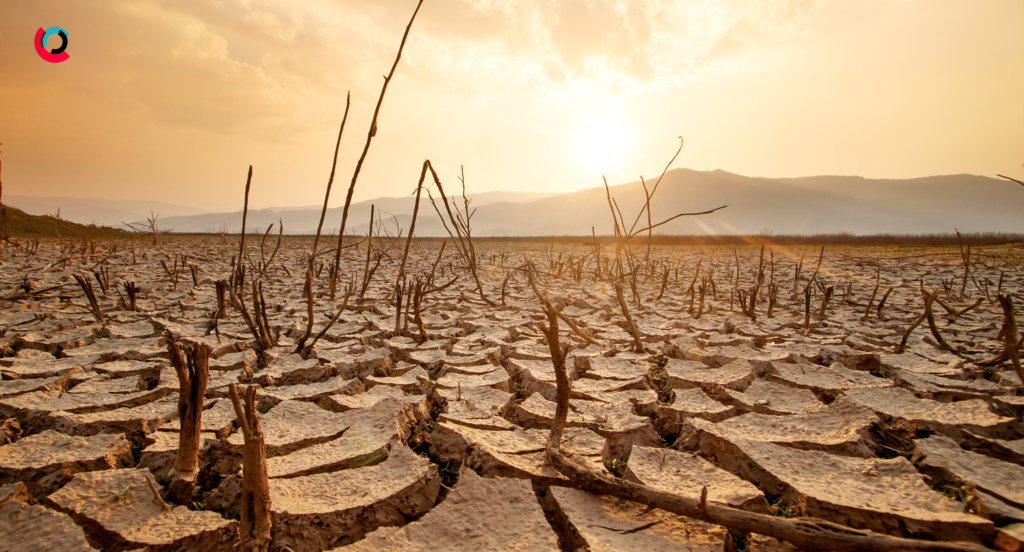
Image Source: Riskline
What is El Niño
El Niño is a natural weather pattern caused by unusually warm ocean temperatures in the equatorial Pacific. It can shift rainfall and temperature patterns around the world, creating droughts in some regions and excess rainfall in others.
The Threat
Most forecasters have confirmed El Niño conditions and some have predicted a roughly ~63-70% chance of a super El Niño. Starting in July and peaking during the winter in the northern hemisphere, the event is expected to alter global weather patterns. It raises the risk of drought in parts of Asia and Australia, heavier rainfall across parts of the Americas, and broader agricultural production disruptions. Expected to potentially continue to the 2027-2028 season, it would be the strongest El Niño event since 2015-16. Early signs have already emerged. For example, Australian farmers stopped planting wheat and canola after months of highly limited rainfall, and India is preparing to receive its first below average monsoon season in three years.
Tropical Crops Are the Most Exposed
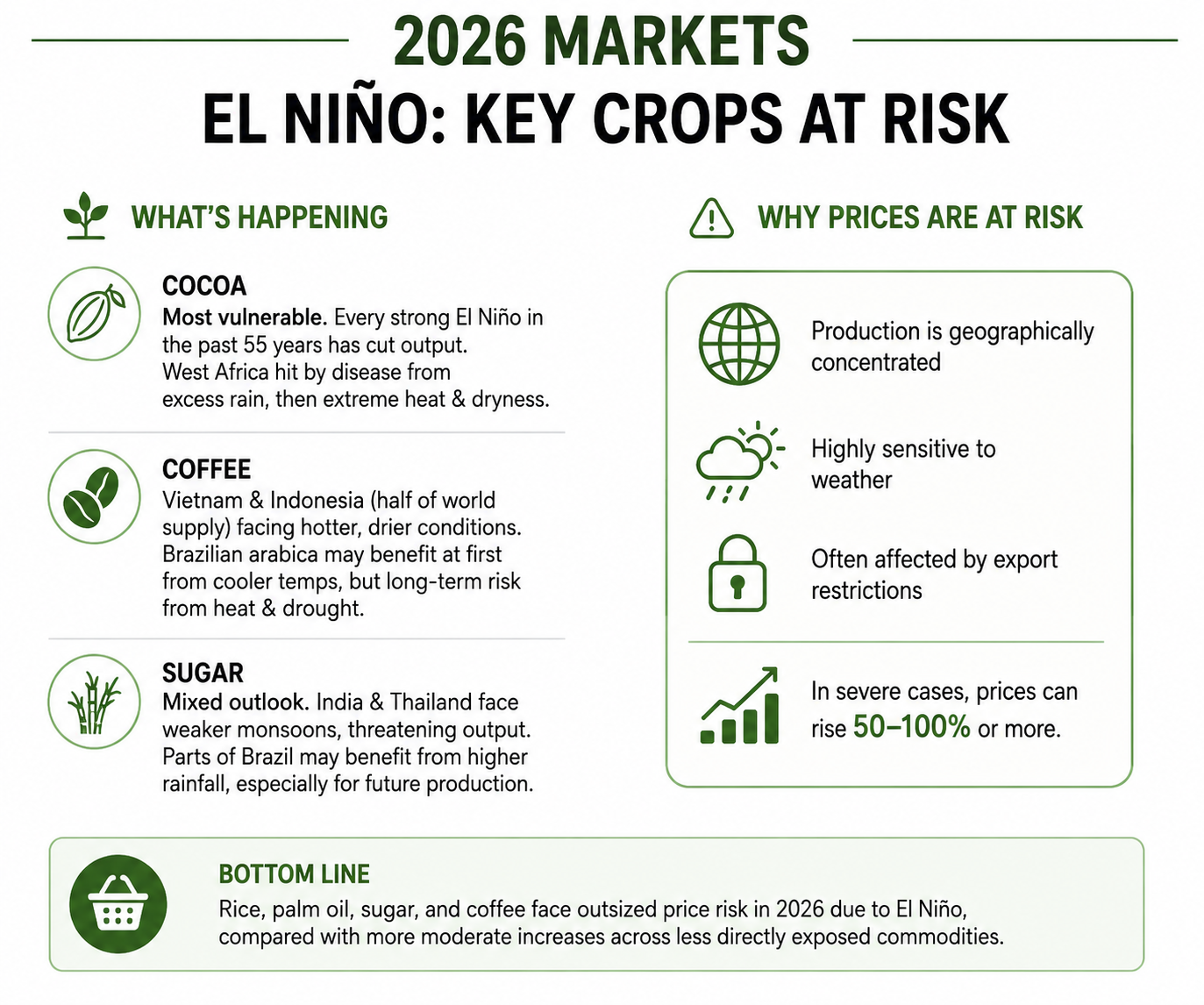
Tropical crops like cocoa appear the most vulnerable. Cocoa historically presents the worst track record. In the past 55 years, every strong El Nino has reduced Cocoa output. Currently, West African growers face disease derived from the contrast of excess rainfall followed by extreme heat and dryness.
Vietnam and Indonesia, who together supply around half of the world’s coffee, are seeing hotter and drier conditions. Despite Brazilian arabica coffee initially benefitting from lower temperatures, it will likely face long-term heat and drought.
Sugar has a more mixed picture. India and Thailand are likely to face weaker monsoon rainfall which threatens output. Therefore, parts of Brazil that benefit from higher rainfall will likely have stronger future sugar production.
The commodities most exposed to El Niño, rice, palm oil, sugar, and coffee, face outsized price risk because production is geographically concentrated, weather-sensitive, and often subject to export restrictions. In severe cases, especially when weak harvests coincide with low inventories or government export controls, prices can rise 50–100% or more, compared with more moderate increases across less directly exposed core commodities.
Grains and Oilseeds
The most pressure lies on Asian staples. Wheat prices have risen by 20% in 2026, and Southeast Asian rice prices have increased about 15% because a drought is disrupting planting. Additionally, a prolonged El Niño can cut palm oil production in Indonesia and Malaysia by 5-12%.
Unlike in 2015-2016, producers of wheat, rice, and other soft commodities have built up strong inventories, with strong reserves and better water management systems. Thus, grains are less vulnerable now than back in 2015-2016.
Argentina Set to Benefit
Argentina is a major beneficiary of El Niño’s pattern, and this is shown through the 2015-16 season. This is encouraging because the season yielded the second largest soybean production on record for Argentina (59.1 million metric tons) and yielded corn 7% above the prior decade’s average. The 2026/27 wheat crop is already being planted, with a potential harvest of 20 million tons, the third largest ever for Argentina.
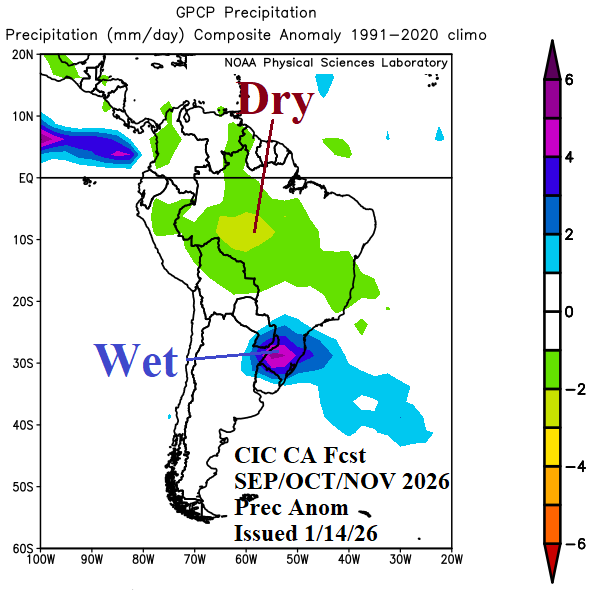
Source: Climate Impact Company
Metals and Energy, a Quick Look
El Niño’s reach extends past agriculture by a margin, and although the focus is on agriculture, El Niño will affect countless different commodities. Copper output in Chile faces a risk of flooding and landslides. At the same time, Zambian copper and China’s Yunnan Province aluminum and zinc are highly vulnerable to drought and power shortages due to dependence on hydropower. Lithium operations in South America can also see disruptions from rainfall in excess. On the other side, the weather will be hotter. This means that air conditioning demand will rise across Asia even as drought curbs hydropower. This would make even greater reliance on coal and gas and intensifying competition between Europe and Asia for Liquified Natural Gas (LNG).
The Real Risk
The view according to consensus is that these high global stockpiles should help the blow soften relative to past harmful cycles of El Niño. The price index of UN FAO rose only about 2% over the past year despite the weather concerns becoming increasingly worrying. However, analysts are consistent to flag policy responses to production shortcomings instead of those shortcomings themselves. If countries restrict exports to protect their own food supplies, or if buyers are in a rush to stock resources out of fear of shortages, prices could rise unnecessarily sharply, even if there is enough available food. These risks are compounded by the Iran conflict, which has increased costs of fertilizer and fuel because roughly 30% of the global urea fertilizer trade passes through the Strait of Hormuz.
Outlook and Conclusion
Markets should expect a split picture in terms of risk. Some commodities are much more at risk than others. Cocoa, coffee, rice, and palm oil prices are most likely to rise sharply if El Niño damages the production of these commodities. In contrast, grains such as wheat, corn, and soybeans are protected better because the global stockpiles are currently extensive. Argentina can benefit from El Niño because the extra rainfall improves crop yields in that region. Overall, a very important factor is how governments and markets react, because that could lead to even more price volatility than just El Niño itself. Marketing decisions such as export bans, and stockpiling, can determine the magnitude of the price shocks.
Sources
- Reuters — Why a Strong El Niño Leaves Tropical Commodities Acutely Exposed
- Reuters — Ample World Inventories May Soften El Niño Food Supply Shock
- Reuters — Hot Weather Hurts Asian Crops as Powerful El Niño Takes Shape
- Reuters — Forecast for Strong El Niño Fans Worries About Global Crops as Iran War Bites
- Reuters — El Niño, a Threat Elsewhere, Likely to Help Argentina’s Crops
- Reuters — Super El Niño Could Trigger a Global Food Price Shock
- FAO — El Niño Is Coming for Agriculture: Where the Risks Are Highest
- Saxo — Weather Risk Returns as El Niño Threatens Crops, Grids, and Mines
- European Commission JRC — Agricultural Production Threatened by El Niño and High Input Prices