
Introduction
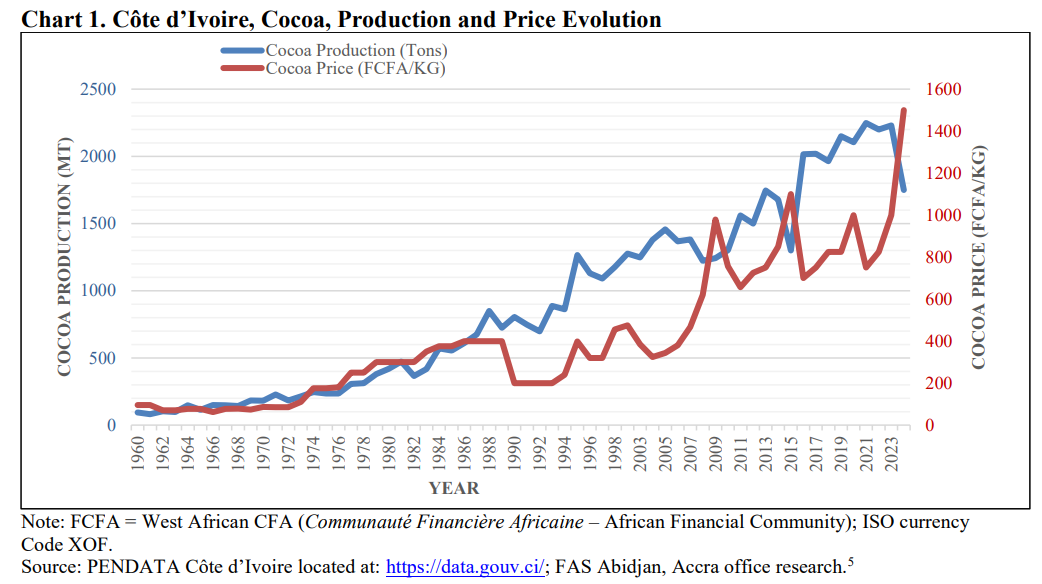
Since the end of the 1970s, Ivory Coast has been the largest cocoa producer in the world, producing roughly 40% of the world's entire cocoa supply, or around 2 million tons per year. Cocoa accounts for 20% of the Ivory Coast’s GDP and over 40% of its exports, directly or indirectly supporting an estimated 8 million of its 33 million people. Unlike most agricultural production, Ivory Coast’s cocoa is grown on approximately 1 million small farms of 1 to 3 hectares each, making the sector highly sensitive to price and market swings.
Source:
https://apps.fas.usda.gov/newgainapi/api/Report/DownloadReportByFileName?fileName=Cote+d%27Ivoire+-+Cocoa+Sector+Overview+-+2025_Accra_Cote+d%27Ivoire_IV2025-0001.pdf
Past Seasons' Production, Prices, and Expectations for this season
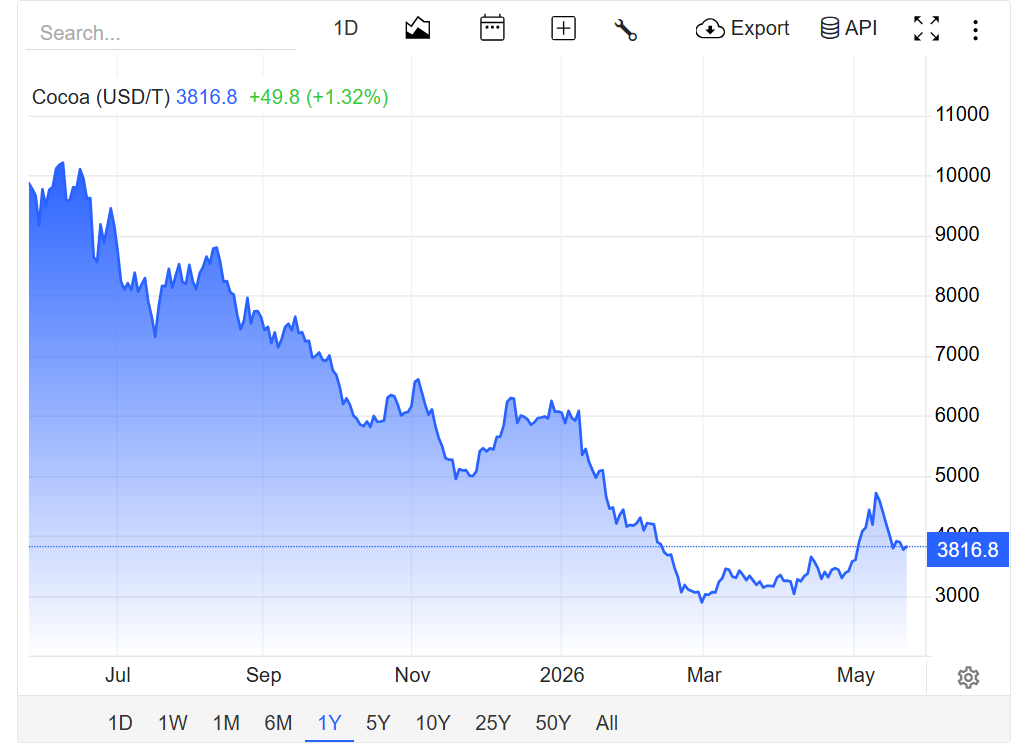
After three consecutive years of adverse weather, ageing plantations, and the rapid spread of swollen shoot disease - an illness that can infect cocoa trees - Ivory Coast’s cocoa production significantly declined. The resulting supply shortage pushed prices sharply higher. Cocoa Futures (USD/T) trading prices had traded around a fluctuating $2,500 during 2021, 2022, and 2023. However, after the shock tightened supply, prices reached past $11,000 per tonne in 2024 and 2025.
Following three years of declining output, analysts expected the trend to continue. The market expected production of around 1.8 million tonnes. However, growing conditions improved, there was favorable rainfall, and farmer investment saw recovery. Ivory Coast’s Conseil du Café-Cacao (CCC), or Council of Coffee and Cacao in English, revised its projection and saw Ivory Coast’s 2025/26 production at approximately 2.2 million tonnes. This is much higher than the market had priced, and represents a 10.5% increase on the prior season.
Source:
https://tradingeconomics.com/commodity/cocoa
Abundant Supply, Its Impact on Price, and Sellers' reactions
The surge in expected supply pressed the market for bearish prices. The ton of Cocoa traded at around $10,000 per tonne in the previous year, and fell to a low of $2,888 in February of this year. This is a collapse of over 70% from the peak.
In response to bearish international prices, Ivory Coast announced that it would cut the official price it pays farmers 57% for the mid-crop harvest that began in spring of 2026. The decision was intended to align domestic prices with global markets, but triggered immediate protests across major producing regions. Ivory Coast’s cocoa Regulators sent officials to the central eastern regions to manage the unrest. Despite all of these efforts, the stockpiles of unsold cocoa are still growing, and the market is interpreting this growing reserve as a sign that the current supply excess is hard to clear at these prices. This is likely to add pressure to make prices even lower, until the surplus matches demand.
Source:
https://www.sciencedirect.com/science/article/pii/S1470160X21005288
Uncertainty (El Niño)
Despite this year’s favorable weather, the expectations seem unfavorable for the 2026/27 season. The US National Oceanic and Atmospheric Administration (NOAA) estimated a 82% probability that El Niño conditions will emerge between now and July and persist until the end of the year, with a 67% chance of a ‘Super El Niño’. A pattern like this typically brings warmer and drier conditions to West Africa, which can severely damage cocoa trees. If the projection comes to be true, both the end of the current season and the beginning of the 2026/27 season would be affected by these disruptions.
Although there’s still uncertainty surrounding El Niño actually happening and its economic effects, Citigroup stated that the cocoa price could recover to $5,000 if conditions start to materialize. This would be a significant rebound, but still well below the highs of 2024.
Next Year's Expectations
Despite the increase in output, farmers’ earnings this season were disappointing due to the collapse in prices. In addition, fertilizer prices rose following the closure of the Strait of Hormuz, which disrupted global supply chains. Fertilizer retailers in major producing regions of Ivory Coast reported that as much as 90% of their inventories remain unsold.
According to the CCC director, this year’s higher output was driven by increased fertilizer use and improved management techniques, supported by last season’s strong earnings from elevated cocoa prices. However, since these earnings have significantly decreased as input costs rise, farmers are reducing or removing their reinvestments. With farmer reinvestment falling and El Niño risk rising, the conditions for another supply contraction in 2026/27 are already taking shape.
Data Sources
- Reuters — Ivory Coast expects cocoa output to rise 10.5% in 2025/26 season, regulator says
- XTB — Cocoa gains 4% trying to rebound from the 2-week low
- Barchart — Cocoa Prices Fall on Dollar Strength and Rising ICE Inventories
- CocoaIntel — Cocoa Prices Fall as Supply Outlook Improves
- Renewable Matter — Why the price of cocoa is dropping, but the price of chocolate is rising
- Barchart — Cocoa #7 May ’26 Futures Price
- Devdiscourse — Cocoa Futures: Navigating Surplus and Price Balancing in 2026
- Barchart — Cocoa Prices and Cocoa Futures Prices