
Introduction
In 2026, the French government offered vineyard growers €4,000 per hectare of vineyards removed, with the total plan aiming to uproot 28,000 hectares. Although this type of plan is not specific to France, it is the most visible symptom of the global wine industry's structural decline.
The Demand Crisis
As of May 2026, the global wine industry has remained under pressure from a structural crisis amid declining consumption. Over the past five years, global wine demand has fallen by 15%, reflecting a structural decline rather than a cyclical one. Much of this decline has been driven by a generational shift among Generation Z consumers, who, overall, drink 20% less than their predecessors. As baby boomers age out of peak consumption years, no younger generation has emerged to sustain previous drinking patterns. This shift is fueled by perceptions of leading healthier lifestyles, driven by the rise of social media and influencers promoting alcohol-free lives. Consumers have increasingly substituted traditional alcoholic beverages with non-alcoholic and perceived healthier alternatives.
The rise of alcoholic alternatives has also led to a lower demand for wine. Hard seltzers and canned cocktails have captured casual social occasions, offering cheaper, more portable alternatives that particularly appeal to younger consumers.
Economic Headwinds
Compounding this, since the pandemic, persistent economic pressure on discretionary spending has suppressed peoples’ willingness to spend on non-essentials or luxuries. Coupled with rising living costs and inflation adding weight to household budgets globally, consumers have shifted away from discretionary purchases such as mid-tier and premium wines. This has particularly affected lower-end producers, whose margins were already under pressure from rising costs and vineyard maintenance expenses.
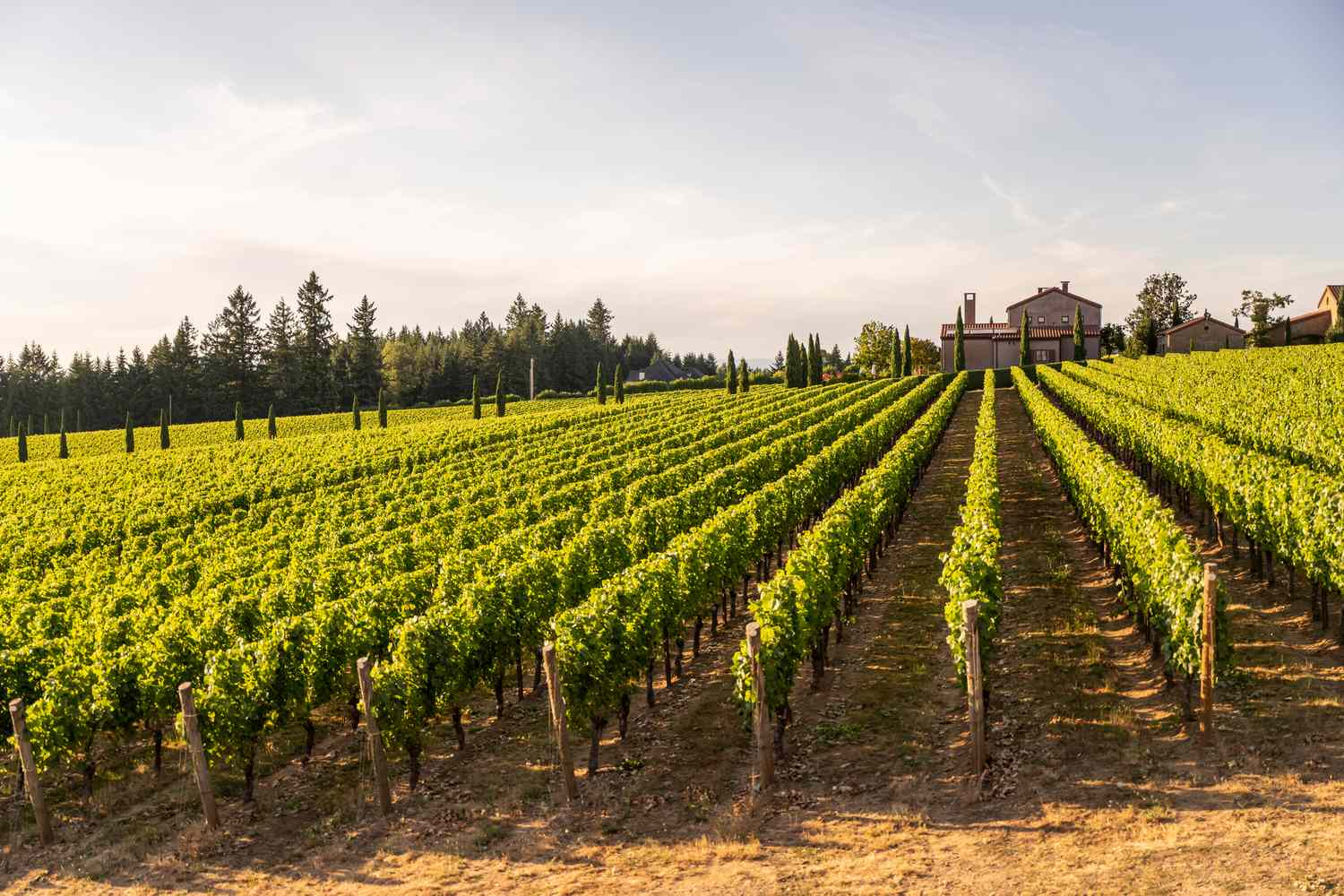
Source: Courtesy of Alloro Vineyard,
via https://www.foodandwine.com/most-beautiful-wineries-united-states-11795014
The Climate and Production Crisis
For these producers, the recent rise in extreme weather events, including droughts and heavy rainfall, has affected global agricultural production, particularly in vineyards across major wine-producing regions. Wine has recently been faced with one of its lowest production years, with 2023 being the lowest output since 1961 at 237.7 million hectoliters (mhl), or 10% lower than 2022. Increasing climate volatility has therefore not only reduced production reliability, but also increased the geographic and financial risk of wine production. Traditional wine regions such as France, Italy, Spain, and Portugal have faced consecutive years of drought, with some reports suggesting that 90% of Mediterranean regions could be gone in decades. This forecast of less predictable yields is forcing producers to absorb higher input costs, to be able to absorb potential climate shocks.
Although production conditions somewhat stabilized in 2025, extreme weather and global warming have increased the likelihood that wine regions will shift to colder environments, more conducive to higher-quality wine. As growing conditions in historically dominant regions deteriorate, wine production is gradually shifting northward toward cooler climates, with regions in the United Kingdom, Scandinavia, and northern Germany emerging as viable alternatives. While this geographical shift may present new opportunities for producers in different regions, it also raises the question of whether demand will follow them.
A Market in Oversupply and Beyond the Vineyard
While shifts in consumer behavior create new opportunities for producers and innovation, the global wine industry remains constrained by a large supply-demand imbalance, as weakening global demand continues to outpace supply adjustments. Global wine production in 2026 is expected to reach 232 million hectoliters, a 3% increase from the previous year. However, global consumption fell to approximately 214 million hectoliters, which leads to a downward trajectory for the industry as a whole in 2026. Nonetheless, production has historically exceeded consumption by roughly 7- 10% each year. The severity of this is underscored by persistent demand weakness, particularly in the second half of 2025. As a result, the industry is increasingly shifting away from expansion toward a managed contraction phase, where long-term survival matters more than growth.
The consequence of this structural decline extends beyond the vineyards. In 2025, LVMH's Wines & Spirits division (Moët Hennessy), the world leader in premium and luxury beverages, saw organic revenue fall 5% and reported revenue fall 9% to €5.36 billion. Profit from recurring operations dropped 25%, confirming that weaker alcohol demand has reached even the highest-end beverage groups. Interestingly, LVMH has stated that Champagne has nonetheless maintained its current market share, but that demand for Cognac and Wine has fallen, particularly in the United States and China.
Although LVMH posted early signs of stabilization in Q1 2026 following a clearly weaker year in 2025, organic revenue growth was 5%, led by the Chinese New Year, which gave champagne and spirits sales a good start to the year.
It is also important to keep in account that there are still concerns about geopolitical tensions amid unpredictable US-imposed tariffs. This has led to a restructuring plan in 2026 for Moët Hennessy, focused primarily on reducing costs from within. They are planning a major job-cut of 1200 employees, or around 10% of the global workforce, and overall are targeting 2019 headcount levels. Internally, there have also been leadership changes to address this new period, in an attempt to signal their already established premium brands and reduce investments in newer, weaker brands to curb declining demand.
Exit Plan
The future of the global wine industry is therefore no longer about restructuring for future growth, but about depending less on scale and volume and more on pricing power, branding, and efficiency.
The most rational path toward market stabilization would be through a strategy of premiumization, paired with supply-side contraction. This would involve uprooting cheaper, lower-quality, lower-production, and lower-demand vineyards, shrinking total output until supply realigns with structurally lower demand. To carry this out, demand would need to fall by around 20 billion liters, and the global vineyard area may need to shrink by 14%. This uprooting is already underway in regions such as France, Chile, and the United States to ensure that varieties are of higher quality and more appealing to consumers. However, this is a long-term strategy without a fast exit. It takes time to market and truly see an impact on inventory and wine pricing. Therefore, there will likely still be similar pressure and challenges in the near future.
Conclusion
The global wine crisis is not a vintage gone wrong. It is a structural unraveling independent of quality alone, but driven by a culmination of factors: a generation that has chosen differently, an ever-changing climate, unexpected trade and tariff pressure, and a supply chain that exceeds demand. Major players within the industry, like LVMH, are all facing a reckoning driven by these structural shifts.
In 2026, France is incentivizing farmers and producers to destroy what they spent generations building, an intrinsic part of French history and heritage. The path of recovery has been blocked; all that remains is a full restructuring of an industry that has existed for 8,000 years to rejuvenate itself. What remains is the long, slow work of rebuilding a smaller, more efficient industry from the ground up.
Data Sources
- LVMH — 2026 Q1 Revenue
- Just Drinks — LVMH wine-and-spirits arm ends 2025 on sour note
- Times — Why Gen Z Is Drinking Less
- Wine Australia — Small increase in global wine production in 2025 despite soft demand and signs of supply-side adjustment
- The Connexion — France to remove 28,000 hectares of vineyards in state-backed plan
- Vinetur — Global Wine Consumption in 2026 Continues to Decline as Consumers Shift Toward Premium and Selective Drinking