
Introduction
Bitcoin was supposed to be a hedge. Against Inflation, against currency debasement, and especially against the systemic fragility of traditional finance. Those ideals carried it from being an experiment of the cypherpunks to a $1 Trillion dollar asset class. As institutional capital poured into ETFs and macro funds built portfolios with both fixed income and crypto assets. The hedge relationship quietly began to deconstruct. That's the narrative of how BTC (Bitcoin) and Long Duration treasuries (LDTs) ended up in the same trade and what it will take to return both BTC and LDT’s to their respective trades.
Counter-Cyclical by Design
The original case for BTC as a portfolio hedge was intuitive. BTC has no sovereign issuer, no central bank, and a fixed supply hard coded at 21 million coins. In environments where investors feared monetary debasement or currency depreciation, BTC offered an alternative store of value without ties to equities or bonds — this made BTC incredibly attractive to people who had lost faith in the fiat systems. In BTC’s early years, it gained a multitude of empirical support. It moved on its own narrative, largely indifferent to rate cycles, liquidity conditions, and even risk sentiments in traditional markets.
The pairing with LDTs was only a logical next step in portfolio construction. Bonds offered the classic risk-free safe haven — when equities would sell off, investors fled to LDTs. BTC, in theory, offered a different kind of safety. As opposed to being a flight-to-quality asset, like LDTs. BTC is a flight-from-system asset. Together, they were supposed to offer uncorrelated protection from different types of macro risks. The once standard division of portfolios — 60/40 — quietly extended into 50/30/20 consisting of equities, bonds, and crypto, it's important to keep in mind that this division is only successful under the impression that all 3 parts move independently.
What Broke the Relationship
The structural shift began in January 2024 with the SEC’s approval of spot BTC ETFs. This launch triggered immediate acceleration in institutional monetary flows — exceeded $10 billion in the first weeks, and reached nearly $50 billion at the end of 2024. BlackRock’s IBIT rapidly grew, becoming one of the fastest growing ETFs in financial history, accumulating over $62 billion in net inflows since launch and dominated the BTC ETF market space with a share of 48.5%. Currently, US Spot ETFs now hold, collectively, around 7% of BTCs possible supply (around 1.5 million BTC).
The consequence was subtle but significant. BTC was no longer primarily held by retail believers, venture funds, or crypto-natives. It was now sitting on the balance sheet of the same institutional macro funds that held LDTs, investment grade credit, and equities. When those funds faced a risk trigger or redemption, they would liquidate across the entirety of their books. In those moments, BTC slowly lost its status as a system-skeptic hedge and became another line item on a multi-asset funds balance sheet.
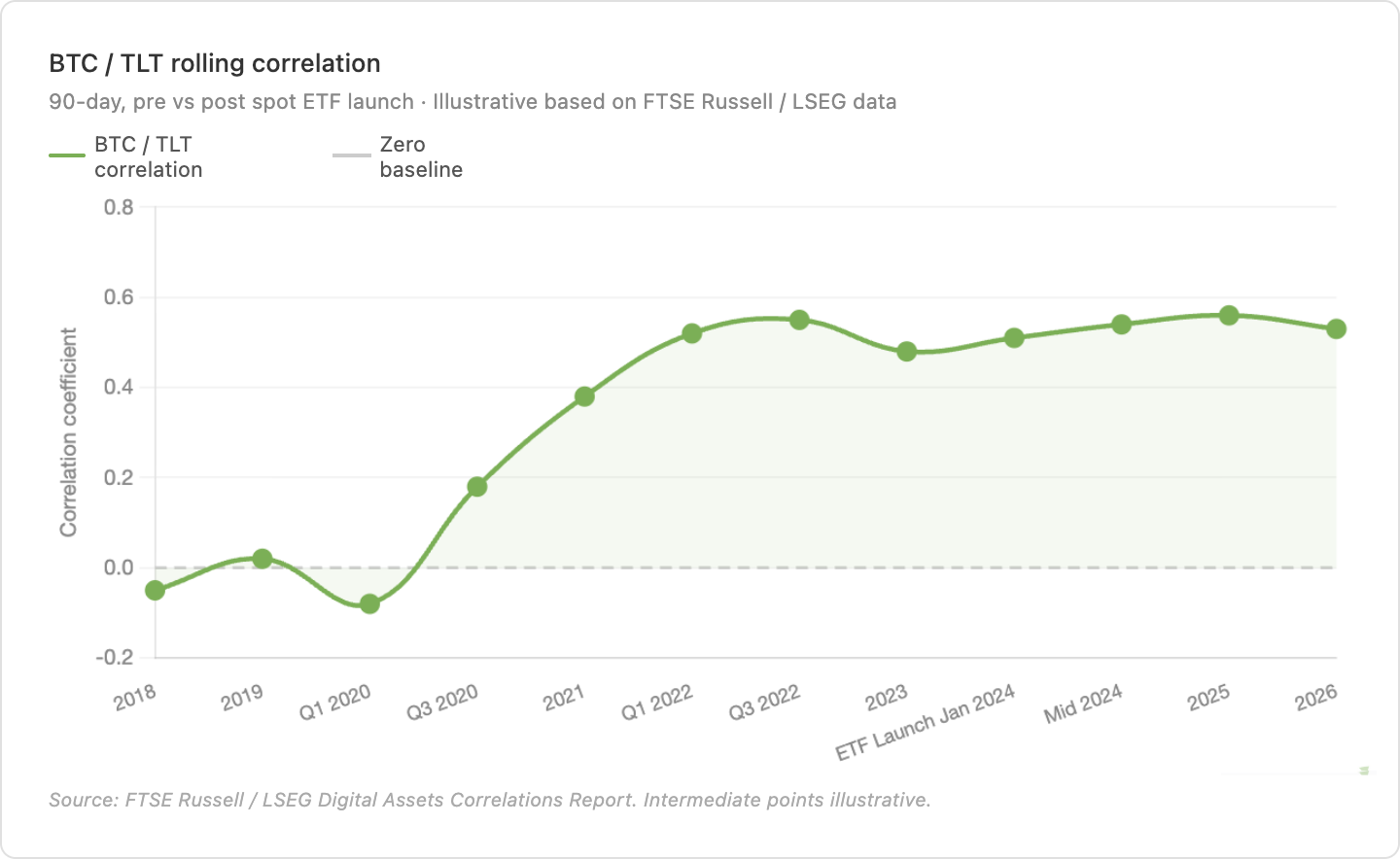
The data confirmed what portfolio managers were observing in real time. Post-covid correlations between BTC and risk-on equities surged to 0.5-0.6, compared to the previous near 0 number in pre-Covid periods. Meanwhile, the correlation between BTC and LDTs barely moved. BTC had become a high β (beta) risk asset but appeared to the naked eye as being “clothed” in safe-haven clothing, a wolf in sheep’s wool if you will.
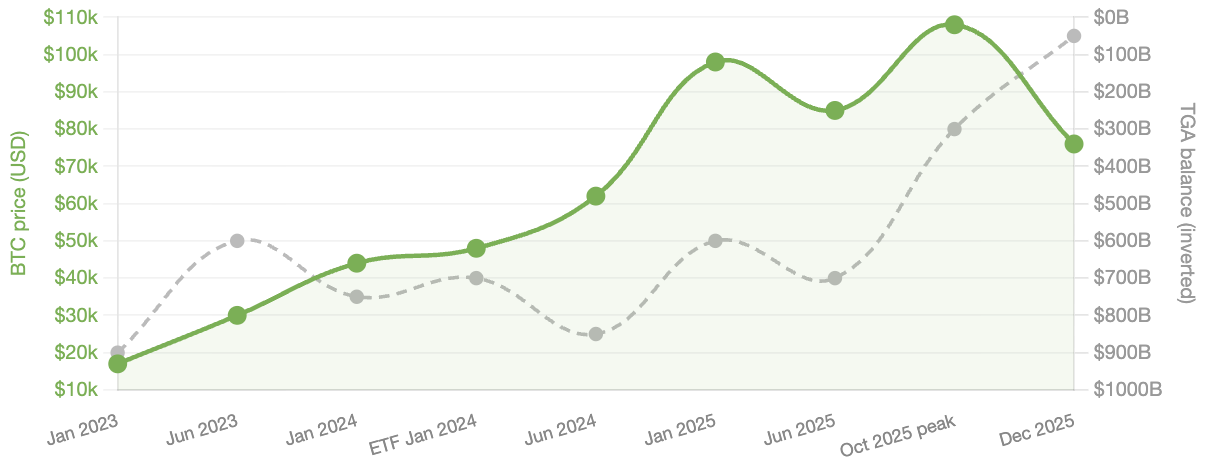
The 2025 liquidity crunch provided the clearest illustration of the breakdown. As the U.S. Treasury moved to rebuild its general account — issuing over $500 billion in bonds to push the Treasury General Account (TGA) toward $1 Trillion — it withdrew a large amount of liquidity from the financial system. Gold, however, surged to $4,000 per ounce from around $2,000 per ounce. The surge in price for gold may have been beneficial in cementing gold as a true safe-haven bid, but at the cost of putting BTC into the standard liquidity track it was designed to hedge against.
The Institutional “Plumbing” Problem
The correlation did not shift to 0.5-0.6 from near 0 over night. In fact, in order to understand the shift, you must understand the “plumbing” of the situation. Spot BTC ETF holders — which now consist of wealth management platforms, pension adjacent funds, and institutional allocators brought in through BlackRock’s wirehouse relationships — are subject to the same redemption cycles as any other ETF investor. For example, when equities volatility spikes and risk budgets tighten, these holders do not hold BTC because of its theoretical hedge properties. They sell what is liquid. BTC ETFs, with their $1.38 billion daily inflow capacity and institutional-grade liquidity infrastructure, are incredibly liquid.
Bitwise projects that U.S.-listed BTC ETFs could purchase more than 100% of all new BTC issuance in 2026 — in theory, this creates a structurally sound demand dynamic, but this demand dynamic, like all demand, is conditional on the supply of BTC, risk appetite remaining positive, and macro funds that drive BTC ETF flows remaining and willing to hold. This condition is extremely risky and situational. In a risk-off event, this condition falls apart. The very institutional adoption that displayed BTCs legitimacy has also made it vulnerable to the same redemption cycles that characterize any ETF-wrapped risk asset.
Three Scenarios
| Scenario | Trigger | BTC Behavior | Bond Behavior |
|---|---|---|---|
| Bull - Relationship Restores | Warsh Cuts + Signs of QT (Quantitative Tightening) Dollar Discipline: Macro funds de-risk BTC as hedge role reasserts | Decouples from equities Rallies on store-of-value | Yields fall: Safe-haven bid Returns to long duration |
| Base - Correlation stays the same | Warsh holds, inflation sticky; institutional flows keep BTC in the same risk asset position | Tracks equities; liquidity driven | Range-bound; no clear safe-haven signal |
| Bear - Both Sell Off | Liquidity crunch; margin calls force simultaneous liquidation across macro portfolios | Drops sharply alongside equities | Initial safe-haven bid, then overwhelmed by large sell-off |
The W Variable
The arrival of Kevin Warsh as Federal Reserve Chair — confirmed by the senate 54-45 on May 13, 2026, in the most divisive Fed confirmation in modern history — introduces a genuinely new macro variable into this analysis. Warsh is the first incoming Fed chair to hold direct exposure to digital assets, with equity stakes in a Bitcoin Payments startup, ties to Bitwise, and a position in a stablecoin project. Most importantly, he has called BTC a “very good policeman for policy” and told CNBC in 2021 that “if you’re under 40, Bitcoin is your new gold.”
Warsh’s policy stance, despite how it might sound, is not straightforwardly bullish for crypto in the near term. Warsh introduces an approach that utilizes QT when cutting rates — an unprecedented combination of cutting the (Federal Funds Rate) FFR to 3.0-3.25% while simultaneously shrinking the Fed’s $6.5 trillion balance sheet. Rate cuts usually indicate a time of liquidity, which drives people to invest in risk assets; balance sheet contraction would simultaneously tighten financial conditions. The net effect on BTCs macro sensitivity is rather ambiguous, which is precisely what makes this a wait and watch moment rather than a directional trade.
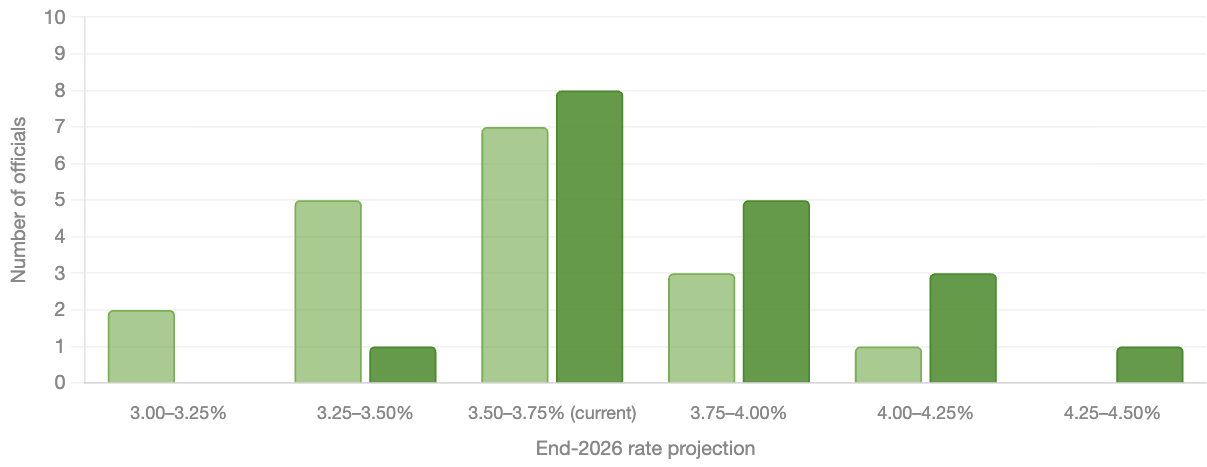
Warsh’s first FOMC meeting on June 17th delivered a unanimous 12-0 hold at 3.50-3.75% — but the real signal came from beneath the decision. The dot plot flipped hawkish: the median policy maker now sees rates ending 2026 at 3.8%, up from March’s rate of 3.4%, implying a hike rather than a cut. 9 of the 18 participants projected at least one rate increase before year-end, with 17 of 18 judging inflation risks to be tilted to the upside. May CPI had printed at 4.2% — the Iran-driven energy shock showing no signs of resolution. Warsh compounded the hawkish reading by announcing he had not submitted his own rate projection, overhauling the post-meeting statement to strip out all forward guidance, and launching five task forces to review the Fed’s entire policy framework. As a result, stocks fell, 2yr Treasury yields jumped 14 basis points (.14%), and risk assets sold off. The necessary catalysts for a BTC regime shift — rate cuts, dollar weakness, looser financial conditions — is now further away than it was at Warsh’s confirmation.
My position: Define the Re-Entry Conditions
The counter-cyclical relationship between BTC and LDTs is broken, but thankfully it’s not permanent. It broke due to structural reasons — institutional co-ownership, ETF driven liquidity, and the same macro funds holding both BTC ETFs and LDT ETFs, creating a behavioral correlation that didn’t exist before. This will require a structural change in the macro regime to reassert itself.
That change has a credible catalyst in Warsh. If he is successfully able to navigate toward rate cuts while maintaining dollar credibility through balance sheet discipline, the macro environment could shift in ways that restore BTCs independence. A weaker dollar, lower real rates, and a Fed chair who publicly frames BTC as a monetary policy signal rather than a speculative asset would constitute a meaningful regime shift.
Rather than positioning for the relationship to heal immediately, investors should define the specific conditions that would signal the shift of the current monetary regime and act on those, not thesis alone.
Re-Entry Triggers To Watch Out For
| Re-Entry Trigger | What to Watch |
|---|---|
| Warsh Rate Cut | Fed dot plot shift: CME FedWatch Cut probability rising above 50% for 2026 |
| BTC-equity 30-day rolling correlation <0.3 | BTC decoupling from Nasdaq on down days - |
| ETF Outflow Reversal | Weekly IBIT net flows turning positive after extended outflow streak; institutional reaccumulation |
| Dollar Weakening | DXY (Dollar index) breaking below key support levels; historically inversely correlated with BTC’s store-of-value |
| CLARITY Act passage + Fed custody guidance | The CLARITY Act is scheduled for a July 17th house hearing. If passed it would grant CFTC jurisdiction over digital commodity spot markets, establish a federal stablecoin, and give clear guidelines for banks on crypto custody. The Fed’s own dollar policy agenda now includes stablecoins, following Governor Waller’s June 22nd conference framing of digital dollar tokens as a monetary policy question. |
Since BTC’s reassertion as a hedge isn’t going to shift solely due to one of the re-entry triggers happening, I would advise to wait until at least two of said triggers fire simultaneously; the base case remains that BTC and LDTs continue to behave as correlated macro assets in risk-off environments. Investors who built crypto positions as a portfolio diversifier should reconsider whether that diversification is actually present. The hedge not working as advertised and the conditions that would restore it are indeed possible, but not yet present. The “Safe Haven Divorce” is real but reconciliation is on the table, and Warsh holds the pen.
Data Sources
- LSEG — FTSE Digital Assets: Evolution and Correlations
- CryptoSlate — Bitcoin ETF Record Outflows Are Deceptive as Crypto Products Absorbed $46.7 Billion in 2025
- Investing.com — Bitcoin ETFs Gain as Institutional Demand Continues to Support Flows
- AInvest — Bitcoin Breaks M2 Correlation as Treasury Liquidity Takes Center Stage
- Blockhead — Kevin Warsh Is Fed Chair: Bitcoin, Payments, Equity, Anti-CBDC Stance, First Meeting in June
- CoinDesk — The Next Fed Chair Has a Crypto Portfolio. Here’s Everything That’s in It
- 24/7 Wall St. — Kevin Warsh Confirmed as Fed Chair: The 5 Things That Could Decide How Bitcoin Reacts
- CNBC — Fed Interest Rate Decision, June 2026
- Fox Business — Federal Reserve Interest Rate Decision, June 17, 2026
- CNN — Fed Rate Decision, June 2026
- Federal Reserve — FOMC Press Conference Transcript, June 17, 2026
- Latham & Watkins — U.S. Crypto Policy Tracker: Legislative Developments
- CryptoSlate — Crypto Finally Has a CLARITY Act Date; Delivery Now Depends on Seven Senate Democrats
- CryptoSlate — Stablecoins Are Quickly Becoming Kevin Warsh’s Fed’s Next Policy Problem