Introduction
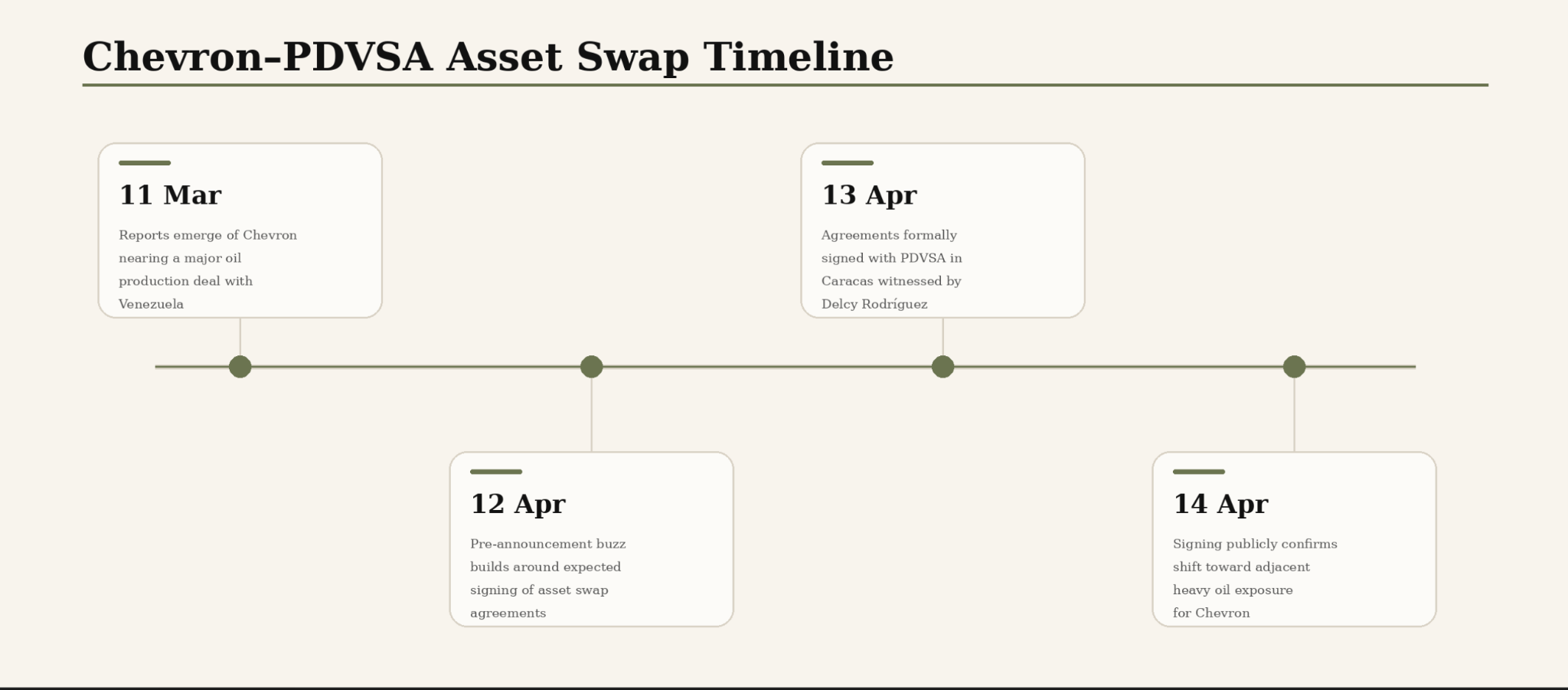
Chevron, the US-based oil company, agreed to exchange certain upstream and downstream assets in Venezuela with its local partner, Petróleos de Venezuela, S.A. (PDVSA). This move was part of Chevron's strategy to adjust its portfolio within the country, focusing more on heavy oil production projects, which are abundant in Venezuela's Orinoco Belt. Essentially, Chevron reduced its exposure to some lighter oil operations while increasing its stake in heavy oil projects, aligning its operations with long-term resource opportunities in Venezuela.
The swap involved operational and ownership shifts in existing oil fields and production facilities but did not represent a new entry into the Venezuelan market. It was a restructuring of existing holdings.
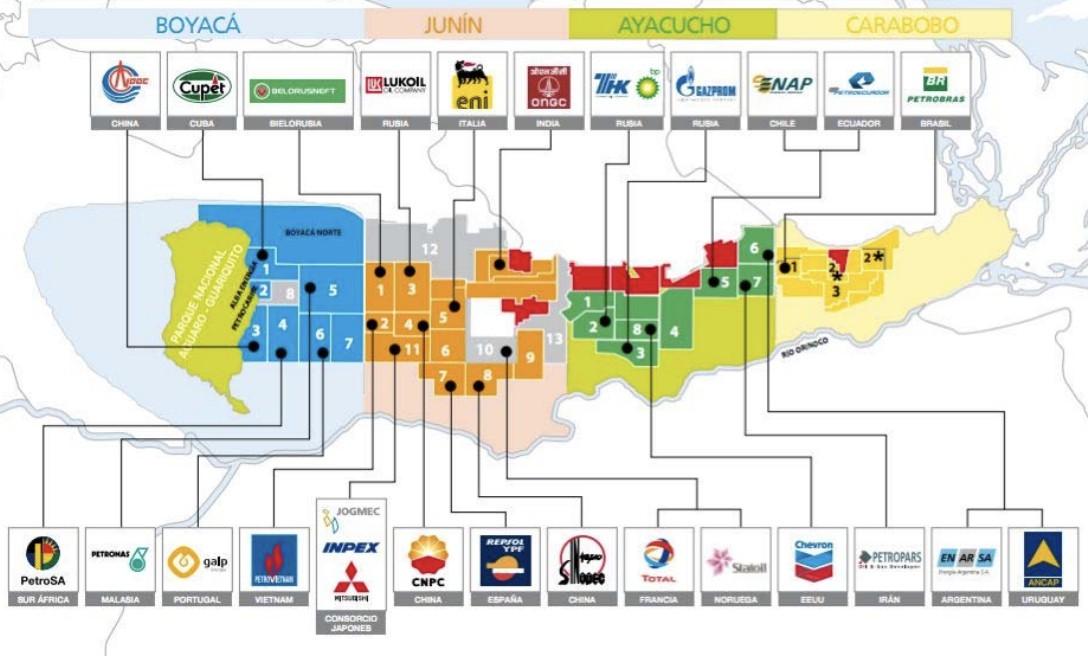
Timeline:
Analysis
Chevron’s shift towards heavy crude is logical: it is attempting to capitalize on the compatibility between its complex refineries in Pascagoula and El Segundo and the heavy crude of Venezuela and seeking economies of scale. These refineries were specifically designed to process high-sulfur, sour crude, the type that trades much cheaper than lighter crude produced at the Plataforma Delta offshore assets that Chevron is giving up. Additionally, transferring these offshore assets offloaded high-capex projects that were likely years away from profitability. Expanding its footprint in the Orinoco belt, the world’s largest proven reserves of extra-heavy crude, allows Chevron to focus its capital on assets that are more likely to produce cash flow, given its refining expertise and to leverage existing infrastructure in an already well-documented region.
Much of what happened follows the series of events in Venezuela following Maduro’s ousting in early January. Regulatory breakthroughs such as the easing of sanctions as well as the reform of Venezuelan law that allowed private companies to gain operational autonomy encouraged foreign investment and will assist in Venezuela’s reintegration into the international energy markets. This Chevron deal highlights the greater interest, specifically American interest, in Venezuelan investment.
The company's ambitious target of 390,000 bpd means Chevron views Venezuela as a long-term extraction source, and ultimately two scenarios could occur depending on the success of the deal. First, in a bullish scenario, the firm successfully synergizes its heavy crude extraction with its refineries. Chevron is already a well-entrenched foreign firm in Venezuela. Its success with this deal would give it even greater influence in the country’s economy and oil market, potentially positively shaping future joint ventures with PDVSA and even greater investment from Chevron. It could also encourage other foreign firms to re-enter Venezuela and act as a major tailwind for Venezuelan oil in the upcoming years. The bearish scenario would be one in which Chevron faces logistical and infrastructure constraints that prevent it from reaching its target, underscoring the country’s neglected oil infrastructure and the sheer scale of investment needed to address it. This would likely discourage the still-hesitant firms from further investing in Venezuela and significantly hinder the country’s recovery in oil production. It is important to note that political stability and the continued lifting of sanctions would be necessary to achieve this success. The bullish case has immense upside for Chevron and its future, while the bearish case would likely leave the capital invested as sunk costs and harm the company and its aspirations.
Overall, Chevron’s deal has many implications for both the company and Venezuela’s long-run outlook, and its ability to capitalize on it will play a role in shaping that outlook.
Our Position on the Matter:
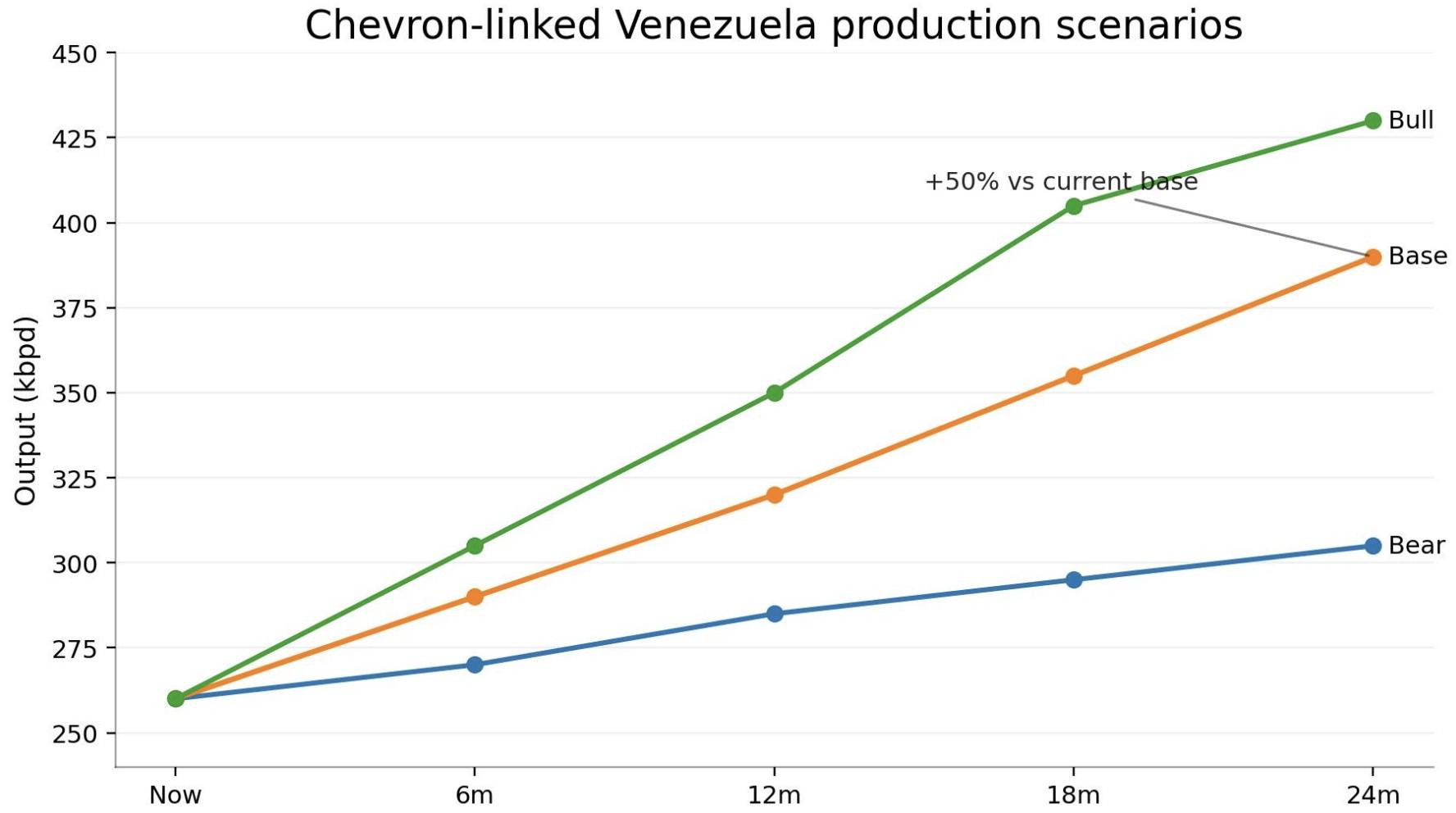
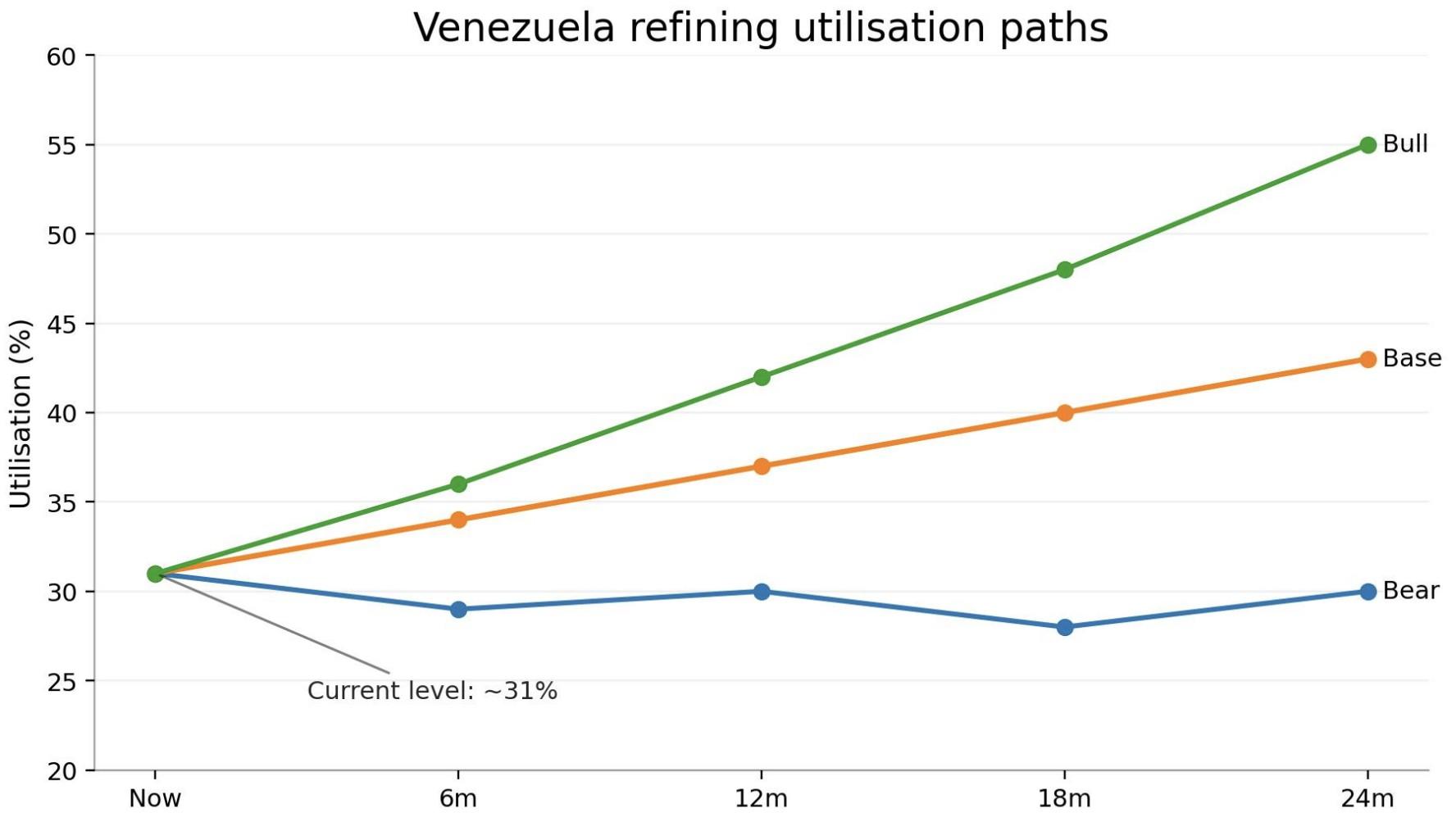
Our position is that Chevron’s Venezuela asset swap is financially positive because it swaps slower, more complex gas optionality for adjacent heavy oil barrels that fit its existing operating base, but that the investment case remains constrained by Venezuela’s legal, sanctions, and sovereign risk. The swap gives Chevron an extra 13.2% in Petroindependecia, a heavy oil joint venture that is more directly aligned with its Venezuela crude strategy. While giving up the Loran gas field and a small western Venezuela oil interest. The gas field is more valuable in the hands of Shell who appears better positioned to commercialise that gas through Trinidad’s LNG and petrochemical system, with first gas targeted for 2027 and pipeline plans already being advanced. That supports the argument that this is a deliberate shift away from more complex gas optionality and towards adjacent heavy crude exposure. By raising its stake in Petroindependencia to 49% and adding Ayacucho 8, Chevron is concentrating on barrels that fit its current Orinoco strategy rather than retaining gas assets that are longer dated and more complex to commercialise. This means that Chevron’s immediate production can go up 50% from 250,000 bpd and reach 390,000 bpd within the next 2 years, which would be a third of Venezuela's total output: supporting Chevron’s dominance in the region. The primary reasons why we do not hold a stronger bullish position is that the risks involved with Venezuelan operations are still substantial. Venezuela remains a high sovereign risk jurisdiction along with having high operational fragility. Chevron itself has said more legal reforms are still needed to support investment at scale, and the current U.S. licence does not remove all sanctions. While the headline asset improvement is real, the execution, fiscal terms and political durability still matter a great deal. Additionally, Venezuela’s infrastructure remains unreliable. The recent oil spills near Cardón and the fact that the country’s refining network is operating at only 31% of capacity highlight the operational fragility that still surrounds any expansion story in Venezuela. With all that being, we remain moderately bullish because Chevron is exchanging gas optionality for heavy oil barrels that are easier to integrate, monetise, and scale within its current Venezuela footprint. Even so, the market should not treat this as a major valuation rerating, because legal uncertainty, sanctions exposure, and infrastructure weakness still place a clear ceiling on the story.
Concluding Statement:
Chevron’s pivot towards heavy crude through this deal is a trade-off aimed at escalating and streamlining production in a re-emerging market. The potential to increase production by 50% to 390,000 bpd positions Chevron as the dominant foreign company in this region, and the long-term success of this asset swap with Venezuela is still heavily influenced by factors beyond the firm’s control, such as Venezuela's geopolitics. The decay of Venezuela’s oil infrastructure will certainly affect Chevron’s future not only in the Orinoco belt but also in the country itself. The success of this deal depends on the investment Chevron makes to take advantage of the massive reserves it acquired, and it will likely have long-lasting implications for its future extraction in Venezuela. This strategy also has inherent risks as well. By concentrating and investing increasingly in specifically Ayacucho 8, it means that Chevron’s future growth is tied to the fragility of the Venezuelan market. Therefore, this deal truly represents the phrase “high-ceiling and low-floor”.
Data Sources
- Reuters — Chevron, Shell sign agreements for oil and gas areas in Venezuela
- Chevron — Chevron consolidates Venezuela heavy oil position in asset swap
- Seeking Alpha — Chevron to swap assets with PDVSA, poised for Orinoco Belt expansion
- MarketMinute — Energy diplomacy: Chevron bolsters Venezuelan presence through strategic asset swap
Disclaimer
This report is published by 6:05 Markets for informational purposes only and does not constitute financial advice, an offer to buy or sell securities, or an investment recommendation. The information contained herein has been obtained from sources believed to be reliable, but 6:05 Markets makes no representation as to its accuracy or completeness. Past performance is not indicative of future results. Readers should conduct their own research and consult with a qualified financial advisor before making any investment decisions. This report is intended for the named recipient only. Unauthorised reproduction or distribution — in whole or in part — is prohibited without the prior written consent of 6:05 Markets.
© 2026 6:05 Markets. All rights reserved.
Website: 605Markets.com Linkedin: https://www.linkedin.com/company/6-05-markets
Back to Oil and Gas Reports