
Introduction
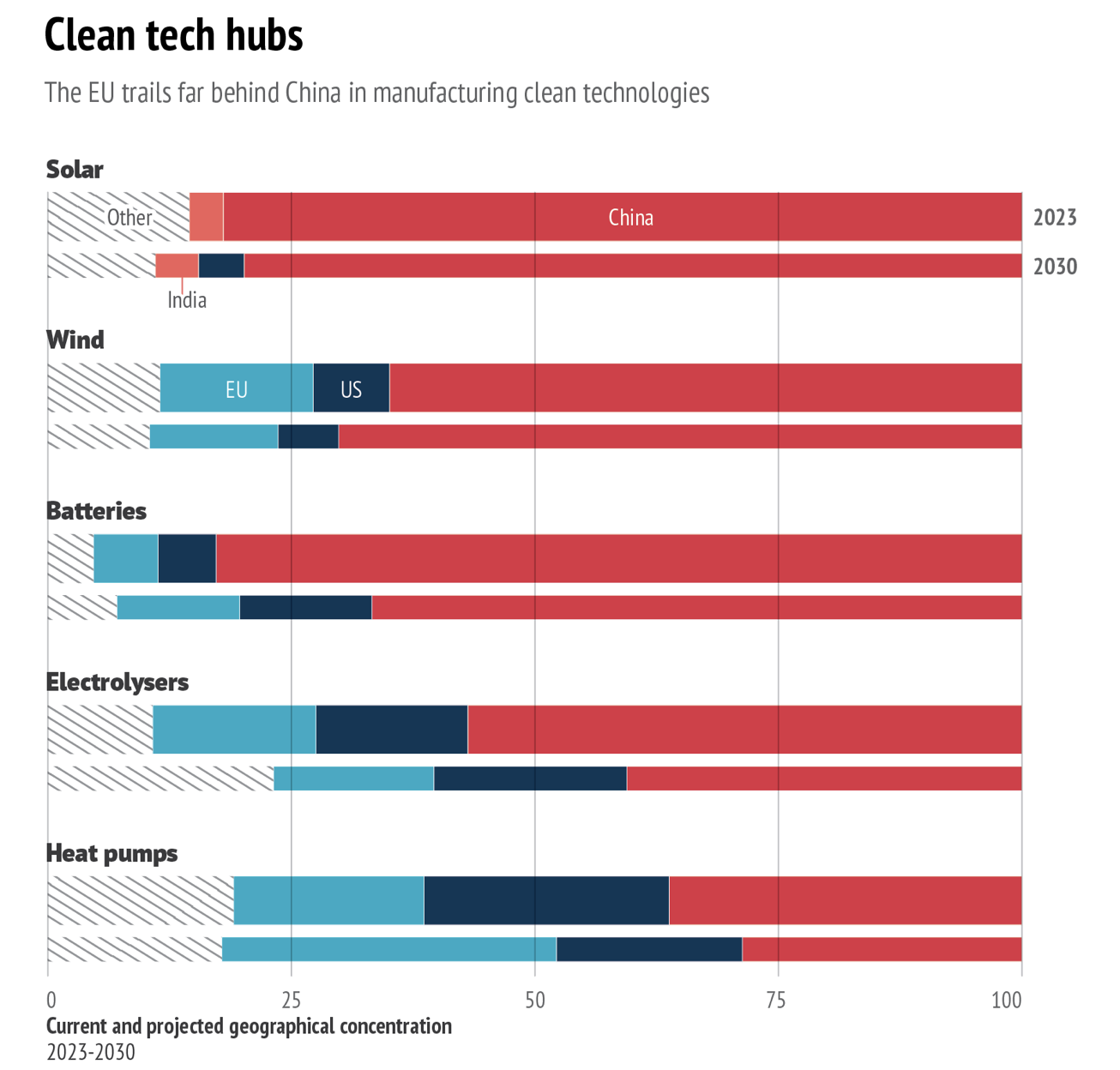
Europe’s transition to renewable energy is often framed as a path towards sustainability and energy independence, particularly as the continent hopes to decrease its reliance on Russian gas. However, Europe may simply be replacing one risk with another. On April 29th, a UK report warned that this transition also creates a vulnerability for the continent due to an increasing reliance on Chinese supply chains. China supplies approximately 98% of solar panels, 88% of lithium-ion batteries (used in smartphones, electric vehicles, and large-scale energy storage), and 61% of inverters (which convert energy from solar panels into usable electricity) used across the continent. While China’s dominance has allowed for the continent to rapidly decarbonize at a relatively low price, it raises economic and geopolitical concerns about replacing domestic manufacturing with dependence on a potentially hostile supplier.
Analysis
Europe’s dependence on Chinese clean technology is both substantial and growing. The EU’s Chinese solar imports reached €19.7 billion in 2023, a share that has risen sharply from 68% a decade ago to 98% and the nearly absolute dominance seen today. Chinese firms now control over 80% of global solar manufacturing capacity, and Europe is a primary destination for these exports, accounting for 45% of China’s EV exports. Clearly, Europe’s dependence is not stabilizing, as Chinese clean-tech exports surged by 52% year-on-year in 2026, with battery exports alone reaching $10 billion in March 2026.
This dependence is rooted in Europe’s willingness to step away from local industry to benefit from lower prices due to China’s scale. Europe once held a significant share of the global solar manufacturing market, accounting for around 30% in 2007, but just a decade later, this figure was at 3%. The decline results from China’s ability to scale production rapidly and reduce costs through state support and industrial policy. Solar manufacturing in China is estimated to be 35–65% cheaper than in Europe, while European production costs can be 70–105% higher, with capital alone costing up to three times as much. As a result, European producers were unable to compete, leading to factory closures and job losses. The weakened state of Europe’s solar production has forced an ever-increasing reliance on imports, making China the central supplier in Europe’s renewable energy transition.
Fundamentally, the risks are similar to those Europe has already experienced with Russian gas. That dependency created direct exposure prior to the war in Ukraine, and reliance on Chinese technology carries the same logic. The primary risk is not sabotage but export restriction, which would delay projects and drive up costs over time. This concern is especially relevant given the EU’s goal to install between 325 and 375 GW of new solar capacity by 2030. Trade imbalances further reinforce this concern, with China recording an $83 billion surplus with the EU in the first three months of 2026.
Beyond economics and geopolitics, there are also significant security risks that come with the infrastructure. Chinese firms are deeply integrated into Europe’s energy systems, including control over large shares of solar inverter capacity. These devices are remotely programmable, raising concerns about potential grid vulnerabilities. Additionally, China dominates the processing of critical raw materials essential to clean technologies, refining 60–70% of global lithium and cobalt and approximately 90% of natural graphite. European dependence on China for rare earth elements is close to 100%, and 95–96% of EU magnesium imports originate from China. This highlights that Europe’s dependence extends to the underlying materials of the entire energy transition.
Despite these risks, reducing dependence clearly comes with its own costs. Diversifying supply chains would require rebuilding domestic manufacturing capacity that was pushed aside due to its higher price point and developing alternative trade partnerships. Both of these factors would slow the pace of renewable deployment in the short term. Given that electricity demand in Europe is expected to more than double by 2050, delaying the transition carries its own risks in terms of keeping domestic energy affordable and accessible.
Policymakers therefore face three options of descending appeal. Option 1 is the easiest in the short term, simply hold course and continue to prioritize rapid decarbonization using existing Chinese supply chains and hope that relations with China remain positive. Option 2 is to accept higher costs and delays in the short term to enhance long-term resilience and strategic autonomy. Option 3, full recarbonization, is politically unfeasible: the continent’s greener politics and volatile oil markets make it a non-starter. However, a mix of these options is likely Europe’s best choice.
https://www.iss.europa.eu/publications/briefs/going-green-without-china
Our Position on the Matter:
A combination of all three options offers Europe the most realistic path forward. Maintaining current Chinese imports allows the EU to continue deploying renewables at the speed required to meet climate targets, but pairing that with long-term investments in domestic manufacturing and supply chain diversification can protect the continent’s decision-making autonomy during times of conflict. At present, this balance is necessary because renewables, while growing rapidly, are not yet able to independently sustain Europe’s energy system. In 2025, wind and solar generated roughly 30% of EU electricity, only narrowly surpassing fossil fuels at 29%, underscoring how large a role conventional energy sources still play. Even when including all renewable sources, they account for only about 48% of electricity generation, leaving a significant portion reliant on nuclear and fossil fuels.
This gap makes a limited, temporary use of Option 3, “recarbonization,” more defensible as a stabilizing measure. Fossil fuels continue to provide dispatchable energy that can compensate for fluctuations in renewable output. For example, periods of low wind and hydropower have already forced increases in gas-fired electricity generation in Europe, showing that fossil fuels remain essential for grid reliability in the near term. From a security standpoint, this approach also reduces overexposure to Chinese supply chains, which currently dominate more than 80% of global clean-tech manufacturing capacity, compared to fossil fuel markets that are far more geographically diversified.
However, the costs of Option 3 are still high and should not become a long-term option if Europe wishes to meet its climate goals and energy independence.
Fossil fuels still are the primary driver of emissions, with global fossil fuel CO₂ emissions projected to reach 38.1 billion tonnes in 2025, a record high. Expanding their role risks delaying Europe’s legally binding goal of achieving at least 42.5% renewable energy in energy consumption by 2030. Due to these goals, recarbonization should only serve as a short-term support. Additionally, as demonstrated by the wars in Ukraine and in Iran, fossil fuels also come with their own geopolitical risks.
Concluding Statement:
As long as Chinese production remains significantly cheaper, European renewable deployment will remain tied to Chinese cost curves, effectively outsourcing price-setting power for the energy transition. Therefore, Europe is likely locked into Chinese supply chains in the near term, as the cost of independence is politically and economically prohibitive.
A successful European energy transition must balance emissions reduction with long-term national security risks. The exact trade-off between expediting decarbonization and expediting supply chain independence, as well as the extent to which Europe is willing to accept higher costs to hedge against political tensions, remains the central policy question. How Europe navigates that trade-off will define its geopolitical position in the next decade.
Data Sources
- Oxford Institute for Energy Studies — The National Security Risks of China’s Role in Europe’s Energy Transition
- Reuters — China's clean tech exporters cash in as Iran war hits oil & gas flows
- EMPN — Europe’s Solar Ambition and Industrial Dependence
- Solar Now — China dominates EU solar photovoltaic (PV) market: 98% of solar panels come from China
Disclaimer
This report is published by 6:05 Markets for informational purposes only and does not constitute financial advice, an offer to buy or sell securities, or an investment recommendation. The information contained herein has been obtained from sources believed to be reliable, but 6:05 Markets makes no representation as to its accuracy or completeness. Past performance is not indicative of future results. Readers should conduct their own research and consult with a qualified financial advisor before making any investment decisions. This report is intended for the named recipient only. Unauthorised reproduction or distribution — in whole or in part — is prohibited without the prior written consent of 6:05 Markets.
© 2026 6:05 Markets. All rights reserved.
Website: 605Markets.com Linkedin:linkedin.com/company/6-05-markets