

Not a Surprise
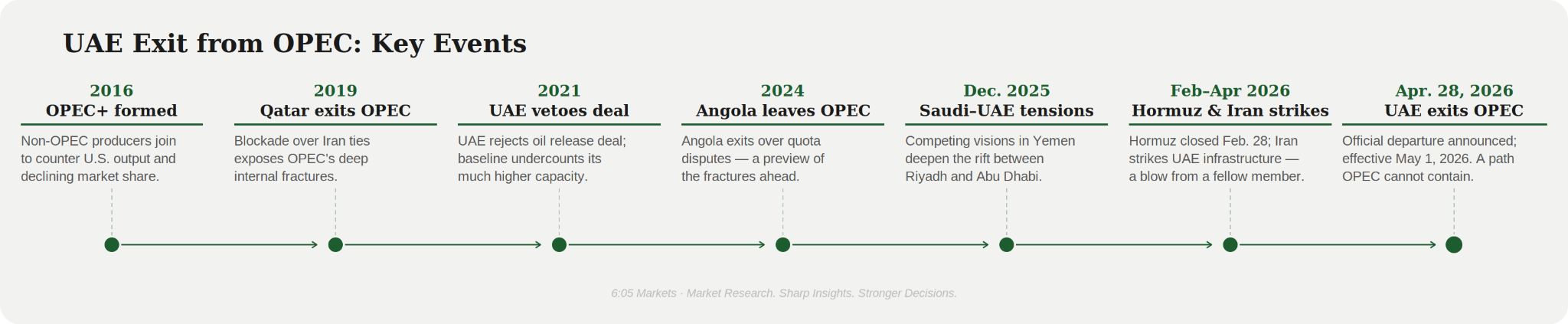
Given its emerging rivalry with the de facto leader of OPEC, Saudi Arabia, the UAE’s exit does not come as a great surprise. Squabbles over the region’s geopolitics as well as oil pricing and quotas have put the two countries at odds. The UAE’s dissatisfaction stems from its recent investments, unable to capitalise due to OPEC’s quotas. Rumors of the country’s exit have also been circulating for years, especially given worsening relations with Riyadh and closer ties with the U.S. and Israel. The Hormuz Crisis further accelerated tensions with Emirati leadership frustrated by other Arab countries’ inability to contribute to its defense.
Despite the decision contributing to slight optimism in constrained energy markets amid the Hormuz crisis, there have been no immediate effects. Brent is still trading around $111 as of Apr. 29. This event will likely have significant implications for markets going forward, but it does not alleviate the current physical supply constraint at Hormuz.
Why This Matters For OPEC
The departure of OPEC’s third-largest producer leaves the future of the cartel uncertain. On the one hand, the UAE’s departure means a 13% decrease in an already shrinking OPEC production capacity, and the Hormuz crisis has constrained the group’s major producers, such as Saudi Arabia, Iraq, and Iran. This hinders the group’s ability to effectively control or influence the market. In the long run, OPEC must act as a unified bloc to continue to exert its influence. However, the UAE's departure taints this unifying image and could lead members to disregard their quotas. This could also spur other disgruntled members with quotas to follow the Emirates' lead and leave the cartel.
Immediately, the cartel seems to be relatively stable in terms of its membership. Iraq, in particular, is steadfast in its commitment to OPEC and OPEC+ according to two Iraqi officials. Furthermore, despite Iran’s geopolitical tensions with various members of the cartel, it has chosen to remain in OPEC. Saudi Arabia remains the only producer with meaningful spare capacity (~2 million bpd), with total capacity around 12 million bpd. Currently, the UAE’s departure would bring OPEC+’s control of nearly 50% of the world’s oil production to around 45%. This decrease is not severely crippling, and the cartel will still be able to control prices.
As the Middle East war continues to wreak havoc in the region, OPEC+’s objectives have shifted from controlling output to repairing and rebuilding oil production facilities to rebound production capacity. Since dissatisfaction with quotas is no longer a factor, near-term member attrition appears unlikely. However, if other members decide to leave, OPEC+ and Saudi Arabia could find themselves in a precarious position.
Why the UAE is Particularly Important
At the core of this split was the UAE’s goal of expanding production that is at odds with OPEC's purpose of enforcing underproduction. The UAE invested significantly in upstream oil and gas production to increase its capacity to 5 million barrels per day by 2030, but remained constrained by the OPEC-induced quota of 3.4 million b/d. Abu Dhabi had previously argued that its baseline underestimated its expanded capacity, but Saudi Arabia has prioritized price defense and cohesion among OPEC member states over revising quotas.
Besides Saudi Arabia, the UAE is the only OPEC member with significant spare capacity. Therefore, the group will experience less flexibility in the face of future supply shocks if it requires an increase in output. Realistically, the loss of a potential 4.8 million bpd from the group’s near 40 million bpd is a shock, but it will not be completely devastating. Saudi Arabia is not without its own limits to constrain production, as it continues to maintain the largest spare capacity of roughly 2 million barrels per day. However, the split also demonstrates a growing divergence between the two economies.
In Saudi Arabia, “oil activities” account for 48% of total GDP and 55% of government revenue. While down from peaks that had exceeded 90% of government revenue, the country remains highly sensitive to oil prices, as the difference between 2.9% surplus of GDP in 2023 and 0.5% deficit of GDP in 2024 was driven largely by a decline in oil export proceeds. Meanwhile, in the UAE, oil remains a significant 25% of GDP, but down from over 30% in 2013 and well below Saudi Arabia’s reliance. Non-oil GDP has been rising by around 5.5% annually, faster than oil, and the official policy goal is to reduce oil to <20% of GDP, with a focus on growing services, logistics, and finance sectors. As a result, the UAE’s economy is more tolerant of lower prices and more focused on volume flexibility.
The UAE May Have Set a Precedent
The UAE's departure is the first time a major producer has left, and it sets a precedent for members if they come into conflict with the cartel in the future.
The UAE’s growth has been delayed by the war and strikes by a fellow member. The UAE has taken more than 2,800 drone and missile attacks throughout the duration of the war, and repair will take some time. The geopolitical alignment towards the United States may also have intriguing future implications for the energy markets. If the U.S. continues its goal of diversifying oil production worldwide, closer ties with the UAE may lead to collaboration that leads to rebuilding of oil production in the UAE.
After leaving the group and possible US support, the UAE will have even greater incentive and ability to increase output up to its capacity. Additionally, it is one of the world’s lowest-cost oil producers, enabling it to better sustain its budget despite low oil prices, especially compared to its neighboring countries. As a result, many assume its heavy investment will continue, and that output will sharply increase alongside upstream and production capacity. Therefore, the 4.8 million bpd should not be OPEC’s primary concern, but rather the long-term Emirati output growth they lost.
Ultimately, the UAE’s decision reflects an economy that is less dependent on oil and increasingly constrained by both OPEC quotas and regional instability. This raises the question of whether the UAE has set a precedent for members in conflict with OPEC to seek external support, particularly from the United States, or if this remains a one-off case.
Immediate Market Impact
Near-term price development remains constrained by existing supply constraints. In the short term the expectation is that the Strait of Hormuz closure will restrict the UAE’s ability to increase exports, limiting any immediate increases to the oil supply in the global market. The UAE does have access to the Abu Dhabi Crude Oil Pipeline, which can allow up to 1.8 million barrels per day to bypass the Strait of Hormuz, but that pipeline is expected to already be operating at or near capacity. Therefore, although oil prices initially fell by between 2% and 3%, they ended the day rising 3% after the announcement, with traders weighing continued Strait closure as a greater immediate driver than the UAE’s OPEC departure. Over the longer term, however, estimates suggest increased UAE capacity and reduced quota constraints could ultimately lower oil prices by $5-$10 per barrel per the NY Post.
Scenario Analysis
Symbolic exit, limited near-term output change
In the least disruptive case, the UAE’s OPEC exit is mainly institutional rather than immediately physical. With the Strait of Hormuz still constraining Gulf exports, the UAE is limited in the amount of crude it can push into the market. Under this scenario, UAE output remains close to the current 3.4 mbpd area, while Brent stays elevated at roughly $115–130/bbl because geopolitical risk outweighs the bearish quota signal. This would make the exit a medium-term credibility problem for OPEC, but not an immediate supply shock. Current prices remain supported by the Hormuz blockage, despite the UAE’s longer-term capacity target being materially higher at 5 mbpd by 2027.
Post-crisis UAE supply expansion
In the base case, the UAE does not flood the market immediately, but raises output once shipping normalises. If exports through the Gulf reopen and the UAE lifts production by 500–800 kbpd over the next several months, Brent could fall back toward $90-105 bbl, especially if the market begins pricing weaker OPEC discipline. The decline would reduce the scarcity premium and would also pressure Saudi Arabia to either absorb the extra supply through its own restraint or for them to tolerate lower prices. This is the most plausible medium-term market impact: the exit is not bearish today, but will be once physical capital flows adjust.
Wider OPEC fragmentation
The bearish stress case is that the UAE exit encourages other producers to test or ignore quota discipline. If total non-compliant or independent OPEC-linked supply rises by 1.0-1.5 mbpd, Brent could fall toward $75-90 bbl after the Hormuz premium fades. The market impact would come less from the UAE alone and more from the perception that OPEC’s coordination mechanism has weakened. In this case, volatility would rise because traders would no longer assume that Saudi Arabia and its partners can reliably manage supply. Russia has already suggested that the UAE’s exit could raise global production and lower prices once the Strait of Hormuz reopens.
Saudi counter-response and price defence
The bullish counter-case is that Saudi Arabia responds by cutting more aggressively to defend price and preserve OPEC’s relevance. If Saudi Arabia cuts output by 500 kbpd-1.0 mbpd to offset additional UAE or broader supply increases, Brent could hold in the $100-115/bbl range even after the immediate Hormuz shock eases. This would support prices, but at the cost of Saudi market share and greater political strain inside the producer block. The risk is that Saudi Arabia becomes the only true swing producer left, making price defence more expensive and less credible over time.
Overall View:
The UAE exit is not an immediate bearish supply release because the current market is still dominated by Gulf shipping risk. While the Hormuz crisis keeps the physical market tight, if UAE production moves from roughly 3.4 mbpd toward its 5 mbpd capacity target, the market could lose part of its OPEC discipline premium. The result is likely that Brent remains supported near $115-130 bbl while Hormuz risk persists, then moves lower toward $90-105 bbl if UAE barrels re-enter a normalised shipping market without offsetting Saudi cuts.
In the long-term, the implication is a weaker and less cohesive OPEC framework. The key question is whether Saudi Arabia can preserve price discipline without one of its most capable Gulf partners, or whether the UAE’s exit marks the beginning of a more fragmented oil supply order.
Data Sources
- Reuters — UAE leaves OPEC and OPEC+ effective May 1, 2026
- AP News — UAE exits OPEC, quota dispute, production capacity context
- EIA — UAE crude oil production capacity target of 5 million bpd by 2027
- EIA — UAE country energy profile and oil production background
- EIA — OPEC/OPEC+ crude oil production data and member definitions
- AP Live Updates — Hormuz crisis and Iran negotiations context