
Introduction
On May 4, 2026, the Trump administration halted 165 onshore wind farms across the United States, citing radar interference and military flight-path concerns as national security risks. This freeze was months in the making, as developers have reported that meetings, permit approvals, and application processing have been stalled since August 2025. With this move, the administration is halting projects that would have added roughly 30 GW of electricity-generating capacity, representing a nearly 20% increase from the current U.S. wind capacity of 150 GW, and would have been enough to power an additional 15 million homes. The Department of Energy projects the U.S. will need roughly 100 GW of additional peak-hour electricity supply by 2030, an increase driven largely by AI data center demand.
Furthermore, the national security case against wind is not as straightforward as the administration suggests. While radar and military flight paths play integral parts of the country’s military readiness, the size of the freeze raises a question of whether the short-term improvements to domestic capabilities of the armed forces caused by delaying large-scale wind development outweigh the long-term economic and energy independence concerns that could have been partially addressed by these halted projects.
The Trump administration has not halted all energy developments, however, and has moved to accelerate approvals for fossil fuel projects, particularly those related to natural gas. The administration has based this pivot on the argument that fossil fuels provide lower-cost and more reliable energy compared to wind and other renewable sources. However, recent market evidence complicates that position, as Lazard’s 2025 levelized-cost analysis estimated that unsubsidized onshore wind now costs roughly $27–$73 per megawatt-hour, whereas new combined-cycle natural gas generation costs roughly $48–$107, creating a more complex pricing picture. Meanwhile, Reuters reported that US battery storage capacity surpassed 39 GW in 2025, a 43% increase from the previous year, strengthening the ability of grids to store excess wind and solar power and use it during high-demand periods.
The predicted increase in electricity demand will almost certainly not be met by wind energy alone, but this report will examine how wind, combined with other sources of renewable generation and advances in battery storage, could play a significant role in meeting that demand. Within this broader context, while concerns regarding radar interference and grid reliability are legitimate, existing evidence suggests that broad restrictions on wind-energy development may create unintended economic and strategic risks by slowing deployment of relatively low-cost generation capacity during a period of rapidly rising U.S. electricity demand.
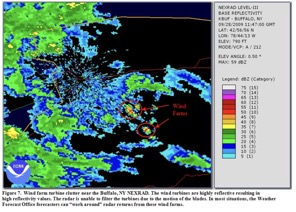
Figure 1: Portrayal of how Wind Turbines can affect Radar Detection
https://www.weather.gov/roc/WindFarms
Rising Electricity Demand and the Need for New Generation Capacity
Rising electricity demand makes the current delay of wind-energy development especially consequential because the U.S. is entering a period in which new generation capacity is becoming an economic necessity, and not simply an environmental preference. The International Energy Agency’s Electricity 2025 report argues that the world is moving into a new “Age of Electricity,” driven by the electrification of buildings, transportation, and industry. The IEA projects that global electricity demand will grow at roughly 4% annually through 2027, shaped by AI-related data-center expansion and electrification.
The United States faces this challenge directly. The Department of Energy’s 2025 resource adequacy analysis estimated that the U.S. will need approximately 100 gigawatts of additional peak-hour electricity supply by 2030, 50 of those gigawatts being attributed to data center demand. The 30-gigawatt freeze therefore has direct implications for AI growth, electrification, and cooling demand.
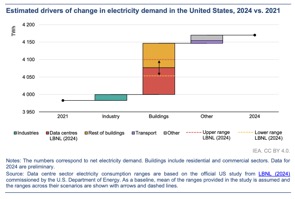
Figure 2: Upper Range Estimates put data centers as the largest driver of electricity demand increases from 2021 to 2024
https://iea.blob.core.windows.net/assets/7c671ef6-2947-4e87-beea-af0e1288e1d7/Electricity2025.pdf
The Economics of Wind Energy
Lazard’s 2025 LCOE+ report found that utility-scale solar and onshore wind remain among the most cost-effective forms of electricity generation. Reuters’ coverage of the Lazard report further noted that onshore wind costs were estimated to be roughly $27 to $73 per megawatt-hour, compared with approximately $48 to $107 per megawatt-hour for new natural gas combined-cycle plants.
Wind’s cost advantage is partly structural. Unlike gas or coal generation, wind has no fuel cost once the project is built. This reduces exposure to commodity-price volatility and makes long-term power costs more predictable. Wind technology has also improved through larger turbines, better siting, higher capacity factors, and more efficient designs. At the same time, new natural gas generation is facing its own pressures. Lazard reported that the cost of building new gas-fired generation has reached a 10-year high, partly because of rising demand for turbines and other equipment, supply-chain constraints, and tightening capacity in the markets. This therefore weakens the argument that blocking wind projects protects consumers from higher electricity costs. If wind development is delayed while gas plants become more expensive and slower to build, the results may be higher long-term system costs rather than greater affordability.
The economics of offshore wind farms present a more mixed picture. For instance, the National Renewable Energy Laboratory’s study on U.S. offshore wind costs from 2025 to 2050 indicates that factors such as inflation, supply chain disruptions, and higher interest rates have increased the costs of offshore wind farms in the near future. However, NREL also projects that in the longer term, wind costs will also decline as deployment expands and turbine sizes increase, and as infrastructure improves. This distinction is important, since the short-term cost pressures are real, but they do not show that wind energy is uneconomic. Instead, they suggest that policy stability, supply-chain development, and scale will strongly influence whether offshore wind becomes more competitive over time.
Additionally, there is evidence that higher wind output can reduce wholesale electricity prices. European power-market data reported by Reuters showed that stronger wind supply has placed downward pressure on spot electricity prices in markets such as Germany. This price effect occurs because wind turbines have a very low marginal cost. Meaning, once the turbines are built, they can bid electricity into wholesale markets cheaply, because they do not need to buy fuel. The implications of this are that wind can help lower market prices during periods of strong output, even though its variability means it must be integrated with storage and backup capacity.
Overall, the economics of wind energy are strongest when wind is understood as part of a diversified power system, rather than as a stand-alone solution. Wind cannot provide all reliability services by itself, and offshore wind continues to face short-term cost challenges. However, onshore wind remains among the cheapest renewable energy sources. For that reason, freezing wind development risks removing a cost-competitive source of new generation at a time when electricity demand is rising, and the grid needs every economically viable supply option.
Grid Reliability and Renewable Integration
Critics of wind energy often point to wind power’s reliance on weather conditions and, therefore, inconsistent output as reasons to limit broader grid reliance on turbines. However, battery storage has emerged as a solution. Texas is the clearest counterexample as the state operates more than 45 GW of wind capacity, but due in part to having 10 GW of battery storage, the Electric Reliability Council of Texas (ERCOT) predicted the state had only a 0.3% chance of rolling blackouts in the summer of 2025. Broadening the scope, U.S. battery storage capacity grew by more than 40% from 2024 to 2025 in the United States to 39 GW.
Furthermore, experts have pointed out that using multiple forms of energy production can mitigate disruptions while allowing for larger reliance on renewable energy. Lazard’s 2025 analysis highlighted that wind, solar, natural gas, nuclear, and battery storage can collaboratively operate. For example, natural gas’s more consistent production can cover gaps in renewable output, while battery storage can capture surplus wind and solar production and release it to smooth over short-term fluctuations. On the flip side, increased renewable reliance can decrease exposure to fossil fuel price volatility. Altogether, a diversified grid mitigates exposure to any one source of production’s weakness.
National Security and Wind Energy
The national security case against wind is narrower than the administration suggests. This argument often assumes that short-term radar and flight path interference concerns surrounding wind energy outweigh the long-term security risks posed by climate change and fossil fuel dependence. However, the Council on Foreign Relations (CFR) has argued that climate change itself is a “serious threat” to U.S. security as it causes extreme weather, droughts, floods, and resource shortages, which in turn cause humanitarian crises, political instability, and conflict. These climate-related disasters can overwhelm domestic disaster-response systems and weaken vulnerable governments abroad, in turn forcing U.S. intervention and straining the U.S.’s armed forces.
In addition, a look at domestic military installations shows one does not need to leave the U.S.’s borders to see how climate change can hinder the armed forces. A Department of Defense study on 79 “priority American domestic military installations” found that 67% of those installations face recurrent flooding problems, while 76% are projected to face future flooding vulnerabilities within 20 years. That same report found that 46% of those military installations are additionally vulnerable to wildfires, which are becoming increasingly severe due to climate change. These vulnerabilities threaten military readiness by increasing infrastructure repair costs, disrupting training operations, and limiting the armed forces’ ability to rapidly respond to crises. Looking beyond the military to the United States at large, according to NOAA, the U.S. sustained 403 weather and climate disasters from 1980 to 2024, where overall damages exceeded $1 billion (including CPI adjustment to 2024). The growing frequency and cost of these disasters place increasing pressure on federal disaster-response systems, state infrastructure budgets, and National Guard deployments.
In addition to being a direct infrastructure threat, climate change can also act as a “threat multiplier,” which means it can act to intensify existing tensions. According to the U.S. Intelligence Community’s 2024 threat assessment, climate-related disasters are increasing risks of migration, conflict, humanitarian crises, and economic instability worldwide. The scale of such displacement is seen in a recent UN report that estimated that climate disasters displaced 250 million people globally over the last decade, averaging roughly 70,000 displacements per day. Large-scale displacement can increase regional instability, intensify border pressures, and heighten the likelihood of humanitarian and military intervention. This creates a long-term national security concern because instability abroad can increase demands for U.S. military involvement, humanitarian aid, and border-security responses.
Wind energy can help address these risks by lowering greenhouse gas emissions. Wind energy’s lifecycle emissions are often 90–99% lower than those of fossil fuels. Furthermore, wind can strengthen energy independence by reducing dependence on imported fossil fuels and vulnerability to shocks to global energy markets, such as the one experienced by oil since the Iran-US conflict. Because wind energy relies on domestic natural resources rather than internationally traded fuel supplies, it is less vulnerable to geopolitical disruptions or global oil-price volatility. As a final point, distributed renewable-energy systems can also improve grid resilience during natural disasters or cyberattacks by reducing dependence on centralized fuel infrastructure.
The argument for wind energy weakening national security tends to narrowly focus on radar interference and military flight-path concerns. However, when national security is broadened to reflect other threats such as grid reliability, infrastructure resilience, energy affordability, protection from fuel-price volatility, climate stability, and disaster preparedness, renewable energy development, such as wind, may actually strengthen long-term national security.
Counterarguments and Limitations
Opponents of wind-energy expansion argue that turbines can interfere with radar and low-altitude flight paths. Specifically, according to the Department of Energy, turbine blades have the ability to reflect electromagnetic signals and interfere with radar detection. These risks are the ones the Trump Administration cited when it froze approval for the 165 onshore wind projects. However, the Department of Energy also notes that federal agencies are already deploying mitigation strategies such as upgrading radar software, adjusting where turbines are placed, and improving how radar signals are processed. Furthermore, interagency coordination, as seen by the DOE, Department of Defense, FAA, NOAA, DHS, and BOEM jointly operating the Wind Turbine Radar Interference Mitigation Working Group, has been improved specifically to address radar and flight path interference from turbines without needing to halt wind-energy expansion.
Another common argument is that wind energy is dependent on weather conditions and therefore does not create a constant electricity output. For this reason, wind requires backup generation and energy storage systems to reliably power electrical grids. However, as addressed in the reliability section, Texas demonstrates that storage integration can contain reliability risks even at scale.

Figure 3: The U.S. sustained 403 weather and climate disasters from 1980–2024, where overall damages/costs reached or exceeded $1 billion
https://www.ncei.noaa.gov/access/billions/
Conclusion
As AI-driven data centers and electrification increase electricity demand, the U.S. must be able to generate an ever-increasing amount of energy to support economic growth. Under these circumstances, delaying large amounts of wind generation is not merely a stance on climate policy, but raises questions about affordability, grid reliability, and national security. Onshore wind has become increasingly cost-effective, especially as rising costs and supply constraints have increased the cost of new natural-gas infrastructure. Although wind energy cannot solve the country’s future energy demands alone, restricting a major source of potential generation may hinder supply growth and increase costs at a time when the grid requires additional capacity.
Concerns about wind energy’s radar interference and reliability are legitimate, but point to a need for storage expansion, backup generation, and careful grid planning rather than a halt to expansion. Furthermore, the broader national-security discussion should also consider more long-term risks of climate-related disasters, infrastructure vulnerability, fuel-price volatility, and dependence on globally traded fossil fuels as opposed to the immediate flight path and radar hindrance. The evidence points toward integration over restriction: expanding storage, refining siting, and upgrading radar mitigation rather than halting deployment.
Data Sources
- Reuters — U.S. Wind Project Freeze Affects 165 Projects
- Council on Foreign Relations — Climate Change and National Security
- Department of Energy — Mitigating Wind Turbine Radar Interference
- IEA-Electricity 2025 Report Charts
- U.S. Department of Energy — Resource Adequacy Report (2025)