
The Incoming Storm
Since late 2025, El Niño has been an increasingly dominant force in global economic discussions. Once confined largely to a meteorological footnote, it has now become a line item in central bank communications, commodity outlooks, and investor discussions as they race to price its impact on inflationary curves.
Impact on Fixed Income in Colombia
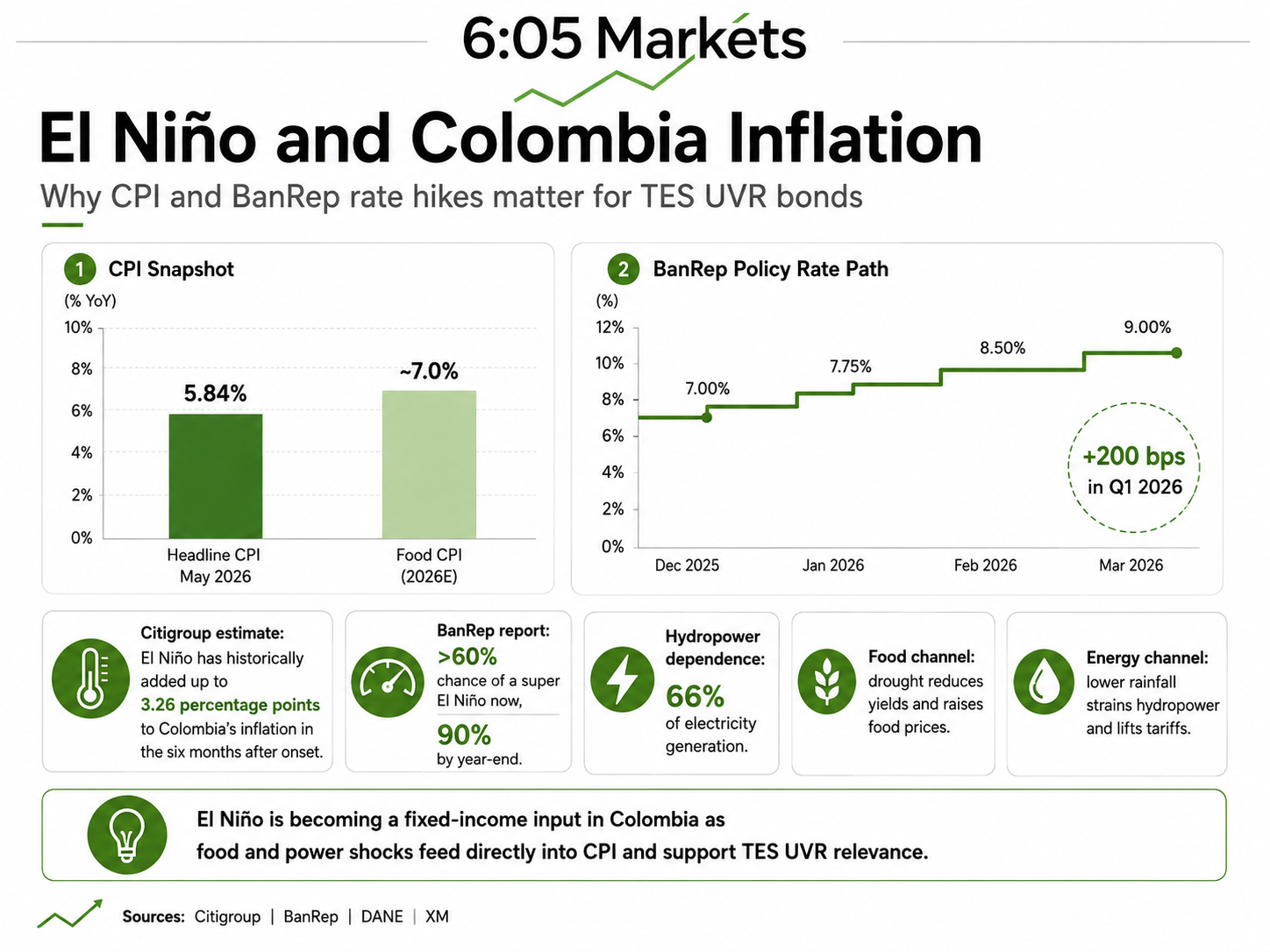
At first glance, El Niño seems like a distant, unrelated topic for a central bank's agenda. But for fixed-income economists, it's become a genuine input, and the same holds for Colombia. Citigroup research estimates the event has historically added as much as 3.26 percentage points to the country's inflation in the six months following onset, with cumulative increases in food inflation during severe episodes.
A recent BanRep report estimates an above-60 % chance of a super El Niño developing, rising to 90% at year's end, which would further exacerbate inflationary pressures from agricultural and energy supply shocks. For Colombia, extreme droughts are a detrimental transmission channel into inflation. Drought conditions create a domino effect by reducing agricultural yields across key growing regions, driving food price volatility. A limited agricultural supply and rising input prices weigh on the Consumer Price Index (CPI). The second channel is energy. Colombia generates roughly 66% of its electricity from hydropower, meaning reduced rainfall directly strains reservoir levels, increases reliance on costlier thermal generation, and pushes regulated energy tariffs higher.
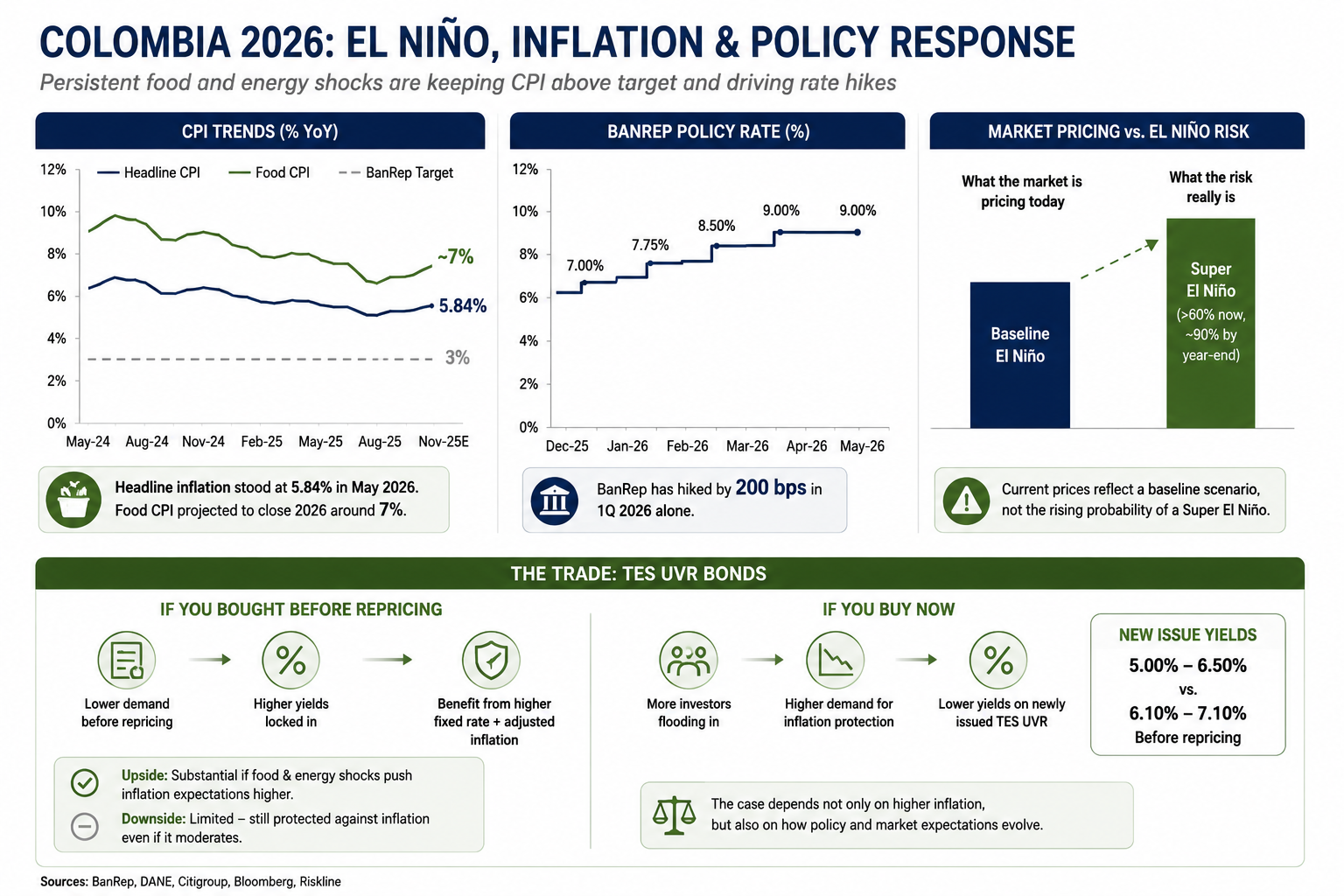
Together, these two channels feed directly into and drive the CPI basket that BanRep has had difficulty controlling, which was originally set at a 3% inflation target. Now, headline inflation stood at 5.84% in May 2026, with food CPI projected to close the year at around 7%, and the central bank has already hiked by 200 basis points in the first quarter of 2026 alone. This is important regarding the TES UVR bond, Colombia’s CPI-linked bond, which tracks the UVR, Colombia’s inflation-adjusted unit.
Sources: Citigroup | BanRep | DANE | XM
The TES UVR Bond
The TES UVR bonds are denominated in UVR—the Unidad de Valor Real inflation-adjusted unit of account that updates daily in line with CPI. Unlike other fixed bonds, TES UVR indexes the principal to the UVR, meaning the bond's value adjusts upward as inflation rises, preserving the holder's real purchasing power.
In an environment where inflation is already running high, the bond has become an instrument of interest. With a supply shock on course, it has become even more attractive. BanRep’s report shows that breakeven inflation derived from public debt securities has risen across all maturities since January. With the two-year breakeven sitting above 6%, more than double the central bank’s target.
Although the numbers are above the typical range, they reflect normal temperatures and are not even close to indicating a potential Super El Niño. If the phenomenon materializes at the intensity now being forecast, breakevens have further to move. Historical precedents, such as in 2015, amongst the strongest El Niño events, show that food inflation spiked, peaking at nearly 12% mid 2016, with effects felt roughly six months post-event.
Sources: BanRep, DANE, Citigroup, Bloomberg, Riskline
The Trade
This produces an asymmetry. Inflation expectations in Colombia have already moved throughout 2026, reflecting persistent increases in food inflation and growing concerns surrounding El Niño as it edges closer. However, current market prices do not fully reflect the magnitude of the inflationary risk posed by a potential Super El Niño event. As of now, it is pricing the baseline El Niño scenario, even as consensus is rising that a stronger one is no longer far-fetched.
For investors who entered TES UVR positions before the recent repricing in inflation expectations, the outlook appears favorable. Before the repricing, demand was lower, and thus, yields were higher. When El Niño hits, those already holding will continue benefiting from the higher fixed rates locked in before the repricing, while also receiving the adjusted inflation rate. As demand for inflation protection rises, newly issued TES UVR securities are likely to offer lower yields than those available before repricing, as stronger demand pushes prices higher and compresses yields. The downside is relatively limited; should inflation moderate, nominal TES holders would yield back more, but those investors would still be safe against inflation. At the same time, the upside remains substantial if food and energy shocks push inflation expectations materially higher.
For prospective investors, however, the opportunity becomes less straightforward. Although there is still time to establish positions in these bonds, more investors are flooding into the market and taking advantage of it, too. The newly issued TES UVR securities, regardless of maturity, have had lower fixed coupon rates and yields in the range of 5.00% to 6.50%, compared to the previously observed 6.1% to 7.1%. Although the bps decrease seems small, demand is not.
The case to add these securities to one's portfolio, therefore, depends not only on whether inflation rises, but also on how monetary policy and market expectations evolve in response.
Conclusion
El Niño is a forming reality that the market baseline is yet to incorporate into Colombia’s rising inflation. The market continues to treat the phenomenon as a temporary disturbance, despite historical evidence to the contrary. The storm is coming, and each cycle has the potential to be more disruptive. And whether it is as strong as forecasts or stronger, the TES UVR market is not fully priced. For those already positioned, the thesis is unfolding. For domestic investors and those with investments in Colombia, the window is narrowing, but the chance still remains.
Data Sources
- BBC — El Niño under way and threatens weather extremes, scientists say
- Imperial — What is El Niño and how is it influenced by climate change?
- Colombia One — El Niño Could Push Colombia’s Inflation Up by 3.26 Points
- BanRep — Monetary Policy Report
- Ministerio de Hacienda y Crédito Público — Informes TES 2026