
The Dilemma
Japan spent decades trying to create inflation while fighting severe deflationary pressures. Now, it faces a fundamental dilemma, and as one of the world's largest creditors, global bond markets are beginning to feel it.
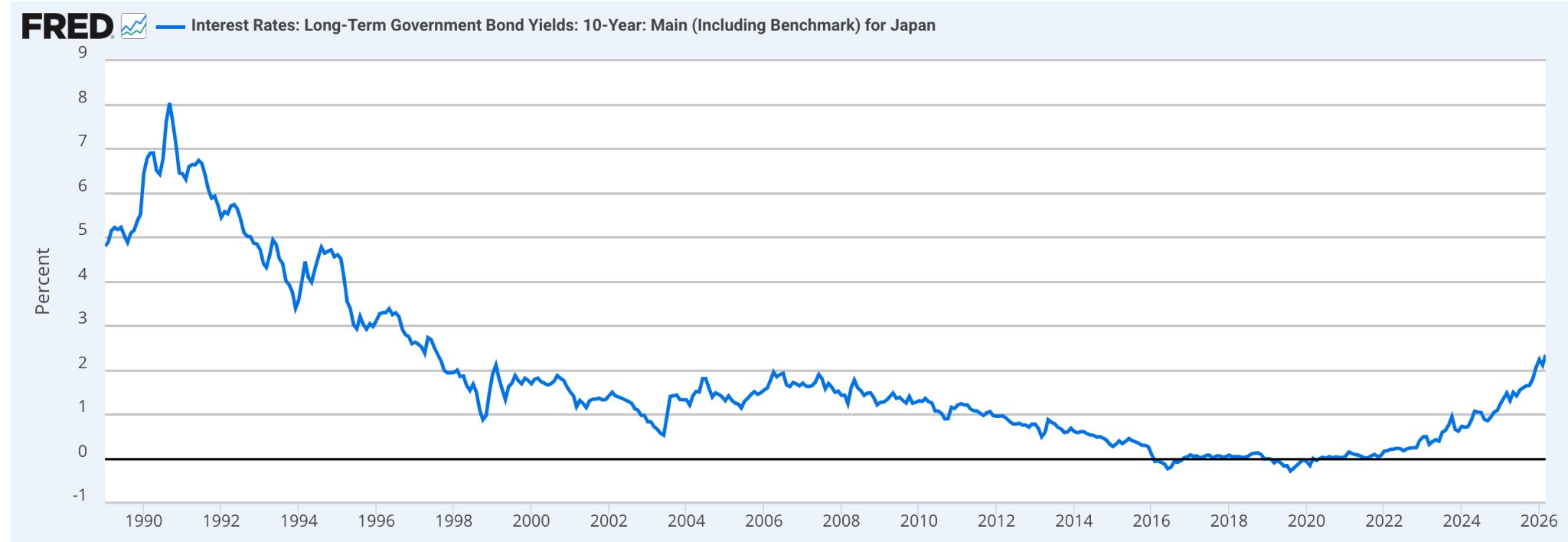
As of May 14, 2026, Japanese Government Bonds (JGBs) have experienced a sharp shift in yields, marking a fundamental break from three decades of near-zero rates and reaching 2.63%. Japan maintained near-zero and even negative interest rates due to the Bank of Japan's (BOJ) aggressive monetary policy, aimed at combating the country's persistent deflation and stimulating economic activity following the collapse of the Japanese asset bubble in the early 1990s. As inflation and wage growth continue to rise, the BOJ faces an impossible choice: allow yields to normalize, risking a domestic banking crisis, or suppress them once again, risking imported inflation through further yen depreciation.
30 Years of Stillness
Japan's deflationary era did not come overnight. Following Japan's post-war economic boom in the 1970s, Japanese economic growth gradually slowed as the high-growth recovery phase from the war naturally matured. In response to the negative impacts of the overvalued US dollar on US exports, in 1985, the Plaza Accord was enacted as a defensive measure to depreciate the US dollar against the Japanese yen and the German Deutsche mark.
There were, however, fears in Japan that a weakened dollar relative to the yen would reduce the country's exports; hence, the BOJ cut rates as part of its monetary easing, a decision later seen as a major contributing factor to the asset bubble. The bubble economy led to a massive economic boom in the 1980s, driven mainly by real estate and stock market speculation. Lower rates meant borrowing became cheap, so banks lent aggressively, and as debt in Japan grew due to these reckless loans backed by inflated collateral rather than economic activity, it reached its peak in 1989, with real GDP expanding at around 6%.
As asset prices soared and speculation intensified, the BOJ became concerned about the sustainability of the bubble. So, the central bank raised rates from 2.5% in 1989 to 6% in 1990 to ease this monetary overheating. The impact was devastating, with the Nikkei 225, the stock market index for the Tokyo Stock Exchange (TSE), falling by over 60% by 1992, ushering in what would be known as Japan's "Lost Decades."
By 1998, Japan entered a deflationary period following the non-performing loan crisis, financial institution bankruptcies, the 1997 consumption tax hike, and the Asian currency crisis. In response, the BOJ pursued increasingly unconventional measures over the following decades, culminating in Abenomics, the economic program launched in 2013 by Prime Minister Shinzo Abe to revive Japan's stagnant economy. Under this framework, the BOJ inflated asset prices, introduced negative interest rates, and implemented yield curve control, committing to buy unlimited quantities of JGBs to keep the 10-year yield pinned near zero and removing price discovery from the world's second-largest government bond market.
Chart 1: Japan 10-Year Government Bond Yield Historical Data
Source: Organization for Economic Co-operation and Development via FRED®
https://fred.stlouisfed.org/series/IRLTLT01JPM156N
The JGB Market Unravels
In 2024, post-pandemic inflation and BOJ rate hikes brought back actual, moving interest rates, reviving volatility in a market that had been suppressed for years. With this stabilization in Japan, the BOJ ended yield curve control by pausing its aggressive JGB repurchase program, raising the short-term rate to 0.75%, and allowing 10-year JGB yields to move freely for the first time in nearly a decade. This shift has started a sharp re-pricing across Japan's fixed-income market. However, normalization in Japan has been much faster than the BOJ expected, pushing the 40-year JGB yield to over 4.24%, the first time it has breached the 4% threshold in over three decades.
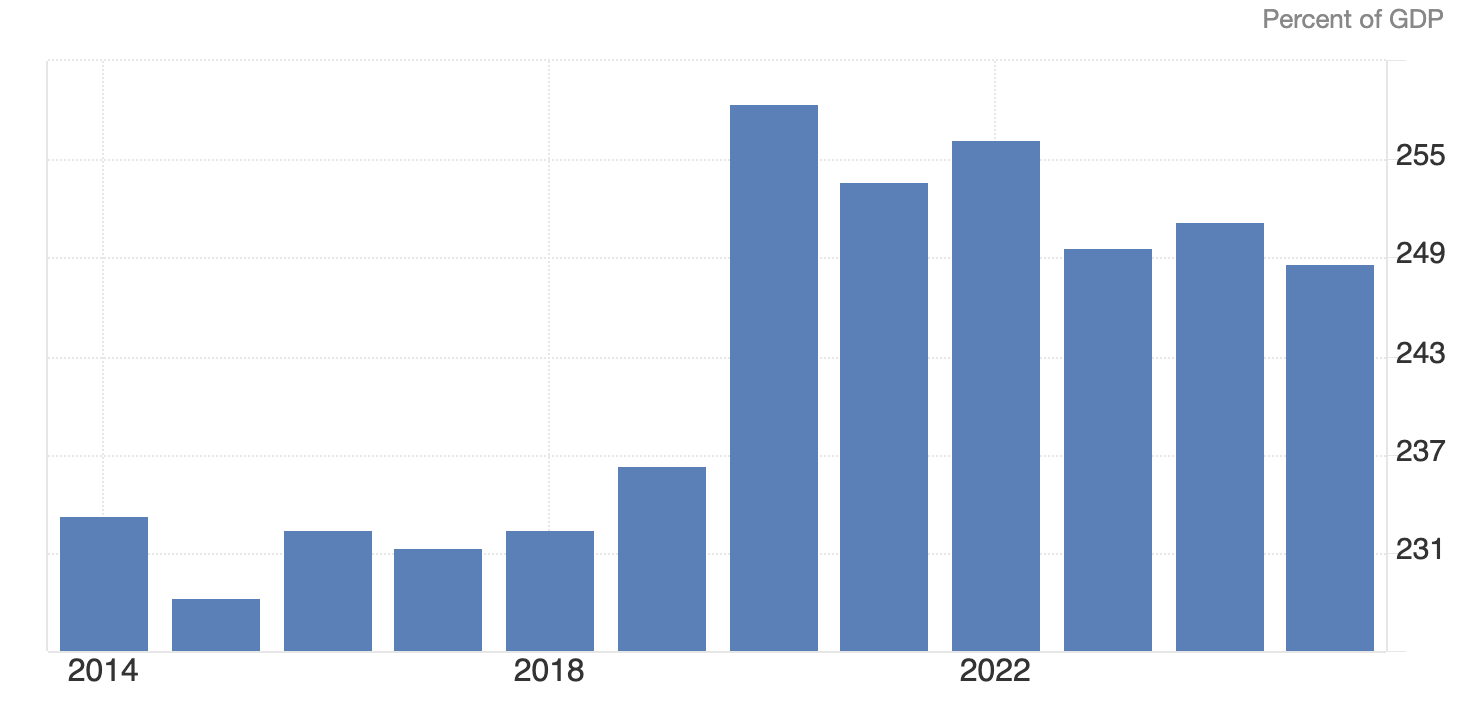
Prime Minister Sanae Takaichi's approval of the ¥21.3 trillion ($135.4 billion) stimulus package, alongside the Iranian oil shock, was the main factor accelerating JGB yield normalization and pushing Japan away from a gradual adjustment. Markets reacted negatively immediately; the yen fell to 10-month lows, and super-long JGB yields hit record highs amid concerns about fiscal sustainability. The spending package was large enough to change how markets viewed Japan's debt risk. The jump in general account outlays to ¥17.7 trillion from ¥13.9 trillion the previous year, combined with the possibility of additional bond issuance, supports concerns that Japan could face a debt trap as borrowing costs rise.
The Iranian oil shock significantly compounded this pressure. As a nation dependent on energy imports, Japan is facing the full force of rising oil prices, which feed directly into inflation and, in turn, into the yields the government must pay to service its debt. Additionally, in April 2026, the BOJ raised its core inflation forecast from around 2% to 2.8%.
The Repatriation Begins
As one of the world's largest net creditors, Japan is the top non-US holder of U.S. debt, with Japanese investors and institutions collectively holding approximately $1.24 trillion in U.S. Treasury securities. Japan's previous near-zero JGB yields incentivized Japanese investors and institutions to seek higher returns abroad, particularly in U.S. Treasuries.
As JGB yields increase, Japanese bonds become more attractive, incentivizing Japanese investors to repatriate capital to domestic markets, sell US Treasuries, and push US borrowing costs higher, thereby simultaneously re-pricing the global fixed-income market.
This repatriation dynamic is already evident, as investors sold $21.8 billion in foreign bonds by February 2026 and redirected funds toward newly issued JGBs. As Japanese investors divest from overseas bonds, especially U.S. Treasuries, they increase supply in the world's largest and most important bond markets, pushing prices down and raising yields. Consequently, the U.S. faces higher borrowing costs, as the government must offer increased yields to attract debt purchasers.
The impact extends beyond U.S. government bonds. U.S. Treasuries function as a benchmark for global borrowing costs, so rising Treasury yields can influence other segments of the financial system. This dynamic generates a broader repricing effect across global bond markets. For instance, securities such as Brazil's NTN-Bs may also face downward price pressure as investors seek higher yields amid shifting global rates.
No Clean Exit
This leaves the Japanese central bank in a precarious position, forced to choose between two unsustainable alternatives.
If the BOJ allows yields to keep rising to facilitate normalization, it risks a banking crisis driven by loan losses, as higher rates could trigger a negative corporate credit cycle. While rising yields would eventually benefit banks through the recapitalization of the banking sector, the transition can be quite difficult for the existing credit portfolio, where the bond portfolio loses value faster than new, higher-yielding ones can replace it. Rising yields make newly issued JGBs more attractive than those with near-zero coupons. Japanese banks hold large portfolios of these near-zero-yield JGBs whose market value falls sharply as rates rise, so selling them locks in losses, while holding them generates almost no return. As of the end of 2025, major life insurers are facing an estimated $86 billion in combined unrealized losses, underscoring the scale of this decision and the potential for a domestic crisis. If yields continue rising, the result of this crisis would choke credit and government spending simultaneously, leading to a period of contraction and paving the way for deflation again.
The other option would be to suppress yields by resuming bond purchases. If the BOJ resumes its bond-buying to raise bond prices, it injects more yen into the JGB market, weakening the currency. This makes imports more costly than they were previously. As a nation dependent on importing most of its energy, the same quantity now costs many more yen, directly raising the cost of living for Japanese households. This diminishes household purchasing power and increases inflation within the country. This path would be unsustainable for Japan, as at the current forecast rate of 2.8%, it cannot afford more pressure on its economy, and with consumer spending collapsing, it risks tipping Japan back into the deflationary period it sought to escape over the last three decades.
Ironically, two distinct paths lead to the same destination: deflation. A banking crisis would choke credit and government spending. Suppressing yields would destroy purchasing power, crush demand, and intensify inflationary pressure. Thirty years of monetary experimentation, and Japan finds itself with no clean exit.
Chart 2: Japan Government Debt to GDP
Trading Economics — Japan Government Debt to GDP
Source: Ministry of Finance, Japan via Trading Economics. Data from 1980 to 2024.
Data Sources
- Trading Economics — Japan 10 Year Government Bond Yield
- Nomura — Japan's Three Lost Decades – Escaping Deflation
- AEI — Japan's Bond Market Matters for the US Economy
- Reuters — Japan's cabinet approves lavish stimulus as markets fret over Takaichi's fiscal policy
- S&P Global — Economic Research: Japan's Higher Interest Rates Are Here To Stay, And That's OK
- US Congress — Foreign Holdings of Federal Debt
- Japan Society — The Bubble Economy and the Lost Decade
- CNBC — Bank of Japan keeps policy rate steady while raising inflation forecast on Iran war worries