Introduction
On August 19, 2026, Treasury Secretary Scott Bessent announced Treasury would at least double its buybacks of long-dated debt, aiming to push down yields, which have hit a roughly 20-year high. The idea is to ensure the government purchases its own outstanding debt from the market, which raises demand and, therefore, bond prices. This mechanically lowers the yield, which relies on the bond price; the higher the price, the lower the yield.
The reason behind this decision is clear. The total US public debt outstanding has reached a record high, passing the $40 trillion mark, double what it was in the last decade. This prompts Bessent’s plan to use debt management to shave off basis points from these long-term yields. But he doesn’t act alone; monetary policy, set independently by the Fed, plays just as large a role in increasing or reducing the yields. And lowering rates isn’t on the Fed's current agenda.
The 1951 Accord
During the Second World War, the Fed and the Treasury agreed, at the Treasury's request, to keep short-term interest rates low at 3/8 percent (0.375%) and long-term rates at 2.5% to finance the war effort. Post-war, however, the situation changed: policymakers feared a new Great Depression, yet the Treasury insisted on continuing cheap financing. The War had pushed federal debt to 106% of GDP, a level not matched until recently.
By February 1951, inflation had reached an annualized rate of 21%, and the Fed had no choice but to end its deal with the Treasury to limit rates, so it could hike them and stabilize inflation again. This led to the separation of monetary policy and debt management, where the Fed and Treasury could use their own techniques to manage their own situations.
The Present Day Dilemma
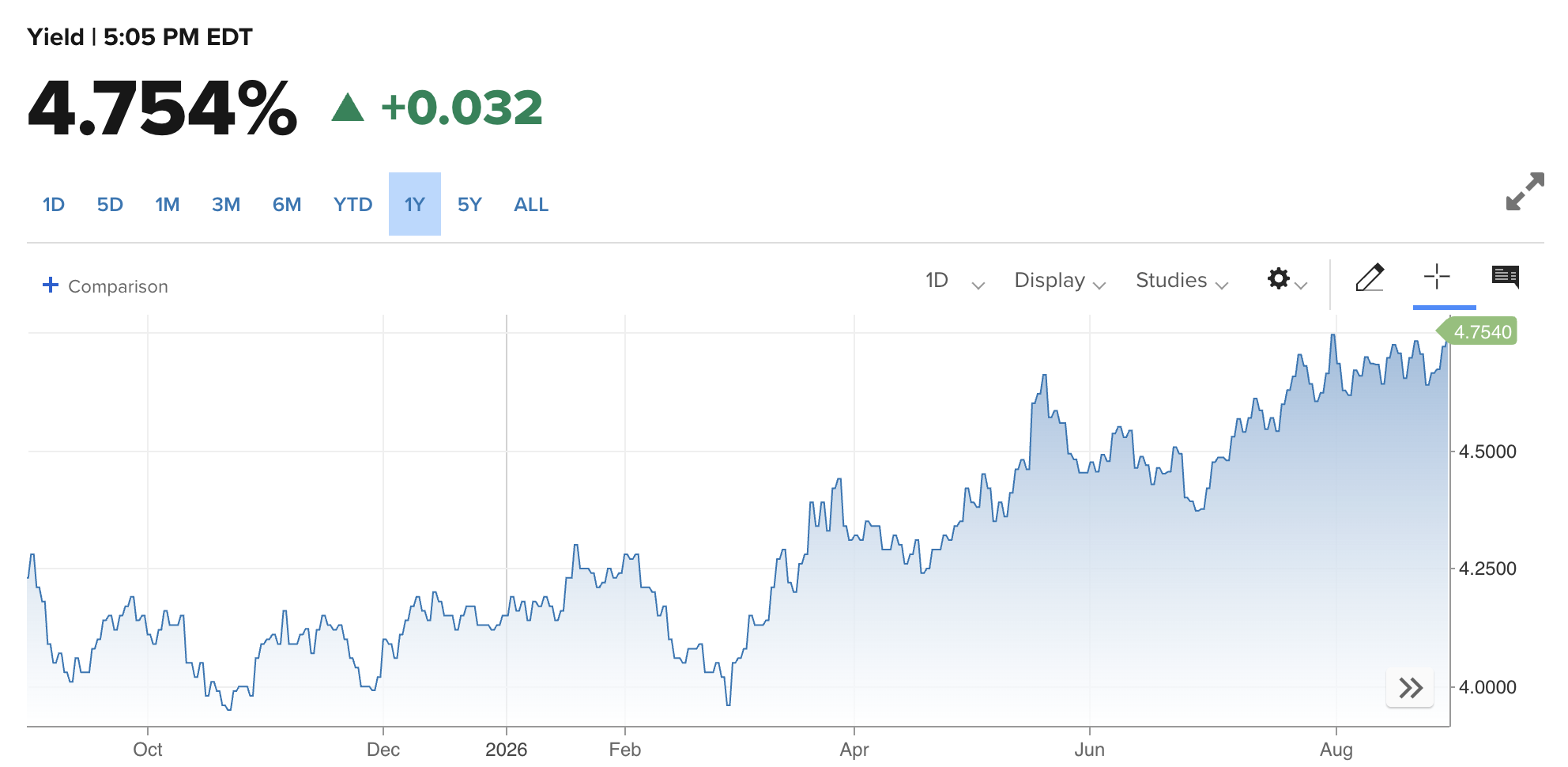
Seventy-five years later, a similar tension is resurfacing. This time, however, no war effort forces a deal between the two parties. Bessent doubled the Treasury's buybacks of long-dated debt to push down yields, which are at a roughly 20-year high, using the same basic lever: buying government bonds to lower their yield- that the Fed once used to hold rates down for the Treasury during WWII. From September 2025 to the end of August 2026, the yield on the US Treasury 10-year bond clearly increased, rising from 4.23% to 4.75%. This further defended Bessent’s decision to take a more aggressive approach to lowering these rising rates.
However, in his August 28, 2026, speech at the annual Jackson Hole Economic Policy Symposium, Federal Reserve Chair Kevin Warsh said the Fed still had “work to do,” according to him, to reach its 2% inflation target. Banks such as Barclays considered the speech “notably hawkish,” as they believe the Fed will still deliver two 25-basis-point rate hikes by the end of this year to continue lowering inflation from its July level of 3.7% PCE to the original target set at the start of the year.
In his speech, Warsh didn’t specifically mention the Treasury’s plans but indirectly pushed back against exactly that kind of intervention. He cautioned against a "regime in which market participants are looking primarily to the Fed for their next trade," a line widely read as aimed as much at Bessent's efforts to manage yields as at the Fed's own communication habits. This highlights the contrasting stances of the Treasury and the Fed on how to address their problems: while the Treasury is trying to intervene and mechanically lower long-term yields through bond buybacks itself, the Fed remains focused on controlling inflation and ensuring monetary policy continues working independently.
What does this mean in the long end?
A divergence in stances by the Treasury and Fed shows an incoming tug-of-war between fiscal management and monetary policy. The market is in for a fundamental economic tension, one where long-term interest rates would be uncertain due to opposing government interventions. This would be a problem for the Treasury as this conflict creates the risk that investors lose confidence in the credibility and independence of U.S. economic policy, demand greater compensation for holding long-term government debt, and ultimately push long-term yields even higher.
Investors should watch the signals in the months ahead involving the buybacks beyond their current $4 billion ceiling. If this happens and the ceiling is raised, it would show this is not temporary but a sustained structural shift involving government intervention to ensure the US manages its debt.
For investors, in the Bull case that the buyback works and rates fall, this creates an attractive government-defended window to lock in high interest rates. However, in the Bear case brought up by investors such as Stanley Druckenmiller of structural inflation, and hence fiscal dominance takes hold, which creates a risk since the Treasury is set to issue $740 billion of new debt by the end of the third quarter, far more than the $4 billion buybacks can offset, and this would make rates end up hiking instead of going lower. Hence, investors must continue being attentive to better understand the fiscal situation and the bond market, seeing whether now is the right time to make the purchase or to wait for a later date if it appears the Treasury will be unable to reduce the bonds or the Federal Reserve policies end up creating volatility in the long-term yield.
Data Sources
- The Wall Street Journal — Bessent’s Moves Test Boundaries Between Treasury and Fed
- BBC News — US National Debt Passes $40tn After Doubling in a Decade
- Federal Reserve History — The Treasury-Fed Accord
- Council on Foreign Relations — The National Debt Hit $40 Trillion, But It’s Not an Issue in the Midterms
- Reuters — Barclays Sees Two More Fed Rate Hikes This Year After Warsh Speech
- Trading Economics — United States Inflation Rate
- CNBC — U.S. 10-Year Treasury Yield
- Federal Reserve Board — In Our Time
- Seeking Alpha — Don’t Let the Bond Market Spook You