Introduction
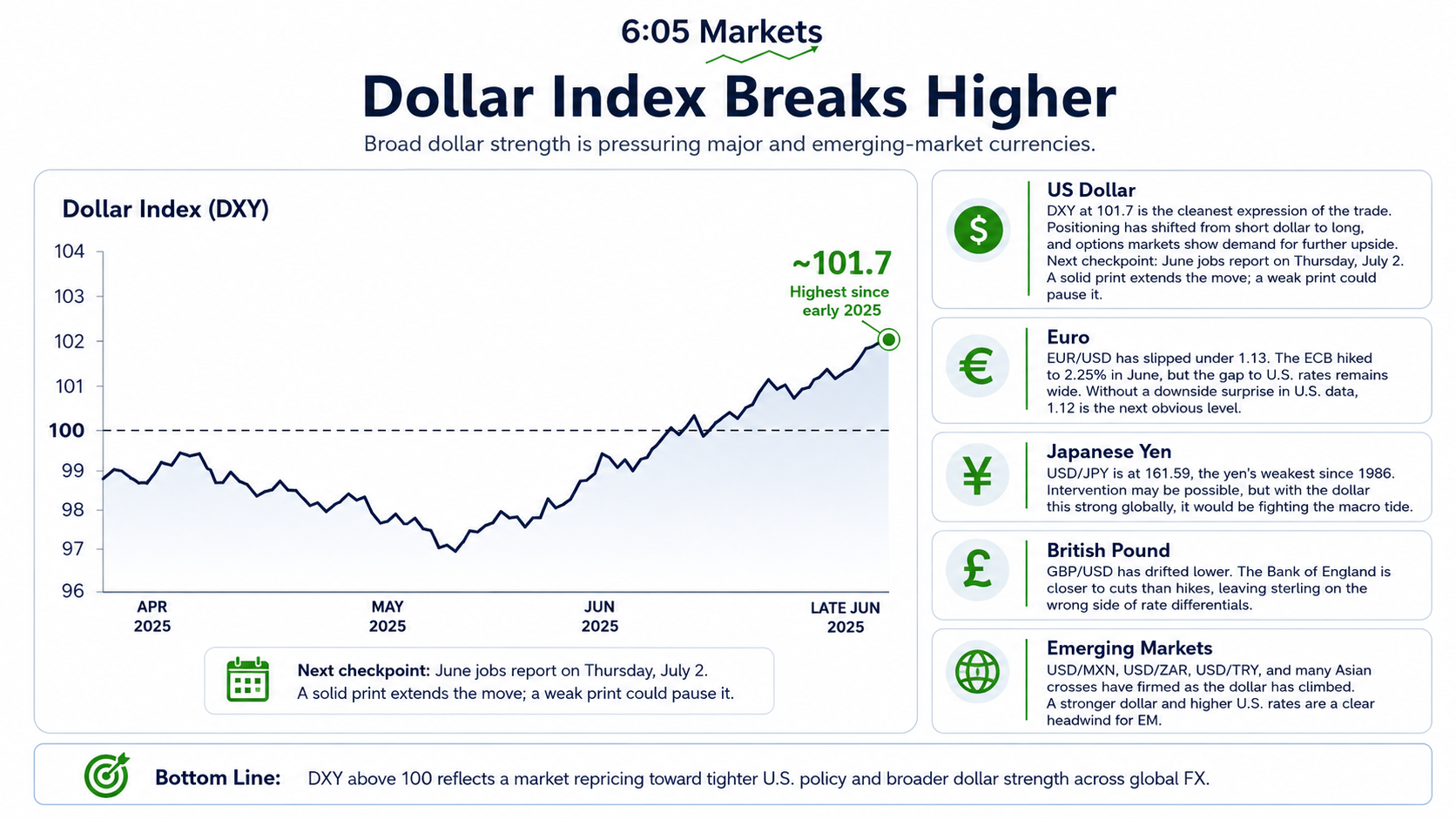
The Dollar Index has pushed back above 100 and reached roughly 101.7 this week, its highest level since early 2025 and its strongest run in more than a month. The catalyst was a complete repricing of what the Fed will do next. After the May consumer price index came in at 4.2% on the back of an energy shock, traders went from expecting rate cuts to expecting rate hikes. The Fed's June 17 meeting confirmed the shift. Every other major currency is now being measured against a dollar that suddenly looks like the strongest currency in the world again.
What Happened
The Dollar Index, which had spent most of the spring drifting in the high 90s, broke back above 100 in mid-June and has now climbed to around 101.7. That is the highest reading since early 2025 and the strongest sustained run for the dollar in more than a month. The move has been broad, with the dollar firmer against the euro, yen, pound, and most emerging market currencies all at once.
The trigger was the May US inflation report. Headline CPI came in at 4.2%, the highest since 2023, driven mainly by the spike in energy prices that followed the disruption in the Strait of Hormuz. Within days, the Fed funds futures curve were repriced. Odds of a September rate hike jumped to roughly 68%, up from just 29% a week earlier. The market that had been pricing cuts a month ago is now pricing the opposite move entirely.
The Fed's June 17 meeting, the first under new Chair Kevin Warsh, sealed it. The committee held rates at 3.50 to 3.75%, but the statement and press conference signaled clearly that the cutting cycle is on hold and that the next move could go either way. Warsh did not commit to a hike, but he did not rule one out, and that was enough to lock in the dollar bid.
Why It Happened
Three forces lined up. The energy shock from the Hormuz disruption pushed crude well above $100. That alone was enough to push CPI to a level the Fed could not ignore.
The second reason is sticky services inflation. Wage growth and shelter prices have not cooled the way the Fed expected earlier in the year, so even stripping out the energy spike, the underlying picture argues against cuts.
The third reason is the change in position. Chair Warsh, who took over earlier this year, has a more hawkish reputation than his predecessor. The market has adjusted its priors about how this Fed will react to any inflation surprise.
The combination flipped the rate-cut trade on its head. Positions that had been built around dollar weakness in the second half of the year have been unwound aggressively. The unwind is part of what is showing up in the price action.
Currency-by-Currency
US Dollar
DXY at 101.7 is the cleanest expression of the trade. Speculative positioning has shifted from short dollar to long, and option markets show traders paying up for further upside. The next checkpoint is the June jobs report being released on Thursday, July 2. A solid print extends the move, while a weak one is the only thing in sight that could pause it.
Euro
EUR/USD has slipped under 1.13. The ECB hiked to 2.25% in June, but the gap to US rates is still wide and the eurozone growth picture is soft. Every dollar repricing pulls EUR/USD lower. Without a downside surprise on US data, 1.12 is the next obvious level.
Japanese Yen
USD/JPY is at 161.59, the yen's weakest since 1986. The dollar's broad strength is the main driver. The April 30 intervention drew a line at 160, and that line is now well behind us. Tokyo has two more IMF-compliant intervention windows before November. However, with the dollar this strong globally, any intervention now would be fighting the macro tide rather than just speculative excess.
British Pound
GBP/USD has drifted lower. The Bank of England is closer to cuts than hikes, which leaves sterling on the wrong side of the rate-differential story. The pound has held up better than the euro, but only marginally.
Emerging Market Currencies
EM has felt the squeeze. USD/MXN, USD/ZAR, USD/TRY, and most of the Asian crosses have firmed as the dollar has climbed. A stronger dollar paired with higher US rates is the textbook headwind for EM, and it is showing up clearly this week.
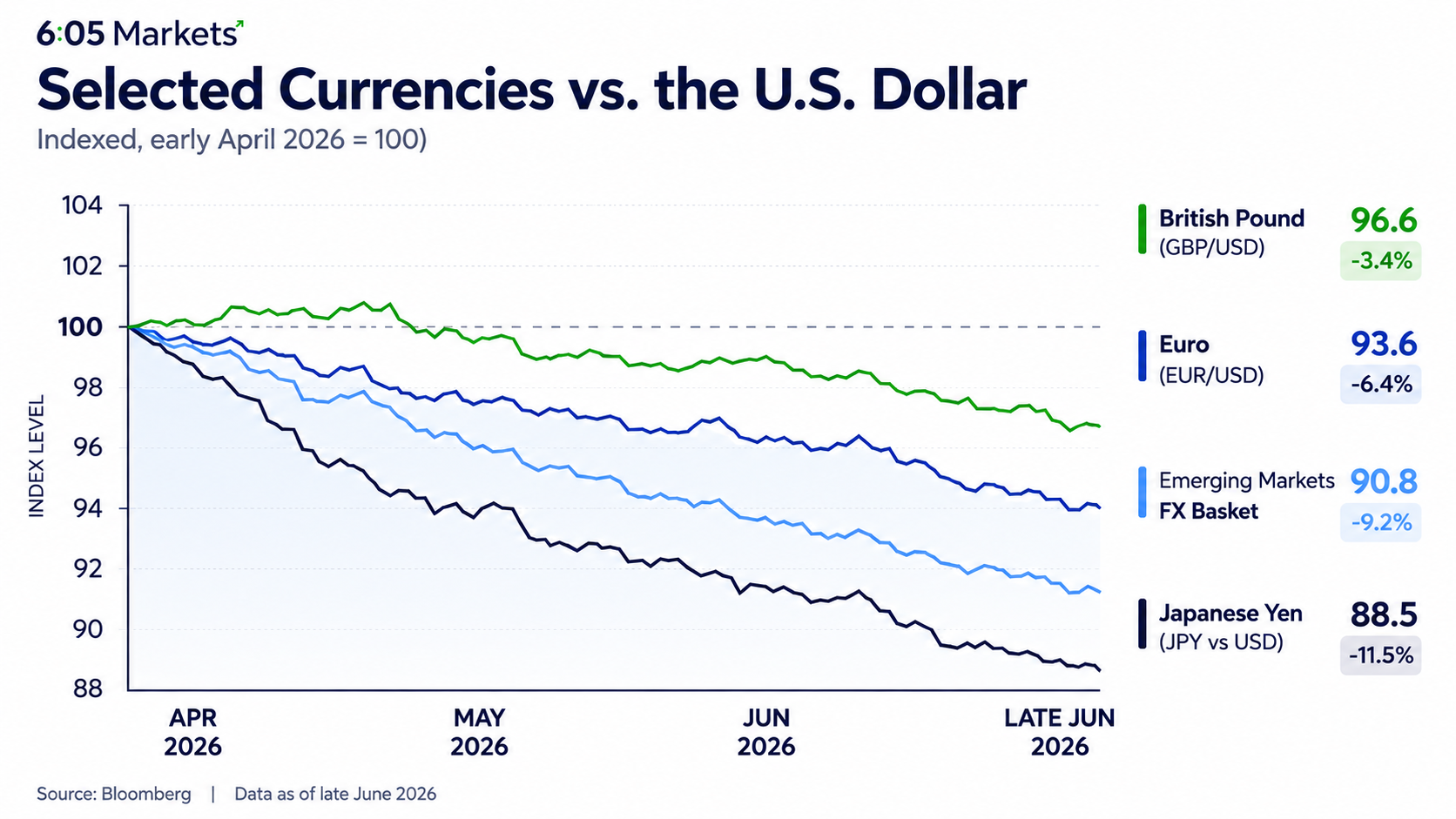
Source: Bloomberg | Data as of late June 2026
Why This Matters
A dollar at 101.7 with rate-hike odds at 68% changes the playbook. It puts central banks that have been hiking in a difficult position because their own moves are being overshadowed. It tightens financial conditions globally without the Fed doing anything. And it pushes commodities priced in dollars, including the same oil that started this chain, into a more complicated path from here.
For Tokyo specifically, the dollar's strength means the yen problem is no longer mainly about the BoJ being slow. It is now about the Fed being too tight. That makes intervention much harder to justify and much less likely to work.
Soft Payroll, Dollar Gives Back the Move
Sub-100k jobs, higher unemployment, and softer wages would knock the September hike trade. DXY pulls back into the high 99s, EUR/USD bounces toward 1.15, and USD/JPY can finally ease into the 158 to 160 range. This is the only scenario in sight that breaks the dollar rally cleanly.
Overall View
The dollar has gone from a currency the market was preparing to short into the second half to the strongest major in the G10 within a few weeks. The trigger was 4.2% CPI and the catalyst was the Fed under Warsh signaling it is done cutting. The result is the US Dollar Index is at 101.7 and most other currencies are under pressure. Until US data softens or oil pulls back, the path of least resistance is more of the same.
Data Sources
- US Federal Reserve — June 17, 2026 FOMC statement and press conference
- US Bureau of Labor Statistics — May 2026 CPI report, headline 4.2%
- CME FedWatch — September FOMC implied probabilities
- ICE — US Dollar Index historical and current levels
- Trading Economics — USD/JPY 161.59, June 26, 2026
- MUFG Research — FX Daily Snapshot, June 26, 2026