
Introduction
As wind becomes a necessity in Europe, the main bottleneck is that generation does not guarantee delivery. To understand the logistics behind Wind Energy’s bottleneck it is useful to look at England.
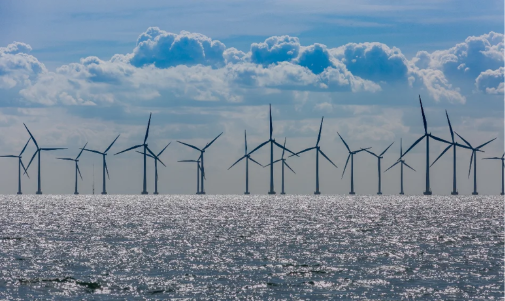
England is rapidly producing offshore wind farms.
Two hundred kilometers east of Yorkshire, England, is the world’s largest offshore wind farm, Dogger Bank, spanning nearly 9,000 square kilometers of seabed. It’s larger than Greater London and is planned to produce 3.6 GW, which is equivalent to approximately 2 large coal plants, and power 6 million homes (roughly 20% of the UK households).
The farm is split into three different sections: A, B, C. Each section corresponds to power loads of 1.2 GW. As of now, section A is the only operational segment of the farm. Section B and C are currently under-construction.
England is building a massive offshore wind energy fleet. Across the entire North Sea, there are dozens of operational wind farms.
Generation does not guarantee delivery
Wind energy is produced when a generator converts the kinetic energy of a wind turbine into electricity. This electricity is then funneled through inter-array cables that run along the seabed, eventually reaching a central offshore substation. Here the voltage of the electricity is pumped up to a much higher level, typically around 300 kV. The higher voltage of the electricity gives the stream of electricity a lower effective current which in turn reduces the energy lost to heat in its succeeding journey to the grid.
To transport the now hyper-charged electricity to the mainland, these windfarms use segments of what they call the “subsea superhighway”. Made of a vast network of insulated copper and aluminum covered subsea cables that run along the ocean floor, the electricity is transmitted through high-voltage subsea cables. When these cables approach the coastline, they bring energy to the grid by buried land-fall connections. Here, the electricity enters the national English grid system and faces its fundamental bottleneck: aging grid infrastructure.
The wind energy is primarily produced off the coast of Scotland in the North of Great Britain. The majority of the UK population is in the South in cities such as London, Bristol, and Birmingham. Since the transport capacity of the grid is poor, the UK is forced to pay wind farms to turn off and simultaneously pay Southern gas plants to turn on. A Montel study found only 61% of the energy which could have been generated in the [Northern Scotland] region made it to the grid. In 2025, direct curtailment payments in Great Britain fell 10% to £363m (US$495.4m), but the total cost of replacing curtailed wind energy surged past £1bn (US$1.34bn), 20% higher than the previous year.
The Great Grid Upgrade
This is why the UK is proposing the Great Grid Upgrade. Proposed as the “largest overhaul of the electricity grid in generations”, the proposal comprises 17 independent construction projects that seek to do away with the old grid that was initially put into place in the 1950s.
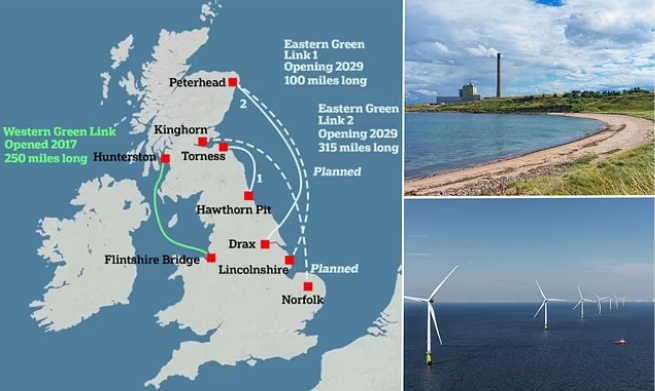
First, they plan to extend the established subsea superhighway, creating bypasses along the east coast to allow more power to get to the south without overwhelming the existing terrestrial lines.
Second, the National Grid is implementing hundreds of miles of new high-voltage overhead lines and constructing massive converter stations.
Third, the subsea superhighway already extends through thousands of miles across the UK as well as Europe. The UK is planning to reconnect the UK to the European super grid and turn the North Sea into a shared power bank.
Europe’s Bottleneck
Across Europe, grid expansion has become the limiting factor on renewable deployment. In France, government spending on grid renewal has more than doubled to €4.2 billion. In Germany, the government has committed to the building of at least 16,800 km of new or upgraded power lines.
While transmission remains the primary bottleneck, storage is emerging as a complementary solution. Battery and thermal storage developers aim to capture excess wind or solar generation during periods of constraint and discharge it when demand rises. However, storage mitigates symptoms rather than solving the underlying issue of insufficient grid capacity.
Grid constraints are no longer a secondary issue. They are now the binding constraint on Europe’s energy transition. Until transmission capacity catches up with generation, adding more renewable supply will not translate into usable power.
Data Sources
- Dogger Bank — World’s largest offshore wind farm (3.6 GW) to power ~6M UK homes
- Lumify Energy — UK average wind speeds support stable long-term generation potential
- Barbour ABI — Pipeline of major UK offshore wind projects expands
- SSEN Transmission — Eastern Green Link 3 grid project supports UK wind integration
- Renewable Energy Hub — Wind turbines convert kinetic energy into grid electricity
- S&P Global — European grid operators face rising investment demands for energy transition
- Bundesnetzagentur — Germany accelerates grid expansion (“electricity highways”) to integrate renewables