
Introduction
The movement of goods between East Asia, particularly China, and Europe has been surging in recent years. Research has estimated that 12-15% of global trade now flows between these two regions.
Traditionally, the primary shipping routes for freight leaving East Asia have been through either the red sea, or on land through the north and south corridors. However, due to an abundance of conflict in these regions – the Houthi insurgency in Yemen, the Russia-Ukraine War, and the Iran conflict respectively – these routes have become unviable for shippers who prioritize secure transport. These unfortunate circumstances have led freight providers to turn towards the Trans-Caspian Shipping Route, known colloquially as the Middle Corridor as the next recourse for getting their stock to Europe.
What is the Middle Corridor
The Middle Corridor, as can be seen in the figure produced below, is a multimodal route that consists of a series of railways and ferries across the Eurasian gap. The journey begins with overland transport across the Central Asian steppe before reaching the Caspian Sea, where cargo is ferried westward toward the Caucasus. From there, goods move through Azerbaijan and Georgia into Turkey, where they can continue by rail across the Greco-Turkish border into Europe or move via the Black Sea toward Romania or Bulgaria.
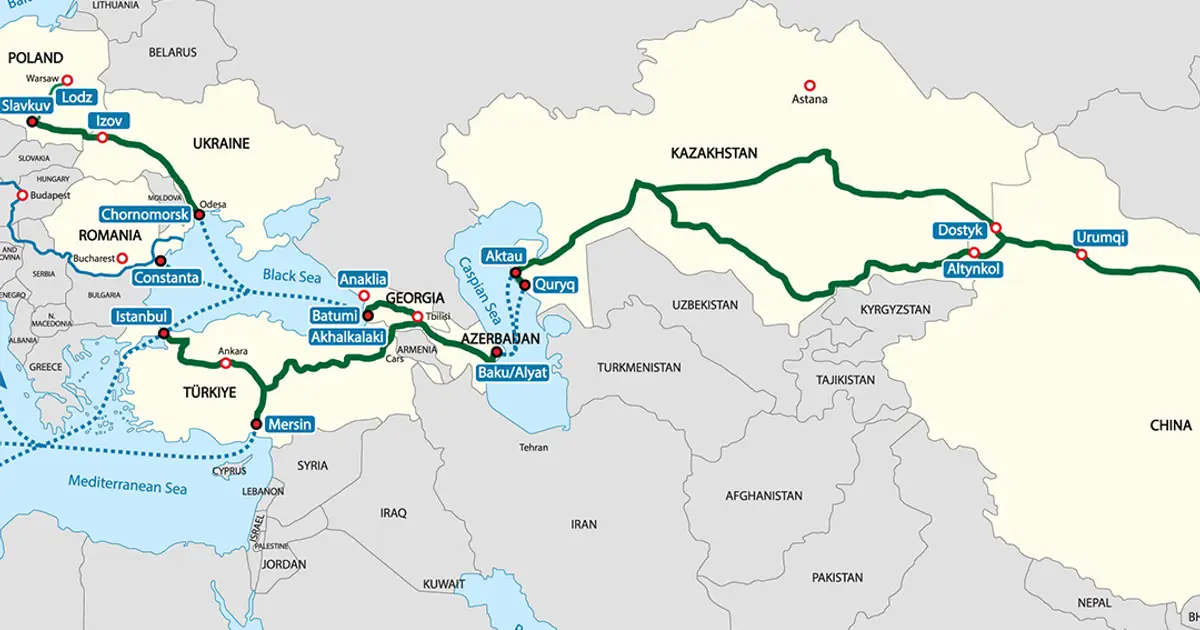
According to data from Kazakhstan’s Ministry of Transport, over the past seven years the volume of cargo transported across the Middle Corridor has increased five-fold to nearly 4.5 million tons annually.
The commitment to the development of the Middle Corridor and its efficiency as a viable shipping route is indicative of the world’s burgeoning distrust of the aforementioned conventional routes. Several nationals have expressed their belief in this newfound utilization of the Middle Corridor. According to The Centre for Eastern Studies, “at a meeting of the heads of government of the Organisation of Turkic States held in Baku in early April this year, participants declared their intention to increase cargo volumes transported via TITR by a further 10% in 2026.” Furthermore, “China has invested in several projects, including a railway linking China with Kyrgyzstan and Uzbekistan, which could potentially be integrated into the Middle Corridor.”
It is also indicative of a shift towards a new generation of logistics. Earlier this year, a unified “Middle Corridor Digital Platform” was launched, allowing shippers to use a single electronic bill lading across Kazakhstan, Azerbaijan, and Georgia. Unlike traditional systems, the Middle Corridor Platform allows for providers to handle all customs and port access with one digital entry as opposed to the route through the Red Sea. For transport through the Red Sea, a freight ship may have to interact with the customs and tariffs of a dozen countries that aren’t coordinated with one another. This allows for a more efficient transportation of goods.
Despite the Middle Corridor Platform providing a digital cost benefit, the net price for the overall journey struggles to compete with established pathways. According to the Times of Central Asia, “Shipping a 40-foot container via the Middle Corridor currently costs between $3,500 and $4,500, compared to $2,800–$3,200 on the Northern Corridor through Russia”. If one transports thousands of containers per year, the costs add up; however, providers still see these shipping routes to be more viable in the long term.
The Limitations of the Corridor
Although an appealing framework and a popular promise, the new major transcontinental shipping route faces a capacity constraint. Despite major shipping routes from East Asia to Europe remaining paralyzed by global conflict, the Middle Corridor is only able to handle 6% of the Northern Corridor’s annual capacity.
Georgia is a primary bottleneck of the Middle Corridor. According to the Carnegie Russia Eurasia Center, “the country’s existing port capacity is nearing exhaustion.” They explain that “the Georgian government has slashed the new Anaklia port’s 2026 funding from 150 million lari ($56 million) to 50 million lari … The government has also shown little willingness to meaningfully expand the ports of Poti or Batumi.
In a similar sense, political in-stability amongst the countries in the corridor are another bottleneck. The corridor traverses a region historically shaped by ethnic conflict and geopolitical rivalry following the collapse of the Soviet Union, particularly between Armenia and Azerbaijan, where renewed transit links continue to carry political and security risks.
Although promising in its development and significant in its institutional backing, the Middle Corridor remains underdeveloped and vulnerable to the same geopolitical instability that disrupted traditional freight routes. Whether it emerges as a permanent Eurasian trade artery or remains a temporary alternative will depend on the corridor’s ability to expand capacity, improve regional coordination, and maintain political stability. Nevertheless, the corridor’s implementation of a unified digital logistics framework may leave a lasting impact on transnational freight systems beyond the route itself.
Data Sources
- OSW — A safer alternative: growing interest in the Middle Corridor in Central Asia
- IRU — The Middle Corridor: A world of opportunities
- The Times of Central Asia — Opinion: A New Southern Gate: How the EU-Armenia Summit Unlocks a Critical Branch for the Middle Corridor
- Carnegie Politika — The Much-Touted Middle Corridor Transport Route Could Prove a Dead End
- SHS Web of Conferences — International cargo transportation through the Suez Canal and alternative routes: by the example of China-EU