Boxed-Up
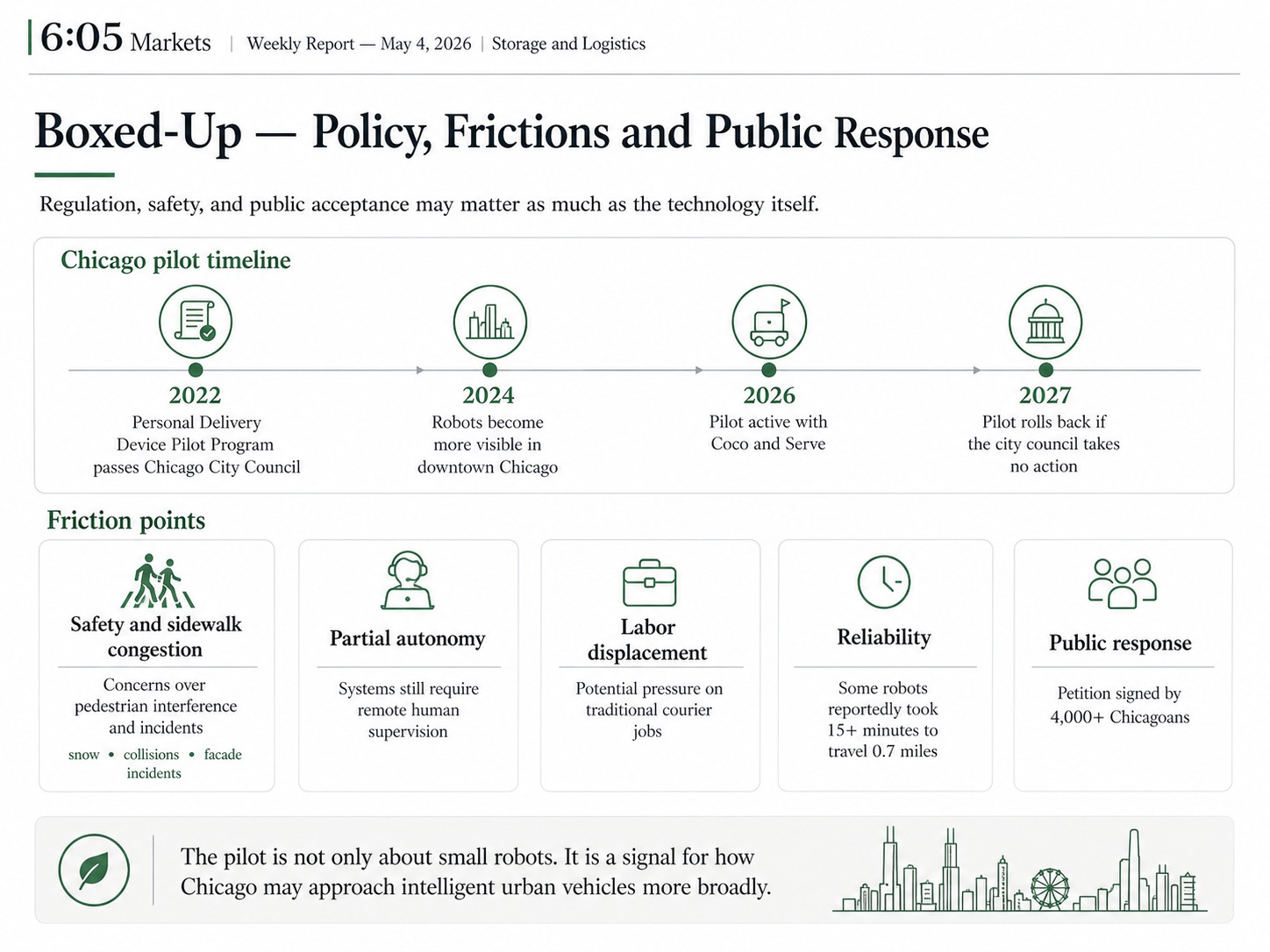
Since 2024, residents of downtown Chicago have started noticing small cubic robots resembling medium-sized boxes with four wheels. Their mission: compete with usual last-mile delivery services like trucks or cars. These cute little robots have started multiplying in the third largest metropolis in the U.S after a 2022 Personal Delivery Device Pilot Program passed the city’s council. Two companies share the duopoly of this developing service in Chicago, although other companies are present in other US cities where these devices are also being tested. Los-Angeles-based sidewalk delivery company Coco Robotics operates 50 such small delivery robots between Fulton Market, the Loop and Greektown. These are recognisable by their bright orange and pink colors. The second company, Serve Robotics, also based in Los Angeles, operates 50 other robots between 14 neighborhoods of Chicago.
These robots, designed to be autonomous, use AI sensors to orient themselves and avoid pedestrians and other obstacles. They are originally developed to rival other short distance delivery services, both in terms of efficiency and carbon footprint, as well as prevent the clogging of streets by navigating on sidewalks.
A Larger Market
Chicago is a microcosm in the broader US last-mile delivery market, which is estimated at roughly $150–200 billion annually and is structurally constrained by high labor costs. Labor accounts for approximately 50–70% of the cost per delivery, with traditional courier orders typically costing $6–10 on a fully loaded basis. Autonomous delivery robots, such as those operated by Serve Robotics and Coco Robotics, are designed to directly compress this cost structure by reducing reliance on human couriers, with target delivery costs below $2 per trip at scale. Therefore, putting downward pressure on delivery costs for platforms like Uber Eats and Doordash. If successful, these systems would not just improve delivery efficiency but fundamentally reprice last-mile logistics by removing labor as the primary cost driver. In this sense, robots are not competing on speed, but on cost.
However, despite projections of the robot delivery system to grow from under $1 billion in 2025 to over $7–$11 billion by 2034–2035, current systems remain only partially autonomous. The robots still require remote human oversight, meaning cost savings are incremental rather than fully transformative in the near term. In the long term, as technology improves the industry could grow even faster and replace traditional human courier services.
Labor Replacement Worries Many
The replacement of labor is a concern to many. The Sun Times reports that Efrain Berrocal, a courier and dispatch coordinator at Chicago-based Cut Cats, a courier service run by cyclists, said the robots may pose a threat to traditional courier services. This contrasted reaction is also visible within these robots’ customers themselves. While some Chicago citizens are neutral, or even enthusiastic about the expansion of these miniature delivery robots (especially because they don’t require a tip), others, especially elders, deplore their presence on sidewalks, observing that they risk displacing congestion on the street to the sidewalks, where they might have more severe consequences. Indeed, several incidents where the robots have gone out of track and ended in the snow, or worse, in a glass facade, contribute to the citizens’ safety concern. Despite them being overseen by human supervisors, a petition to prevent their expansion has been signed by over 4000 Chicagoans.
These small miniature robots seem to have a torn future in front of them. Although their development aims to create competition for traditional last-mile services, their expansion in Chicago has been met with skepticism, with even their initial mission being questioned as some robots have been timed to take over 15 minutes to travel 0.7 miles. However, another concern has been safety, and as the autonomous cars developed by Waymo start roaming in Chicago, the future of the Coco and Serve robots will impact more than just the box-like robots but be a signal for the entire intelligent vehicle industry within the Midwest metropolis. With no action from the city council, the pilot program will be rolled back starting 2027.
Concluding Statement
The future of the last-mile delivery industry will not be determined solely by city-level policy, but by whether platforms like Uber Eats and DoorDash adopt these systems at scale. If robots can consistently deliver at a lower cost than human couriers without degrading reliability, they will become embedded infrastructure within delivery networks. If not, they will remain a niche solution, limited to dense urban areas and low-value orders.
Data Sources
- Chicago Sun-Times — Food delivery robots are rolling into Chicago, bringing convenience and concerns
- Block Club Chicago — A day in the life of a food delivery robot: lots of waiting and a few collisions
- City of Chicago — Personal Delivery Device (PDD) Pilot Program Passes
- Chicago Tribune — Letters: Food delivery robots raise safety and accessibility concerns
- ABC7 Chicago — Chicago leaders address concerns over delivery robots damaging infrastructure
- Fortune Business Insights — Delivery robots market size, share, and growth analysis