
Europe has a critical-minerals strategy, but it lacks a financing strategy. The Trojárová antimony-gold project in Slovakia shows the gap between Brussels’ regulatory ambition and its ability to deploy capital into upstream extraction.
The Trojárová Antimony-Gold Project
On May 11, 2026, Bloomberg published a feature on the Trojárová antimony-gold project in the Little Carpathian hills near Bratislava, owned by Canada-based Military Metals Corp (CSE: MILI). Nearly two years after Military Metals acquired the Soviet-era property, no European government, fund, or industrial buyer has put up financing or signed an offtake agreement. The company carries a market capitalization below USD 30 million.
On April 8, 2026, it published a maiden Inferred Mineral Resource Estimate of 6.5 million tonnes at 1.02% antimony and 1.06 grams per tonne gold, 67,000 tonnes of antimony and 222,000 ounces of gold, making Trojárová the largest antimony resource defined to a modern regulatory standard in the European Union.
At full reactivation, the company estimates annual production of roughly 6,000 tonnes, close to one-third of Europe's annual antimony demand. The EU has no equivalent direct-financing facility for upstream extraction. In other words, the EU has a potentially strategic antimony resource inside its own borders, but it has not yet treated it like a strategic asset.
Why Antimony Matters
Antimony is a small-volume mineral with outsized strategic importance. Global production runs roughly 150,000 to 180,000 tonnes per year. China accounts for 55 to 60% of mine output and dominates downstream refining, particularly antimony trioxide, the form most industries actually consume.
Roughly 15% of antimony demand is used in munitions, armor-piercing rounds, night vision goggles, and infrared sensors. The remainder is split among flame retardants, lead-acid batteries, semiconductors, and antimony-doped solar cover glass, the fastest-growing non-defense outlet.
China weaponized this concentration in August 2024, when the Ministry of Commerce introduced export licensing requirements for antimony ore, metal, and oxide, as well as related smelting technologies. On December 3, 2024, Beijing escalated to a full ban on exports to US military end users.
The Fastmarkets antimony assessment peaked at USD 59,750 per tonne on July 4, 2025, roughly four times pre-restriction levels. China partially suspended several controls in November 2025 as part of a broader trade détente with Washington, and prices have softened since.
A Bifurcated Market
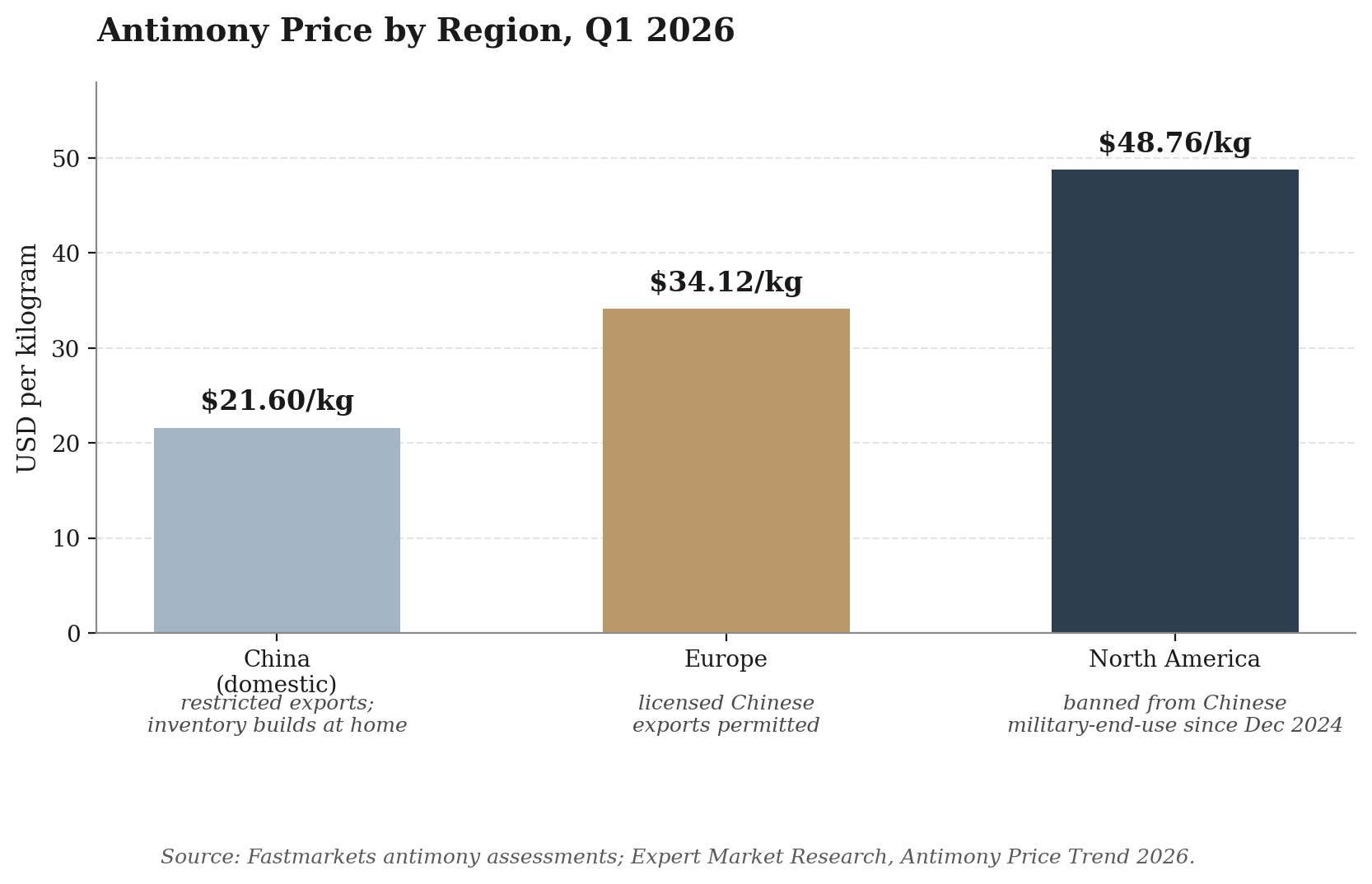
The market has settled into a bifurcated structure, with three price tiers corresponding to three levels of access to Chinese supply. Chinese domestic prices fell to roughly USD 21.60 per kilogram by Q1 2026, as restricted exports left inventories piling up at home. European buyers, who can still import Chinese antimony under licensed export arrangements, settled at around USD 34.12 per kilogram in the same quarter. North American buyers, locked out of Chinese military-end-use sales since December 2024, paid USD 48.76 per kilogram, more than double the Chinese domestic level for the same metal.
For Europe, the exposure runs through processing rather than mining. Even European-refined antimony trioxide flowing through Belgian and French facilities ultimately traces back to Chinese ore, which means the bloc's apparent diversification is partly an accounting layer over the same upstream dependence.
The EU's Framework
The Critical Raw Materials Act entered into force on May 23, 2024. It designates 34 critical raw materials and a narrower list of 17 strategic raw materials, with antimony on the critical list. The CRMA gives Europe targets, faster permitting, and Strategic Project status. To accelerate execution, the Commission can designate qualifying projects as Strategic Projects, granting a faster permitting timeline. In 2025, the Commission approved 60 strategic projects spanning 13 member states and 13 third countries, covering 14 of the 17 strategic raw materials. What it does not give Europe is a large direct-financing tool for upstream extraction.
Where the Capital Isn’t
Brussels lacks both a clear mandate to mirror US-style direct industrial financing and the budget headroom to deploy it at scale. In Germany alone, the economy ministry, the chancellery, and the foreign ministry have not agreed on what a critical-minerals de-risking strategy should entail.
In contrast, allied actors are much more able to deploy capital. On April 7, 2026, the US International Development Finance Corporation(DFC) signed a Project Development agreement worth up to USD 5 million with Australia-based Pela Global Limited to advance the Krstov Dol antimony project in North Macedonia — the DFC's first antimony investment. Krstov Dol sits in a NATO member and EU accession country and is being structured around US-based processing through PGM Processing. Trojárová, inside an EU member state, has no equivalent commitment from a European institution.
On April 24, 2026, US Secretary of State Marco Rubio and EU Trade Commissioner Maroš Šefčovič signed a Memorandum of Understanding establishing an EU–US Critical Minerals Action Plan, with explicit discussion of coordinated price floors, offtake mechanisms, and standards-based market design. Šefčovič said initial pilot price-floor mechanisms could launch before year-end.
For Military Metals, the EU–US agreement may become the most credible near-term financing pathway for Trojárová. That is the central irony: the project is located inside the EU, but its most likely source of strategic capital may come through joint instruments that allow American financing to reach European-jurisdiction assets.
Our View
Trojárová illustrates a broader pattern. The EU’s critical-minerals tools are concentrated around regulation and coordination: project designations, faster permits, offtake matchmaking, and recycling targets. However, the actual bottleneck for projects like Trojárová is upstream capital deployment through price volatility and multi-year development timelines.
The probable near-term outcome for Trojárová is not closure but transfer of strategic agency. Financing arrives, if it arrives, through joint US–EU instruments or through Japanese trading-house participation, similar to how JARE rescued Lynas in the mid-2010s. That outcome strengthens the broader allied bloc and may suit US policymakers. Still, it leaves the EU with the regulatory architecture for a critical minerals strategy while ceding equity, offtake, and pricing authority to partners outside the bloc.
The key risk is November 2026, when China’s partial suspension of its 2024–2025 export controls is set to expire. If Beijing reimposes restrictions and antimony prices spike again, EU manufacturers could face the same supply shock they faced in 2024, but with no new domestic capacity online. European buyers may remain structurally exposed to Chinese feedstock even if Europe appears diversified at the refining stage.
Data Sources
- European Court of Auditors — Special Report 04/2026: Critical raw materials for the energy transition (April 2026)
- European Commission, DG GROW — Critical Raw Materials Act and Strategic Projects list (2025–2026)
- Council of the European Union — Position on the amended Critical Raw Materials Act (March 4, 2026)
- Military Metals Corp — Maiden Inferred Mineral Resource Estimate, Trojárová Project (April 8, 2026)
- Bloomberg — "Critical Minerals: US Rivalry With China Is Leaving EU Behind" (May 11, 2026)
- US International Development Finance Corporation — DFC Backs Revival of Key Antimony Project (April 7, 2026)
- Office of the US Trade Representative — United States–European Union Action Plan for Critical Minerals Supply Chain Resilience (April 24, 2026)
- Fastmarkets — Antimony Market Outlook 2026
- US Geological Survey — Mineral Commodity Summaries, antimony chapter (2026)