Introduction
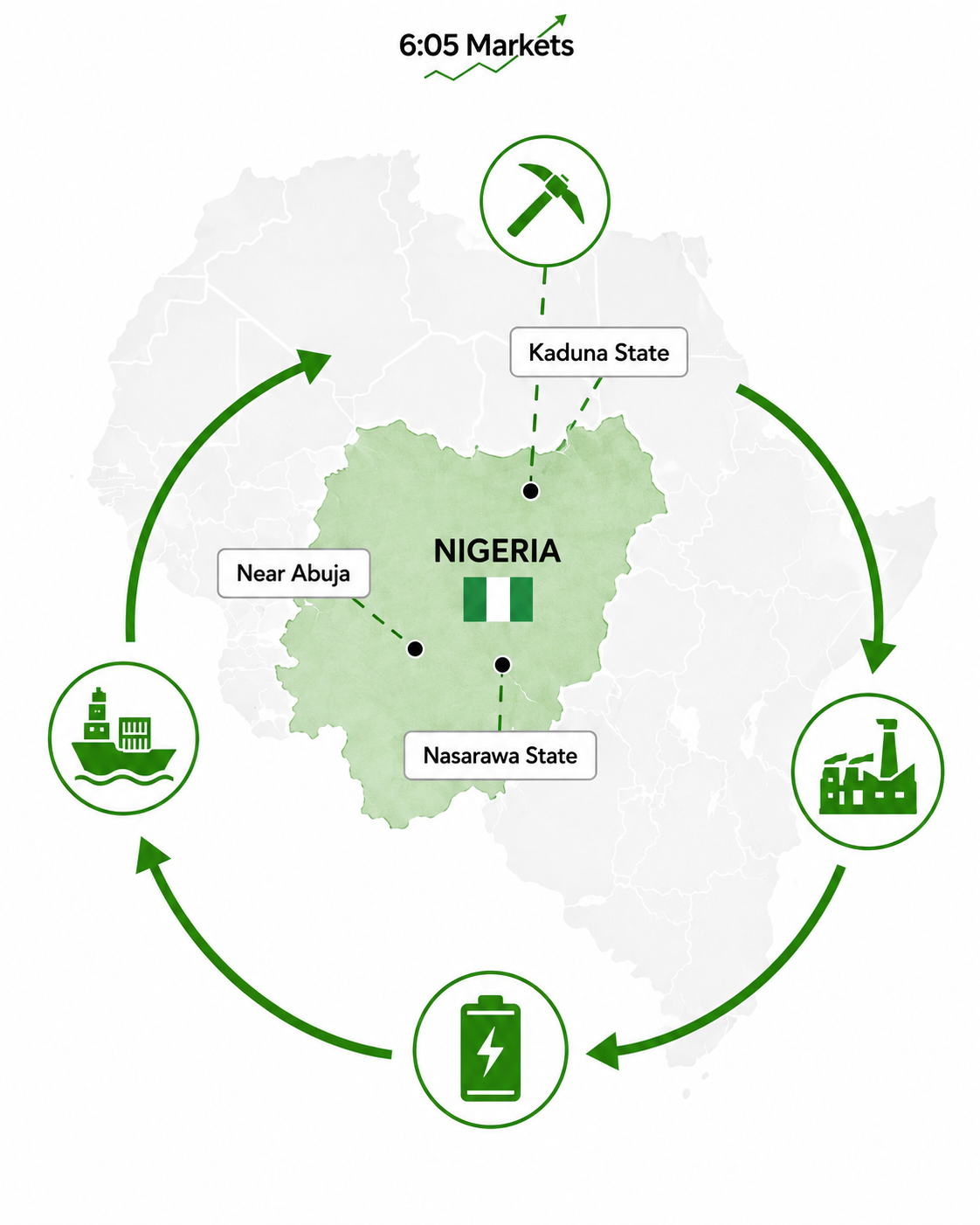
On June 28, at the African Natural Resources and Energy Investment Summit in Abuja, Nigeria's Minister of Solid Minerals Development, Dele Alake, unveiled what the government called a “world-class” polymetallic province in Kaduna State: platinum group metals, gold, nickel, copper, and rare earth elements in one basement complex, alongside a separately disclosed 3.3-million-tonne lithium reserve near Abuja, both verified by the Nigerian Geological Survey Agency. Five days later, on July 3, President Bola Tinubu commissioned a 6,000-tonne-per-day lithium processing plant in Nasarawa State, the largest such facility in West Africa. The two announcements are Nigeria's arrival as a critical-minerals producer. They are also the clearest demonstration yet that forced-localization policy in an emerging producer is the cheapest route for China to extend its refining dominance into new ground.
A Chinese-Built Refinery
The policy is succeeding in Chinese hands. For two years, the argument has been that Western mineral vulnerability is a processing problem, not a geology problem; that capital reliably funds the mine and stops at the refinery gate, leaving the chemistry to China. Nigeria inverts that thesis. Here the refinery is being built, on producing-country soil, where the value-capture logic says it should be.
Nigerian Modernization
Abuja no longer issues a mining title without a local-processing plan. The ministry has revoked more than 1,600 active-but-idle titles and the Mining Cadastre Office has canceled over 4,700 dormant or illegally held licenses to force consolidation. That mandate has attracted one category of investor at scale. Chinese firms such as Jiangxi Jiuling Lithium and Shenzhen-listed Canmax Technologies have supplied more than 80 percent of the financing for the country's four announced lithium processing facilities, with local partner Three Crown Mines holding the balance. Jiuling and Canmax together account for over 20 percent of global lithium-chemical capacity, and both supply CATL, the world's largest EV battery maker; Canmax founder Pei Zhenhua is himself a CATL investor. Their combined committed processing spend in Nasarawa and Kaduna now exceeds $1.3 billion.
The Nasarawa plant Tinubu commissioned is the model that Kaduna could be based on. Its output feeds into the international EV battery supply chain, which is, to say, the Chinese one. Nigeria captures the jobs, royalties, and beneficiation headlines. The battery-precursor and cathode-active-material stages, where the margin sits, remain in the investor's home jurisdiction.
Critical Minerals at the G7
Eleven days before Tinubu cut the ribbon in Nasarawa, G7 leaders met at Évian and committed to cutting dependence on any single non-G7 supplier of rare earths and permanent magnets below 60 percent by 2030, backed by an IEA monitoring platform, lithium and nickel stockpiling pilots, and 195 announced projects totaling €64 billion. The one mechanism that would have pulled private capital into midstream refining: the U.S.-drafted floor-price plan for critical minerals was rejected by allies. The bloc that has declared Chinese processing dominance a national-security threat spent its summit building a dashboard to measure the threat, while the country that built refining capacity did so by handing the midstream to Chinese firms.
The G7 wants diversified refining and will not underwrite it. China wants feedstock security and will underwrite it anywhere, including inside a beneficiation regime designed to keep value at home. When those two postures meet over the same African ore, the refinery gets built, under whichever flag is willing to pay for it.
Lithium Price Volatility as the Investor Filter for China
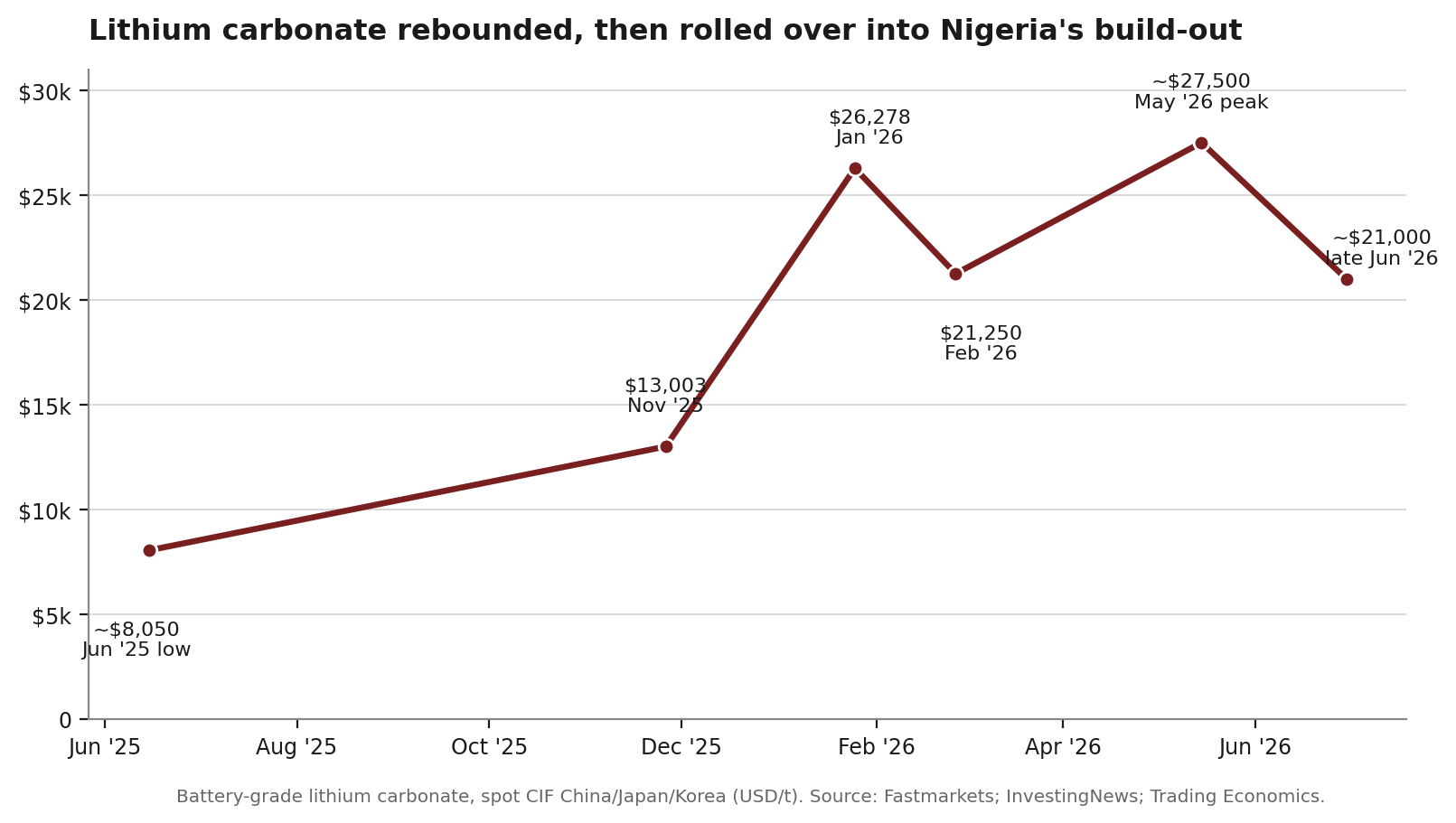
China building in Nigeria is the reason for the market backdrop. Battery-grade lithium carbonate collapsed to a four-year low of roughly $8,000 per tonne (Fastmarkets CIF China/Japan/Korea) in mid-2025, then staged a violent recovery, and nearly doubling to about $26,300 per tonne by late January 2026, a 95 percent move in two months, before rolling over again to a three-month low near $21,000 by late June on speculation that CATL's suspended Jianxiawo mine could restart in the second half of the year. Spodumene feedstock crossed $2,000 per tonne for the first time since October 2023. This is a market that has just delivered two round trips in eighteen months.
That volatility was the filter that determined who invested in Nigeria. Through the depths of the 2024–25 downturn, when carbonate sat near four-year lows, Western-planned refineries were shelved on financing grounds, the same environment that killed the largest planned U.S. hydroxide project and stalled expansions in Australia. Chinese processors did the opposite: Canmax and Jiuling took control of the Nigerian Ganfeng refinery in mid-2024 and expanded across Africa despite an almost 90 percent fall in lithium prices from the 2022 peak. Counter-cyclical capital deployment into midstream is not a quirk of Nigeria; it is the mechanism by which Chinese firms have consistently acquired processing capacity while Western lenders wait for prices that reward it.
The demand signals now flashing amber compound the point. Chinese new-energy-vehicle sales fell 7.5 percent year-on-year in May, and the market is already pricing a supply response. A high-cost new entrant: Nigeria, with power shortages, transport gaps, and no integrated buyer of its own, is the marginal supplier that a renewed price slide would squeeze first. The plants likely to run through the next trough are those with a Chinese parent that can absorb losses because it wants the feedstock regardless of the spot price.
Our View
Nigeria's beneficiation mandate will continue to drive processing investment, and that investment will remain overwhelmingly Chinese for as long as the West offers producing nations offtake agreements but not capital. The ministry's raw-export ban is the instrument routing Nigerian ore into China's supply chain. For the G7, Nigeria is the counterfactual: proof that midstream capacity in a resource-rich, security-challenged jurisdiction is financeable today, just not by them.
The key execution risk is with Nigeria. The binding constraints, such as power shortages, transport gaps, artisanal-mining insecurity, and a solid-minerals sector still under 1 percent of GDP, are the same conditions Chinese investors have shown they will tolerate and Western lenders will not. If those constraints occur, the mandate stalls and the ore reverts to raw export. If constraints ease, they ease for whoever has already placed investment on the ground. Either path deepens the dependence the G7 says it is trying to unwind.
Data Sources:
- Mining.com — Nigeria Identifies Major New Critical Minerals District and Large Lithium Discovery
- Oilprice.com — Nigeria Unveils World-Class Critical Minerals Discovery
- Federal Ministry of Information / Channels TV — Tinubu Commissions 6,000-Metric-Tonne-Per-Day Lithium Processing Plant in Nasarawa
- Mining Technology / The Assay — Nigeria to Launch Lithium Processing Plants with Chinese Investment
- Bloomberg / Nigerian Mining — Chinese Lithium Firms Take Over Nigeria Refinery Project
- Discovery Alert — Nigeria’s Major Lithium Reserve Discovery Near Abuja
- G7 Leaders’ Declaration — Securing Supply Chains for Critical Minerals
- Mining Digital — G7 Acts on Critical Minerals as China Tightens Grip
- Semafor — Nigeria Discovers New Mineral Deposits