Introduction
At last month’s FT Commodities Summit in Lausanne, traders pointed to metal geopolitics in the DRC, Kazakhstan, and Latin America as one of the supply constraints holding back the energy transition. Since then, the headlines have backed them up: Kinshasa is sending 20,000 guards to mining sites, Astana is backing a Nasdaq-listed tungsten venture, and Washington has invested more than $1 billion in Latin American critical minerals since January 2025.
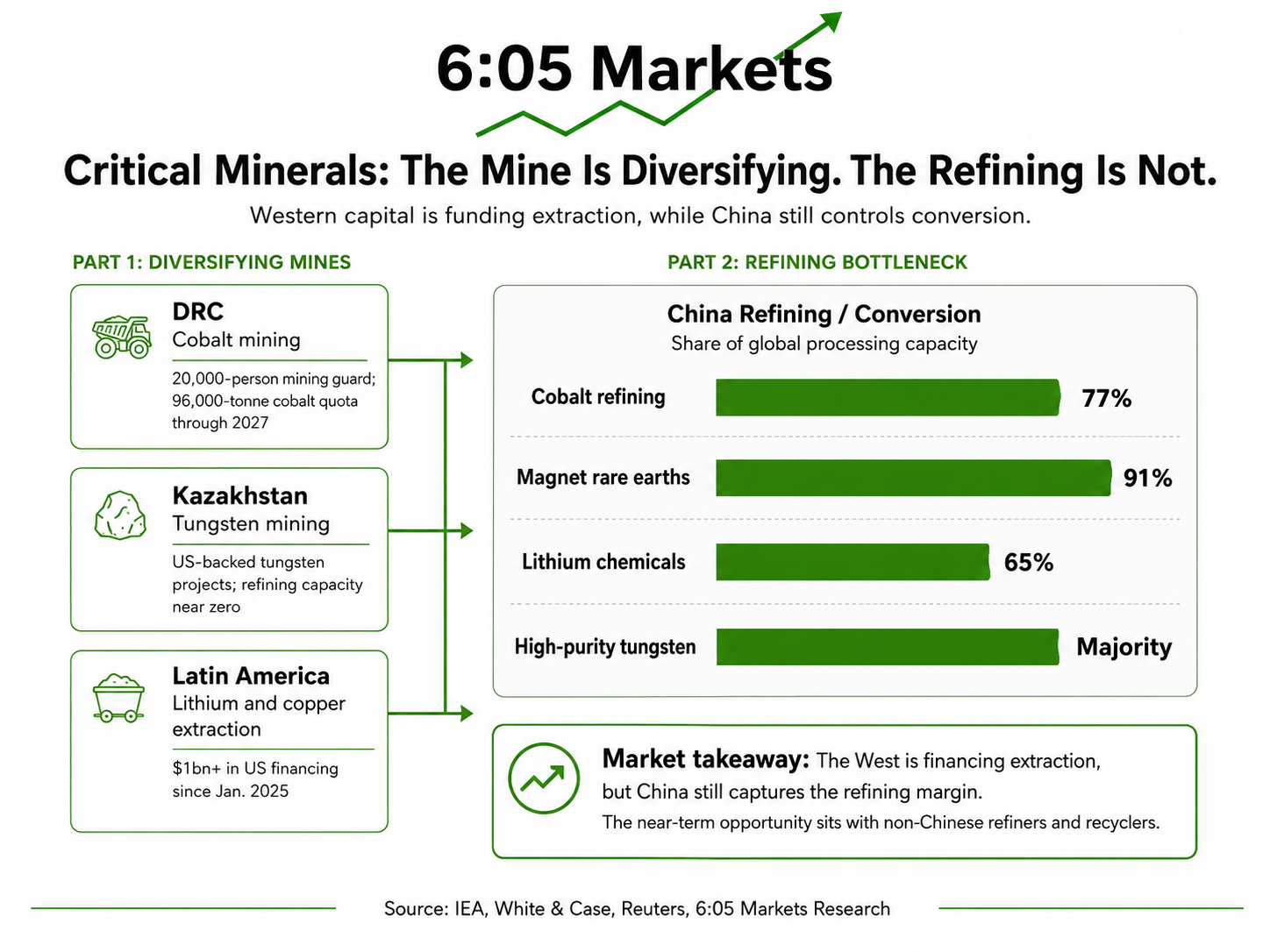
Despite the West trying to create an alternative supply route from China, China remains dominant in the refining stage. The IEA estimates China refines roughly 77% of cobalt, 91% of magnet rare earths, about 65% of lithium chemicals, and most high-purity tungsten. The West is financing extraction and China still controls conversion.
DRC: Guarding the Mine, Not the Refiner
On April 27th, the DRC announced a “mining guard”, a 20,000-person paramilitary unit funded by a $100 million U.S.- and UAE-linked package. The DRC accounts for 73% to 76% of global mined cobalt production. Additionally, the DRC holds roughly half of the world's proven cobalt reserves. Additionally, the DRC's 2026–2027 export quota of 96,000 tonnes has tightened supply enough to flip cobalt into a deficit, but it has not moved a single tonne of refining offshore from China.
Kazakhstan: A Mining MOU, Not a Refining One.
The U.S.-Kazakhstan critical minerals architecture is built almost entirely around extraction. Tokayev's April Washington visit, the November 2025 MOU, the Cove Kaz Capital merger creating Kaz Resources Inc., and the proposed $700 million LOI to finance the Severniy Katpar and Upper Kairakty tungsten projects are all mines. Severniy Katpar/Upper Kairakty could eventually produce ~12,000 tonnes of tungsten annually, roughly 15% of the current global supply. But Kazakh APT and tungsten carbide capacity are effectively zero today. The metal would still ship to Chinese (or, optimistically, Vietnamese) processors. Kazakhstan hosts 21 of the 50 minerals on the U.S. critical list, but currently produces none at a commercial scale.
Latin America: Ore South, Chemistry East
The same holds in Latin America. Per White & Case, the $1 billion-plus in U.S. financing since January 2025 has funded lithium and copper extraction in Chile and Argentina, as well as lithium development talks in Bolivia. China processes roughly 65% of global lithium chemicals and over 75% of battery cells. Australian spodumene, Argentine carbonate, and increasingly Bolivian brine flow east to become battery-grade lithium hydroxide before re-export to Western OEMs. The Lithium Triangle's structural problem is that despite sitting on 60% of the world's lithium resources, there is an absence of integrated refining.
The Constraint on the Energy Transition
Western EV makers and grid operators are on track to pay twice for the diversification they are nominally financing: once to source ore from a politically aligned mine, and again when that ore moves through a Chinese refinery before reaching them. The market-level corollary, echoed by traders in Lausanne, is that Chinese physical demand is establishing a firmer price floor under copper, cobalt, and lithium. China has a floor that is partially subsidized by Western capital flowing into ore that China will refine anyway.
Put simply, China has a toll on all critical minerals mined in the world. If a manufacturer wants a processed critical mineral, the minerals, financing to pay for the refinement, must pass through China.
Where An Opportunity Arises
That pricing arbitrage is also where the trade is. The Western refining bench is thin enough that any name with a permitted, financed, near-commissioning facility outside China stands to capture a structural premium for “audit-clean” units.
Electra Battery Materials is building what it describes as North America's only cobalt sulfate refinery in Temiskaming Shores, Ontario, targeting mechanical completion and commissioning in 2027. With cobalt hydroxide having quadrupled and DRC quotas locked through 2027, Electra's offtake economics improve every month the quota system holds
Westwin Elements is constructing the first U.S. nickel/cobalt refinery in Lawton, Oklahoma, backed by $265 million in federal grants toward a $732.5 million full-scale facility, with a stated 2030 ramp to 20,000 tonnes of cobalt and 64,000 tonnes of nickel annually. Permitting and Indigenous-led opposition are real risks worth pricing in, but the strategic minerals case for the project is what is drawing federal capital.
For OEMs that cannot wait for Western refining capacity to come online, the more immediate workaround is to substitute chemistry and recycle. LFP cell adoption (which removes cobalt entirely) accelerated through 2025, and Fastmarkets notes consumers are increasingly sourcing non-DRC feedstock, such as MHP from Indonesia and black mass from recyclers, to dodge both the quota premium and the Chinese refining toll. Black-mass-to-cathode-precursor names with Western footprints are the second-order beneficiary of the same dynamic that makes Electra and Westwin interesting.
The metal race the FT panels were describing is the diversification among extraction, not refinement. The trade, for now, is the handful of Western refiners willing to bridge the gap.
Data Sources
- Qorvis — What we learned at the 2026 FT Commodities Summit
- IEA — Global Critical Minerals Outlook 2025, Executive Summary
- IEA — Rare Earth Elements, Executive Summary
- Al Jazeera — DR Congo to establish US-backed paramilitary guard for mines
- Africanews — DRC creates paramilitary mining security unit backed by US and UAE funding
- Shanghai Metals Market — Cobalt Market in 2026: Geopolitics Intensifies Market Volatility
- Times of Central Asia — U.S.-Kazakhstan Tungsten Venture Advances as Critical Minerals Cooperation Deepens
- U.S. Mission to ASEAN — 2026 Critical Minerals Ministerial
- Mining.com — US pours $1B into Latin America critical minerals
- White & Case — Washington’s US$1 billion critical minerals spree reshapes Latin American mining
- Market Growth Reports — Lithium Hydroxide Market Size & Share Trends