
Introduction
On April 28, the U.S. Geological Survey announced that the Appalachian region holds an estimated 2.3 million metric tons of undiscovered, economically recoverable lithium, enough, the agency said, to replace 328 years of U.S. imports at last year's level. Interior Secretary Doug Burgum framed the finding as evidence that "POTUS has reclaimed America's mineral independence." The southern Appalachian mountains, concentrated in the Carolinas, hold the largest share at 1.43 million metric tons of lithium oxide. Six weeks earlier, in South Carolina, the most advanced domestic plan to actually convert that lithium into battery-grade material was scrapped.
Mineral independence is delivered by refineries, and the largest planned U.S. lithium refinery died.
The Carolina Chain
A working domestic lithium supply chain requires three pieces in sequence: a mine that produces spodumene ore, the standard feedstock for lithium hydroxide refining, a concentrator that produces spodumene concentrate, and a refinery that converts that concentrate into battery-grade lithium hydroxide. Albemarle, the only active U.S. lithium producer, has been building exactly this chain across the Carolinas. Two pieces were advancing, but the third collapsed.
The mine, at Kings Mountain in North Carolina, was the site of the first large-scale lithium pegmatite mining in the United States and operated until the early 1990s. On March 12, 2026, Albemarle completed dewatering of the open pit, removing 1.57 billion gallons of accumulated rainwater. On March 30, the Federal Permitting Improvement Steering Council confirmed that the Kings Mountain project had completed federal permitting via FAST-41. State permitting still takes roughly two years, and construction is a multiyear project afterward.
The concentrator, also at Kings Mountain, is funded by a roughly $150 million Department of Energy grant under the Bipartisan Infrastructure Law and a $90 million Department of Defense Defense Production Act award. The DOE published its Final Environmental Assessment for the processing plant in March 2026. The facility is designed to produce approximately 420,000 metric tons of spodumene concentrate annually. The concentrator matters because raw pegmatite ore is, by mass, more than 90 percent rock that no battery wants. Concentration is the step that makes the material economically shippable to a refinery in the first place; without it, lithium-bearing rock has nowhere useful to go. It is also the step where most of the world’s lithium-bearing rock is loaded onto ships bound for China.
However, the refinery is where things fell apart. In 2023, Albemarle announced a $1.3 billion lithium hydroxide "Mega-Flex" plant in Chester County, South Carolina, on an 800-acre site near Richburg, designed to produce 50,000 metric tons of battery-grade lithium hydroxide annually, with expansion potential to 100,000 metric tons. Construction was supposed to begin in 2024. On March 17, 2026, the Chester County administrator publicly confirmed that Albemarle had withdrawn from the site for the time being and had reached out to the South Carolina Department of Commerce to withdraw. The reason was straightforward: the collapse in global lithium prices, more than 80 percent off the 2022 highs, made the project's economics unworkable at the scale the company had committed to. The Mega-Flex plant, had it been built, would have been one of the largest non-Chinese lithium hydroxide refineries outside Australia.
China’s Advantage
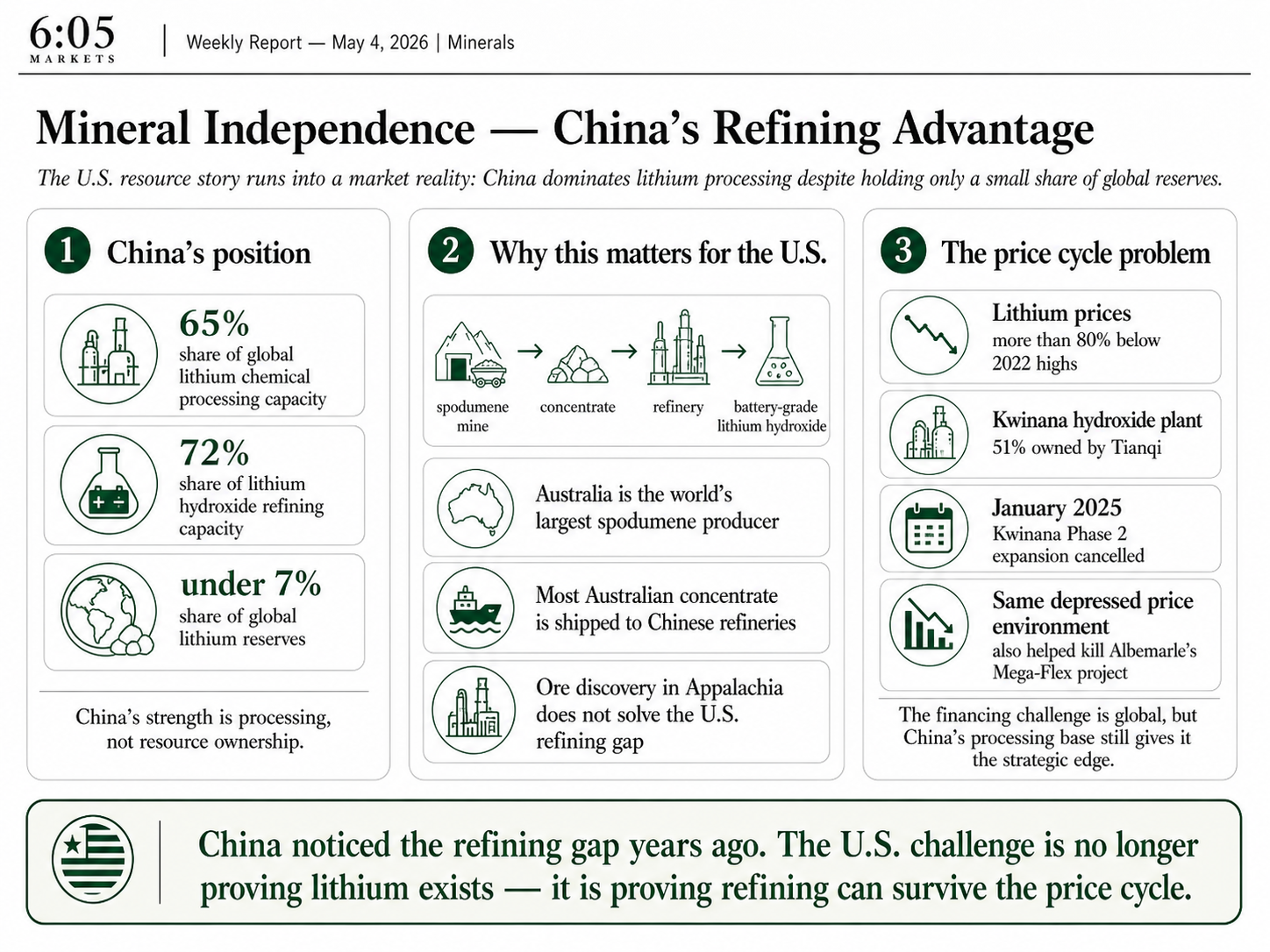
The USGS announcement came forty-two days later. China noticed the gap years ago. China holds an estimated 65 percent of global lithium chemical processing capacity and roughly 72 percent of lithium hydroxide refining, the critical step for spodumene, despite controlling under 7 percent of global lithium reserves. Australia, the world's largest spodumene producer, ships most of its concentrate to Chinese refineries; its flagship Kwinana hydroxide plant is 51 percent owned by China's Tianqi, and its Phase 2 expansion was canceled in January 2025, citing the same depressed price environment that killed Mega-Flex.
The Appalachian discovery extends the U.S. resource clock on paper, but it does not change the binding constraint: whether refineries can be financed and built in a price environment that has defeated the largest planned domestic project. Mineral independence is announced in press releases, but it is delivered in metric tons of lithium hydroxide leaving an American refinery gate. The question for the next several years is not whether the ore is there. The question is whether the United States can maintain its refining ambitions amid a lithium price cycle that does not reward them.
Data Sources
- U.S. Geological Survey — Appalachian region holds 2.3 million metric tons of undiscovered lithium resources
- Reuters — Albemarle withdraws from planned South Carolina lithium refinery amid price slump
- U.S. Department of Energy — Kings Mountain lithium concentrator receives federal funding and environmental review
- U.S. Department of Defense — Defense Production Act award supports domestic lithium supply chain
- Federal Permitting Improvement Steering Council — Kings Mountain project completes FAST-41 federal permitting
- Reuters — Global lithium prices fall over 80% from 2022 highs, pressuring new projects
- International Energy Agency — China dominates global lithium refining capacity despite limited reserves
- Reuters — Tianqi-backed Kwinana lithium hydroxide plant expansion canceled due to weak prices