
Introduction
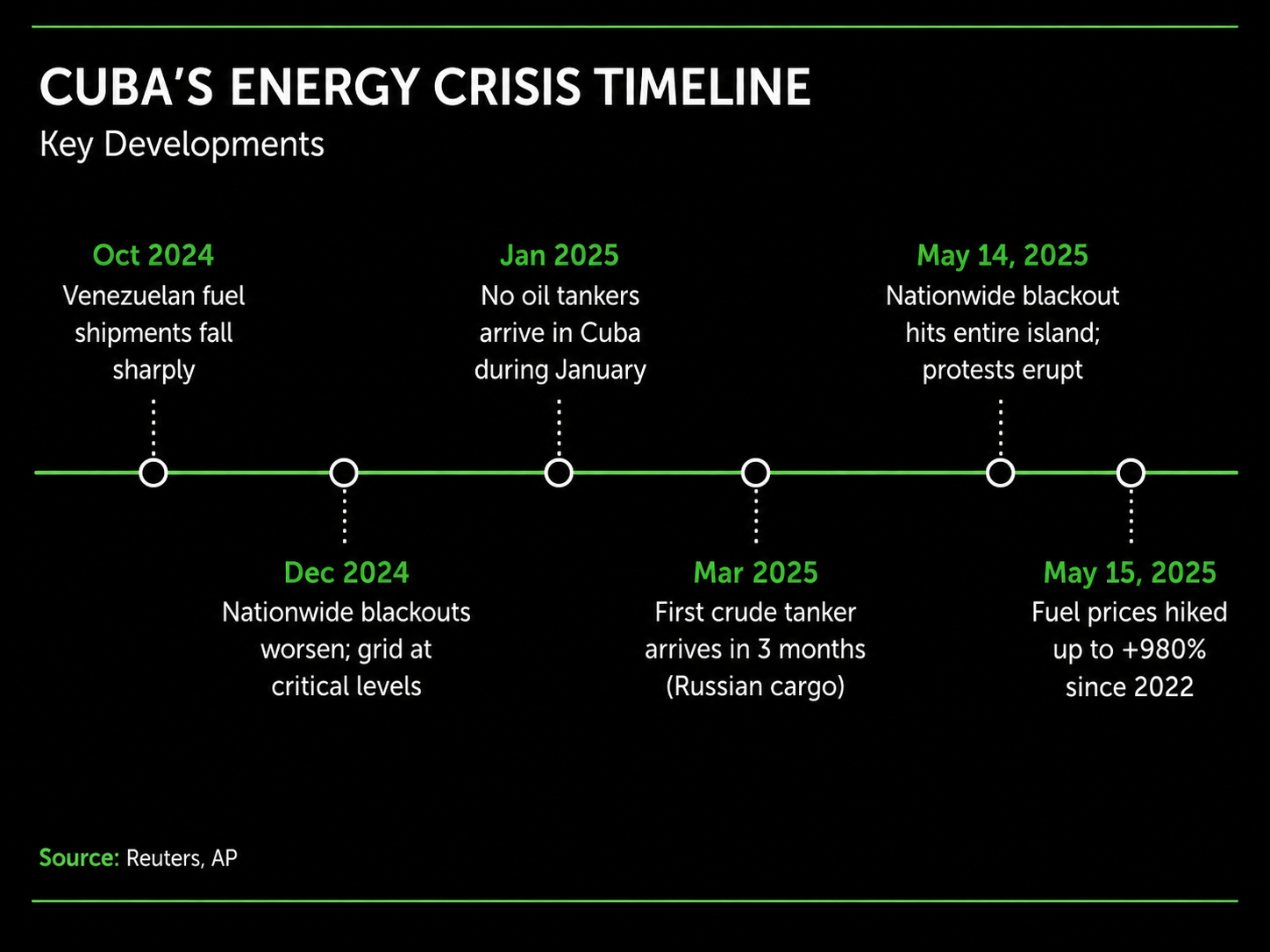
Cuba’s current energy crisis shows what happens when a country relies on a state controlled system that cannot adapt to rapid market changes such as shortages, increased demand or marketing failures. A series of fuel shortages, grid collapses and repeated blackouts have disrupted daily life, fueled protests and exposed the weakness of the Cuban economy. Years of reliance on imported crude, first from the Soviet Union and later from Venezuela, left the island exposed to external supply shocks. Once those flows weakened, Cuba’s aging power grid had little ability to absorb the pressure. Fuel shortages, repeated blackouts, and grid failures have now disrupted daily life, strained tourism and industry, and fueled public unrest.
The crisis is not large enough to move global crude benchmarks, but it matters regionally. Cuba’s shortage increases pressure on Caribbean fuel markets, especially for diesel and fuel oil, while also exposing the risks of underinvested grids and politically dependent energy supply chains.
What are the Catalysts?
The main catalyst for Cuba’s energy crisis is its heavy reliance on crude imports, a practice dating back to the Soviet era, when the Soviet Union supplied the island with sufficient crude. After their main benefactor’s collapse, Cuba shifted to receive the majority of its imports from Venezuela, then under the reign of Hugo Chavez. Historically, this has kept the island afloat, providing nearly 70,000 bpd and refined products worth $1.3 billion from late 2024 to late 2025. However, U.S. action in Venezuela in early 2026 completely severed this lifeline, laying the foundation for the ensuing energy crisis in Cuba.
The final nail in the coffin was the U.S. blockade imposed on Cuba in February, which completely cut Cuba off from other main suppliers, such as Mexico, which still provided the country with a moderate amount of imports. This left the island alone, reliant on its own domestic production to maintain power. However, Cuba's problem is that it produces only 40,000 bpd of crude, which is well below the 100,000 bpd required to meet the island's energy needs of 11 million. Cuba had likely recognised its vulnerability and, over the past two years, has undergone a tremendous surge in solar panel production, backed by agreements and imports from China. By the end of 2025, Cuba had 1,084 MW of solar power, up from 280 MW at the end of 2024.
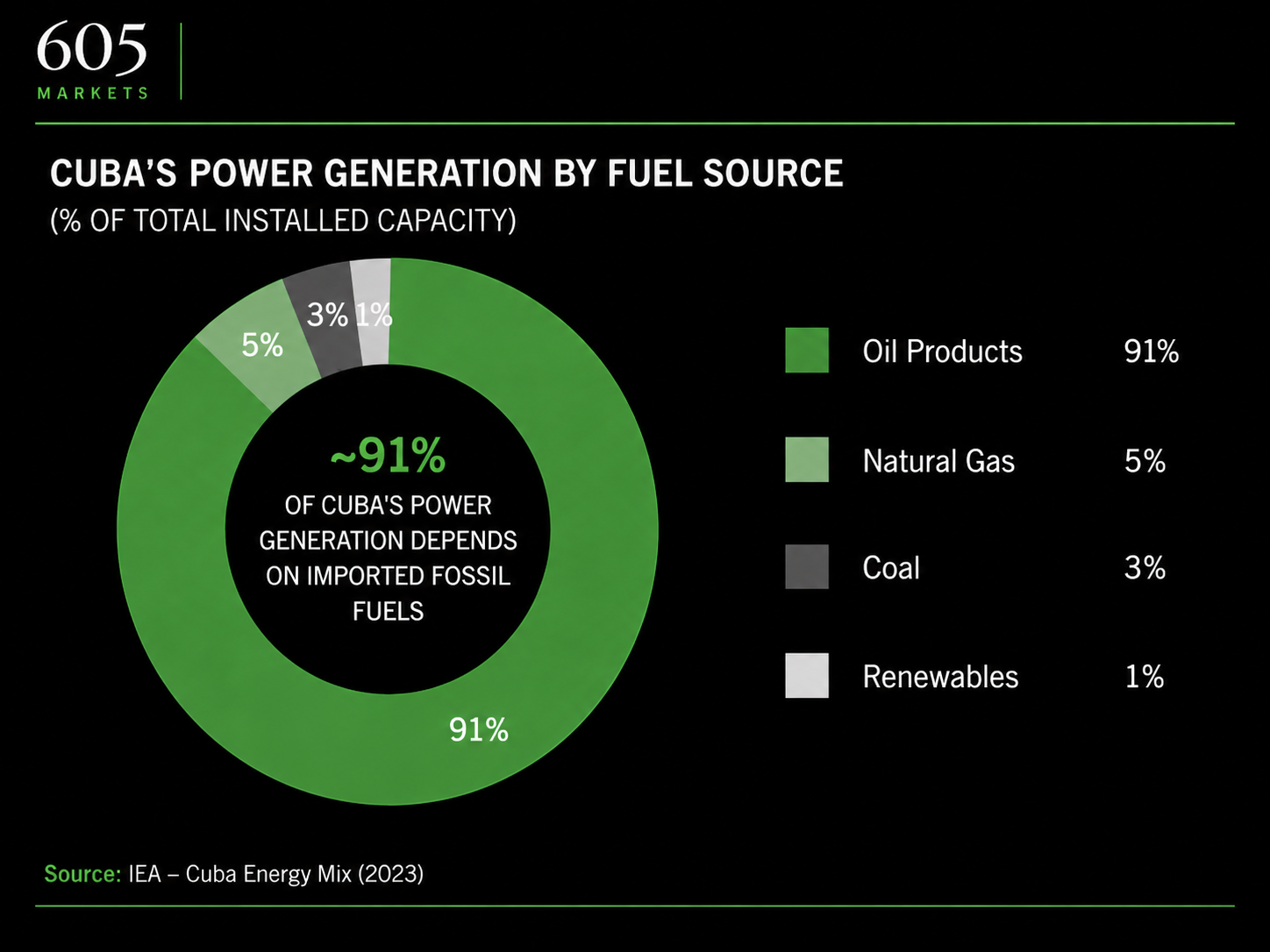
However, this shift may be too little too late. As shown in the graph below, only about 1% of Cuba’s power is generated from renewables. Despite its solar revolution in the past two years, it is realistically impossible for these new sources of energy to completely offset the massive amounts of imported fuel needed to power the country. In addition, Cuba’s power grid is extremely outdated, with some power plants not having been maintained for over 4 decades, which has been another factor in blackouts. Electrical grids require constant reinvestment in maintenance and modernisation to prevent issues like these. A World Bank study concludes that the investment rate in the electrical system should be around 25% of GDP to avoid infrastructure bottlenecks. However, the Cuban investment rate in the past two decades has almost always remained below 10%. This means that even if Cuba magically resolves its fuel shortage, a broken power grid would still result in reduced power generation. This is evidenced by the fact that the nation still suffered power generation shortfalls in previous years, despite not experiencing a fuel shortage.
Why This Matters Beyond Cuba
Cuba’s crisis would still affect the Caribbean region's prices. This is because Cuba is desperate for any fuel it can acquire, so it will be willing to pay a premium on gasoline and diesel once the blockade is eased or lifted. This means local companies would be more willing to sell to Cuba than to other nations in the region, directly leading to higher prices in the Caribbean.
Our Analysis
Bull case: China and Russia come to the rescue
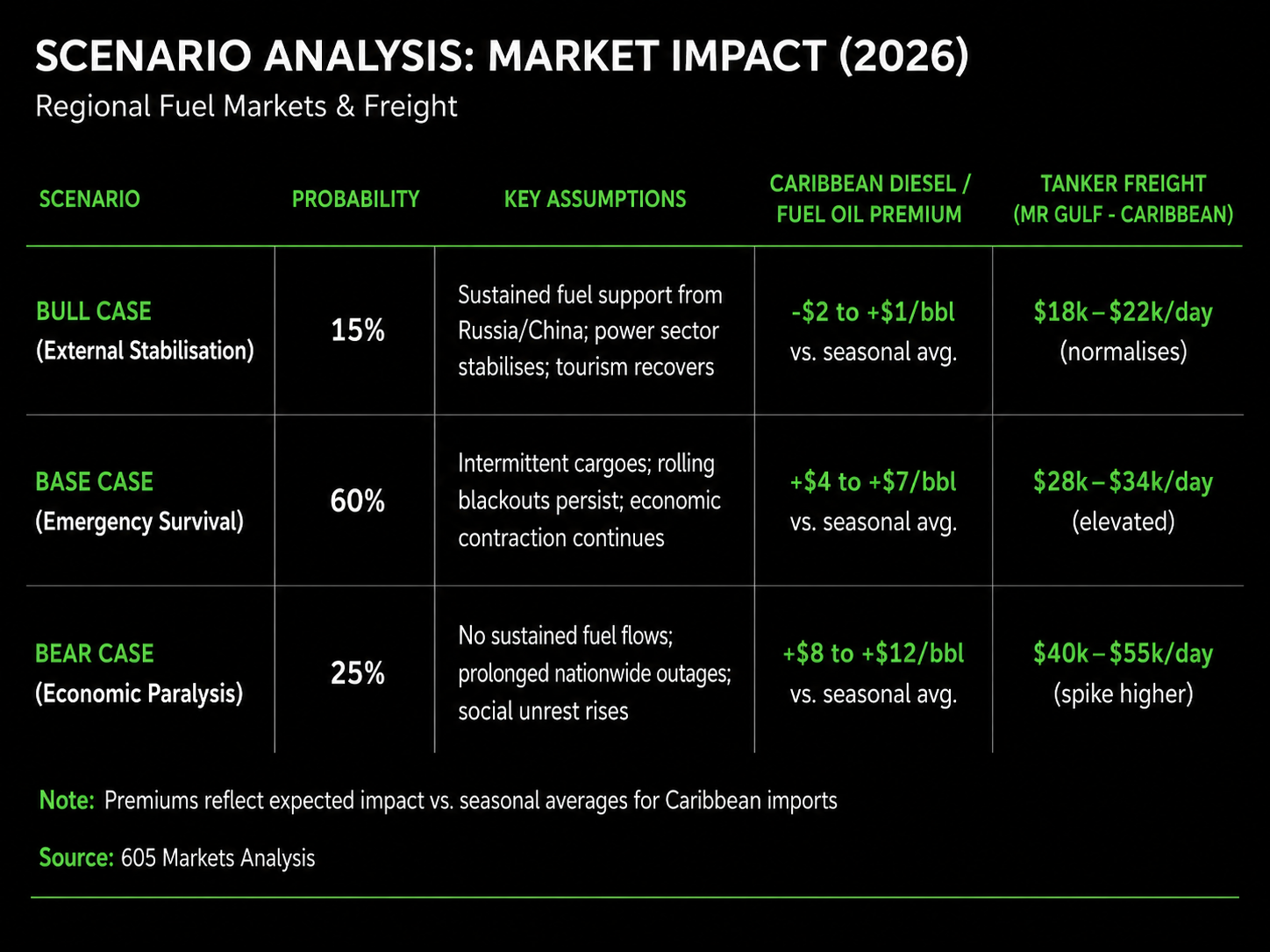
In the bull case, Cuba secures consistent state-backed shipments from Russia or Chinese-backed financing through China, allowing fuel inventories to rebuild and generation capacity to stabilise. Tourism gradually recovers, industrial output improves, and blackouts become less frequent by early 2027. This would enable regional product tightness to ease, freight premiums to normalise, and Caribbean import spreads to narrow. Energy markets would likely treat Cuba as stabilised, removing much of the political risk premium currently embedded in regional fuel procurement.
Base case: Cuba goes into emergency survival mode
Under our base case, Cuba avoids complete grid collapse through sporadic emergency shipments from Venezuela, Russia, or politically aligned intermediaries, but import volumes remain well below historical norms. Nationwide blackouts continue throughout 2026, industrial production contracts further, and tourism infrastructure operates intermittently.
Market implications remain regional rather than global. We expect Caribbean fuel oil and diesel premiums to remain structurally elevated, likely $4–7/bbl above seasonal averages, while Gulf-Caribbean product freight rates stay firm as buyers compete for limited cargo availability. Brent itself would likely see negligible direct pricing impact, due to Cuba’s small size as an importer.
Bear case: Complete economic paralysis and energy grid failure
In the bear case, emergency shipments fail to materialise, major thermoelectric units remain offline, and nationwide outages extend from periodic blackouts into prolonged multi-day grid failures. Industrial activity, tourism, and food logistics deteriorate sharply, increasing the probability of social unrest and outward migration.
For markets, this would likely trigger emergency spot buying across the Caribbean, lifting regional fuel oil and diesel premiums toward $8–12/bbl, while medium-range tanker rates in the Gulf-Caribbean corridor move materially higher. Global crude benchmarks would still remain largely untouched, but regional traders would begin pricing Cuba as a persistent source of logistical and political supply risk.
Our Position
Cuba’s energy crisis is no longer simply a possibility of something that may become serious down the road. The major issues have already arrived. Nationwide blackouts and the collapse in tanker arrivals show that the island’s fuel-import model has effectively broken down. While Cuba may be too small to move worldwide Brent or WTI prices, it still matters greatly on a regional level through much tighter Caribbean fuel availability, higher diesel and fuel oil premiums, and increased freight and credit-risk costs.
Our base case is emergency survival rather than recovery. Cuba avoids total grid collapse through sporadic external support, but blackouts, weak industrial output, and economic stagnation persist through 2026. Unless sustained fuel flows or major infrastructure support materialise, Cuba will remain a live example of how energy insecurity can rapidly become economic paralysis.
Data Sources
- Reuters - Cuba's electrical grid suffers partial collapse as protests flare
- Reuters - Protests break out in Havana over power cuts
- Reuters - Cuba hikes gasoline and diesel prices but filling stations remain shut
- Associated Press - Cuba's power grid collapses and plunges eastern provinces into a major blackout
- OHCHR - United States must end “energy starvation” of Cuba with severe human rights impacts: UN experts
- IEA - Cuba: Countries & Regions
- NY Times - Cuba Says It Has Run Out of Oil
- CNN - As the US starves it of oil, Cuba is pulling off one of the fastest solar revolutions on the planet — with China’s help
- OilPrice - U.S. Pressures Mexico Over Fuel Supply to Crisis-Hit Cuba
- Columbia Law School, Cuba Capacity Building Project - Cuba’s Energy Crisis: Structural Roots and a Comparative Perspective
- Time - The Crisis in Cuba, Explained