Introduction
The reopening of the Strait of Hormuz has created a sharp shift in oil market sentiment. After months of disruption, delayed cargoes, and security concerns, the market has begun to price in relief as shipping activity recovers and Gulf exports restart. However, reopening does not mean normalisation, and the physical market remains exposed to uneven tanker flows, elevated insurance costs, delayed exports, and continued uncertainty around the durability of the U.S.-Iran peace framework.
This report argues that the oil market is currently mispricing risk in Hormuz. While the immediate geopolitical premium has faded, the underlying logistics of the market remain fragile. In the short term, we expect this fragility to keep crude volatile and potentially support higher prices, especially as countries rebuild inventories and producers struggle to clear delayed barrels smoothly. Over the longer term, the same recovery in supply that eases the current shortage could eventually create the opposite problem: a supply overhang if production and OPEC+ additions return faster than demand can absorb.
What Happened
The Strait of Hormuz, one of the world’s most important energy chokepoints, was disrupted after the escalation of conflict between the U.S. and Iran earlier this year. The crisis restricted commercial shipping and forced producers across the Gulf to stockpile oil that could not be moved efficiently through the Strait. This created a supply shock for oil and LNG markets, particularly for Asian buyers, who depend heavily on Gulf energy flows.
The recent temporary peace deal between the U.S. and Iran has allowed commercial shipping to restart, with traffic through Hormuz rising from the extremely low levels seen during the conflict. Gulf producers, especially the UAE, have already begun increasing exports as previously trapped barrels start to move. However, the reopening has not fully restored market confidence. Several tankers have still been attacked, uncertainty remains over shipping rights, and companies continue to treat the Strait as a high-risk route rather than a fully normalised trade corridor.
This has created a complicated transition for the market. Before reopening, the key concern was shortage: barrels could not move freely, inventories were being drawn down, and buyers were forced to compete for limited accessible supply. After reopening, the risk has shifted. The market now has to absorb delayed exports, higher OPEC+ production, stockpile releases, and continuing logistical friction at the same time. This is why Hormuz reopening is not simply bearish for oil. It reduces the most extreme geopolitical risk, but it also creates a volatile rebalancing process.
Market Reaction
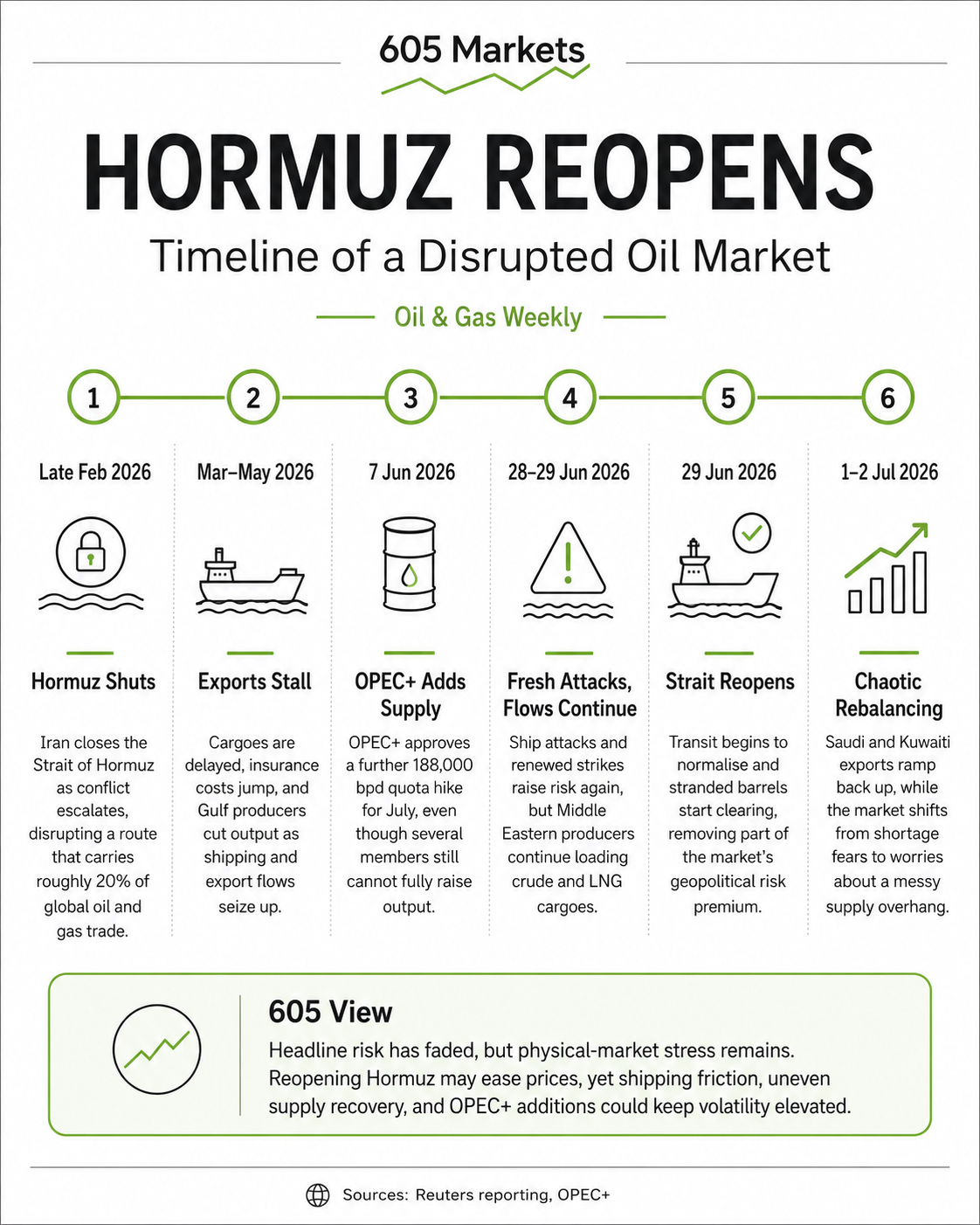
The reopening of Hormuz has led the market to remove part of the geopolitical premium that had built into crude prices during the disruption. As shipping activity improved and Gulf exports restarted, traders began pricing in a lower probability of a severe supply shock. This has pushed crude lower from crisis-level pricing and shifted market attention from immediate scarcity toward the possibility of higher supply over the coming months.
However, the price move has been uneven because the market is still balancing two opposing forces. On one side, the reopening reduces the risk of a sustained blockage and supports a softer crude price. On the other, the physical market has not fully normalised, meaning traders still need to account for uncertainty around shipping flows, insurance costs, and the speed at which delayed exports can actually reach buyers. This leaves crude in a fragile position: prices have eased, but the market remains highly sensitive to any evidence that the reopening is slower or less stable than expected.
Logistical Constraints
The main logistical constraint is the gap between legal reopening and operational normalisation. Even if ships are allowed to transit Hormuz, cargo movement depends on tanker availability, port scheduling, insurance coverage, and the willingness of operators to use the route. These frictions mean that export recovery is unlikely to happen in a straight line.
Tanker positioning is particularly important. During the disruption, cargoes were delayed, vessels were rerouted, and Gulf producers accumulated barrels that could not move efficiently. As traffic resumes, producers now need enough available tankers to clear these backlogs without creating congestion around loading terminals or along alternative routes. This is not simply a question of how much oil is available, but how quickly it can be moved into the market.
Our Supply-Side Analysis
Over half of a month since the announcement of the temporary peace deal between the U.S. and Iran, which guaranteed safe, unrestricted commercial shipping in the Strait of Hormuz, suppliers still remain wary. These suppliers have been stockpiling oil since the beginning of the crisis back in February. However, many risks still remain that prevent Hormuz traffic from achieving pre-war levels. First, as the past couple of weeks have proven, the peace framework between the two nations remains unstable, and multiple oil tankers have been struck or attacked. Current disputes between Iran and the U.S. about shipping rights in the strait continue to make shipping difficult. Second, many companies are still concerned about the remaining sea mines that may still linger in the strait or in the two gulfs it connects, the Persian Gulf and the Gulf of Oman. This forces tankers to divert to two temporary routes: one that hugs the coast of Oman and another that runs closer to the Iranian coast. This creates a more vulnerable chokepoint, further discouraging suppliers and exacerbating the uncertainty suppliers experience about the peace deal. Third, insurance premiums have increased compared to pre-war levels. However, this situation is still bullish compared to before the peace deal. Daily traffic stabilized at around 40 vessels, much higher than the numbers in June. Therefore, in the short run, a couple of weeks or so, worries about the Strait will continue a slight supply shortage and volatility, albeit likely with much less severity.
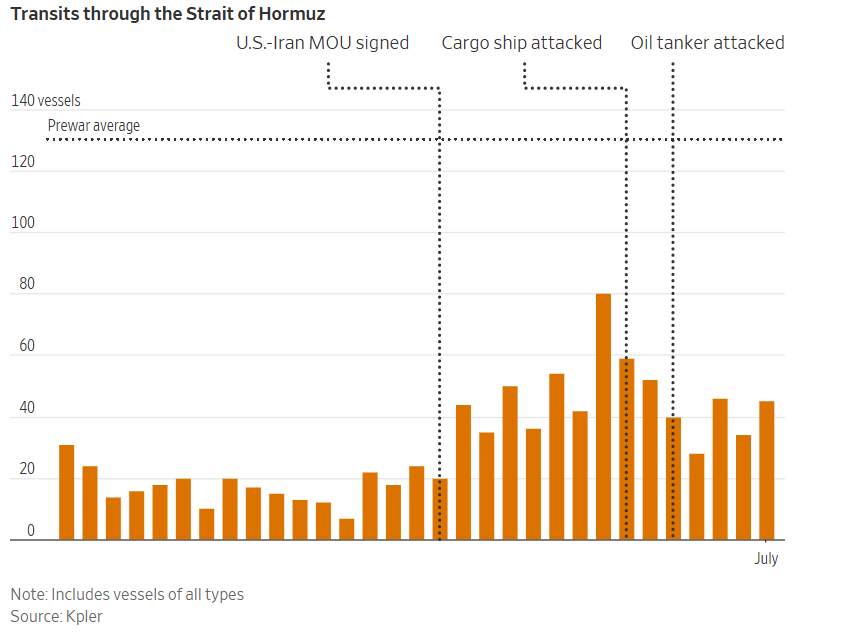
Source: WSJ
On the other hand, in a couple months, supply and shipping will return to normal. The UAE has already drastically increased its exports, likely shipping its stockpiled supply. The rest of the Gulf countries, then, will also see increased exports as this stockpiled oil becomes accessible. Iran could also resume production after the U.S. lifted the blockade on the country. Also, the OPEC+ countries’ increased quotas also signify attempts towards normalisation. While the group had increased production in the previous months as well, those increases were likely to help ease the supply shock during the war. The quotas were never achieved, as countries such as the Gulf states had to cut oil production due to a glut in their stockpiles. These new production increases, then, will not be able to be materialised immediately since it would take a couple months for the oil fields in the Middle East to become fully operational. However, given that stockpiled oil is finally being shipped, a large amount will enter the market once production ramps up. Therefore, assuming worries about the Strait will continue to ease, we expect supply to increase sharply after a couple of months and in the long run.
Given the variety of factors still at play, supply will remain volatile in the short and long term, and it is near-impossible to predict how it will change amid the uncertainty of the peace deal. However, this volatility can have major implications for the markets.
Our Demand-Side Analysis
Similar to supply, demand will also vary heavily in the short-run and the long-run. As the crisis draws to a close, countries are focused on replenishing their depleted oil reserves. According to the International Energy Agency (IEA), global oil inventories fell by around 350 million barrels in March, April, and May. The U.S. recently reached 325.7 million barrels in its Strategic Petroleum Reserve, the lowest level since 1983, with plans to eventually replace it at pre-war levels of between 400 and 500 million barrels. Combined, this is a large number to replace, especially given that oil flowing through the Strait of Hormuz only supplied around 20 million barrels per day (bpd) before the war. As countries seek to restock their reserves, demand for oil and gas will skyrocket in the short-run. This could be especially true for Asian countries, which were arguably the most heavily affected by the war in Iran. However, energy-vulnerable, oil-importing nations may encounter decisions that may affect demand in the long-run.
These countries must decide how to reduce their vulnerability to future crises. The most common solution is to reduce their overall dependence on oil and gas by pivoting towards renewable energy sources. However, to accomplish this, especially from scratch, countries must take on high-capex projects that they may not have the financing for. These projects take time and money, and they are not a guaranteed protection against crises. Therefore, in addition to these projects, ample oil and gas reserves remain necessary to mitigate vulnerability. The Hormuz crisis, then, may have been a sign for many countries to not only replenish but also increase their reserves. This would astronomically increase demand in the short run. China, however, offers a counterexample to this statement. As electric vehicle use and renewable energy increased and construction activity decreased during the Hormuz crisis, China’s oil demand fell sharply as a result. Even as oil prices drop and traffic in the Strait of Hormuz increases, the world’s largest traditional oil importer still hasn’t increased its imports. In fact, it has decreased due to a change in behavior. Compared to pre-conflict levels, Chinese imports decreased rather than increased. This suggests that vastly heightened short-term demand is not necessarily set in stone. Therefore, we expect short-term demand to remain elevated yet slightly volatile, given China’s recent decline, which may influence the strategies of other nations as well.
This may also have implications for long-run demand. Eventually, the restocking will taper off, significantly lowering demand from the short-run high. In addition, while diversification in the short run may seem unimportant, in the long run it can lead to a change in behavior, as seen with China. While Chinese imports may increase in the future, for now, the country’s action evidences that governments that facilitate a decrease in dependence on oil/gas could lead to lower long-run demand. For China, Hormuz was not necessarily the reason its imports decreased, but it simply highlighted its capacity to reduce oil and gas imports. Over the next couple of years, other countries may come to a similar realization leading to a wider long-run decrease in demand.
Our Position
Given our beliefs about short-term supply uncertainty and heightened demand, we believe the market is mispricing oil at $68 per barrel. In the next couple of weeks, we expect crude to correct and rise to around $75-$80 as concerns about the Strait's safety and rising insurance premiums keep supply still volatile amid heightened demand. Also, we expect prices to remain volatile as the uncertainty of the peace deal remains in effect. Other logistical issues, such as the delayed exports, will also affect this volatility, pushing the price up further. However, as the situation stabilises in the next couple of months, we expect a flood of supply to hit the market as production ramps up. Still, prices will likely remain elevated as countries replenish their reserves.
In the long run, overall demand will decrease from its peak due to restocking and changes in behavior. Here, since we also expect production to continue to increase, we expect the current oil shortage to turn into an oil glut. As countries learn their lessons from the Hormuz crisis and producers continue to increase crude production, prices would plunge, possibly dropping under $60.
As the Hormuz crisis comes to an end, there is already a pattern of increased production, seen in OPEC+, to compensate for lost inventories during the war. This may be an overcorrection, though. Just as we believe the crude price is currently underpriced due to uncertain, volatile demand, this pattern of increasing production may overstate the long-run demand. The most significant consequences that may have resulted from these actions in the past two weeks and the conflict in general may not be its direct
impact on short-term supply, but how it ultimately affects the long-term demand for crude and gas.
Risks to our position
The greatest risk to our position is that the reopening of the Strait of Hormuz goes smoother than expected, allowing the delayed barrels to clear quickly and removing the remaining logistical premium from crude prices. Additionally if tanker availability improves, insurance costs decrease to previous normalised levels , OPEC supply additions reach the market without disruptions, then the market could shift from pricing residual geopolitical shock to pricing a short term supply overhang. In this scenario, our expected elevation of volatility would weaken, and crude oil prices would face more sustained downward pressure than we currently anticipate.
Concluding Statement
Hormuz reopening has reduced the immediate geopolitical premium in oil, but it has not removed the structural fragility of the market. The key issue is no longer simply whether barrels can move through the Strait, but whether the wider system can smoothly absorb the restart of delayed exports, higher OPEC+ supply, and persistent shipping uncertainty. Even if crude prices ease in the short term, the physical market remains exposed to bottlenecks in tanker availability, insurance costs, and uneven export flows from key Gulf producers.
Our view is that the reopening of the Strait of Hormuz causing relief in the market is a correct movement, but that the market is wrong to assume a clean normalisation. The reopening of Hormuz should reduce the most extreme upside risks for oil, yet it also introduces a more complex rebalancing problem as delayed cargoes return and supply expectations adjust. Until shipping flows, freight conditions, and OPEC+ delivery become clearer, volatility is likely to remain elevated even if the headline crisis appears to have passed.
Data Sources
- EIA — Hormuz oil/LNG flow volumes
- Reuters — Gulf export rebound
- Reuters Open Interest — chaotic rebalancing / physical market stress
- Reuters — OPEC+ July quota hike
- Reuters — Tanker and LNG vessel movement
- WSJ – Hormuz Traffic Settles Into New Normal
- WSJ – What’s the State of Play in the Strait of Hormuz
- Al Jazeera – With Hormuz Reopened, has the oil shortage turned into a glut?
- Reuters – China learns to live on less fuel, to the relief of oil markets