
Introduction
Iran has increased its attacks on the UAE, causing oil prices to jump 6%. The escalation will most likely cause higher oil prices for the coming weeks. These attacks have also caused structural damage to Fujairah, a key UAE port. Following the strike, the U.S. Navy confirmed it had engaged and sunk seven Iranian fast boats attempting to harass commercial shipping in the Strait of Hormuz, further complicating the diplomatic landscape. The market now faces a period of acute instability, as global energy security hinges on whether the UAE chooses to answer these provocations with direct-overt military action, a prospect that has already prompted emergency security consultations between Abu Dhabi and Washington.
Why is Fujairah so Important
The Strait of Hormuz is the main choke point for oil exports in the Gulf. One fifth of the world's oil passes through the waterway. Thus, any disruption to the strait leads to an increase in the global price of oil. The UAE’s oil exports, particularly Fujairah, are important because they provide a bypass route around Hormuz and handle large crude flows.
With the current turmoil, Fujairah is a backup route for crude imports and exports to the war torn area. Fujairah alone exported over 1.7 million barrels of crude oil in 2025. If one of the ports is suddenly threatened, then the market loses one of the few alternatives that helps keep supply moving. In practice, traders price in both actual outages and the risk of interruptions, which is why tensions in either place add to an immediate geopolitical premium to oil prices. Fujairah is also a major storage and bunkering hub, meaning disruption would affect both crude flows and wider shipping logistics. Even if barrels are not immediately lost, higher insurance costs, rerouting delays and tanker congestion would raise the effective cost of moving oil through the region. As a result, attacks on either Hormuz or Fujairah would likely have an outsized impact on market sentiment relative to the immediate physical supply loss.
Iran’s Strategic Response
These missile attacks mark the first Iranian strikes on the UAE since the ceasefire went into effect on April 8th, and they appear to be a response to several recent events, namely the UAE’s withdrawal from OPEC on May 1st, regional geopolitical developments, and the U.S. announcement of Project Freedom.
One of the primary motives for the UAE’s decision was growing tensions with its neighboring Gulf states, chiefly Saudi Arabia. Many Emirati officials were frustrated that other Gulf states were not taking enough action to prevent the earlier Iranian barrages in March and April. These strikes have severely damaged the country’s oil infrastructure.
We believe that these Iranian attacks were likely meant to further divide the UAE and the other Gulf nations, hedging against the UAE ramping up criticism of other Gulf countries, specifically Saudi Arabia, for their inaction.
Behind Iran’s Strategic Decision to Divide the Gulf Countries
We believe Iran’s targeted actions were political, intending to create divisions between the UAE and other Gulf nations.
If Iran’s main goal was to further cripple the energy markets, then a more effective course of action would be crippling oil infrastructures across the entire Middle East. For example, Saudi Arabia seems to pose a more significant threat than the UAE, both militarily and energy-wise. Production wise, the country’s petroleum and other liquids production (11.2 million bpd) is nearly triple that of the UAE (4.6 million bpd). Infrastructure-wise, Saudi Arabia can circumvent the Hormuz blockade by utilizing its East-West pipeline, whereas the UAE has started relying on hidden tankers to bypass the blockade.
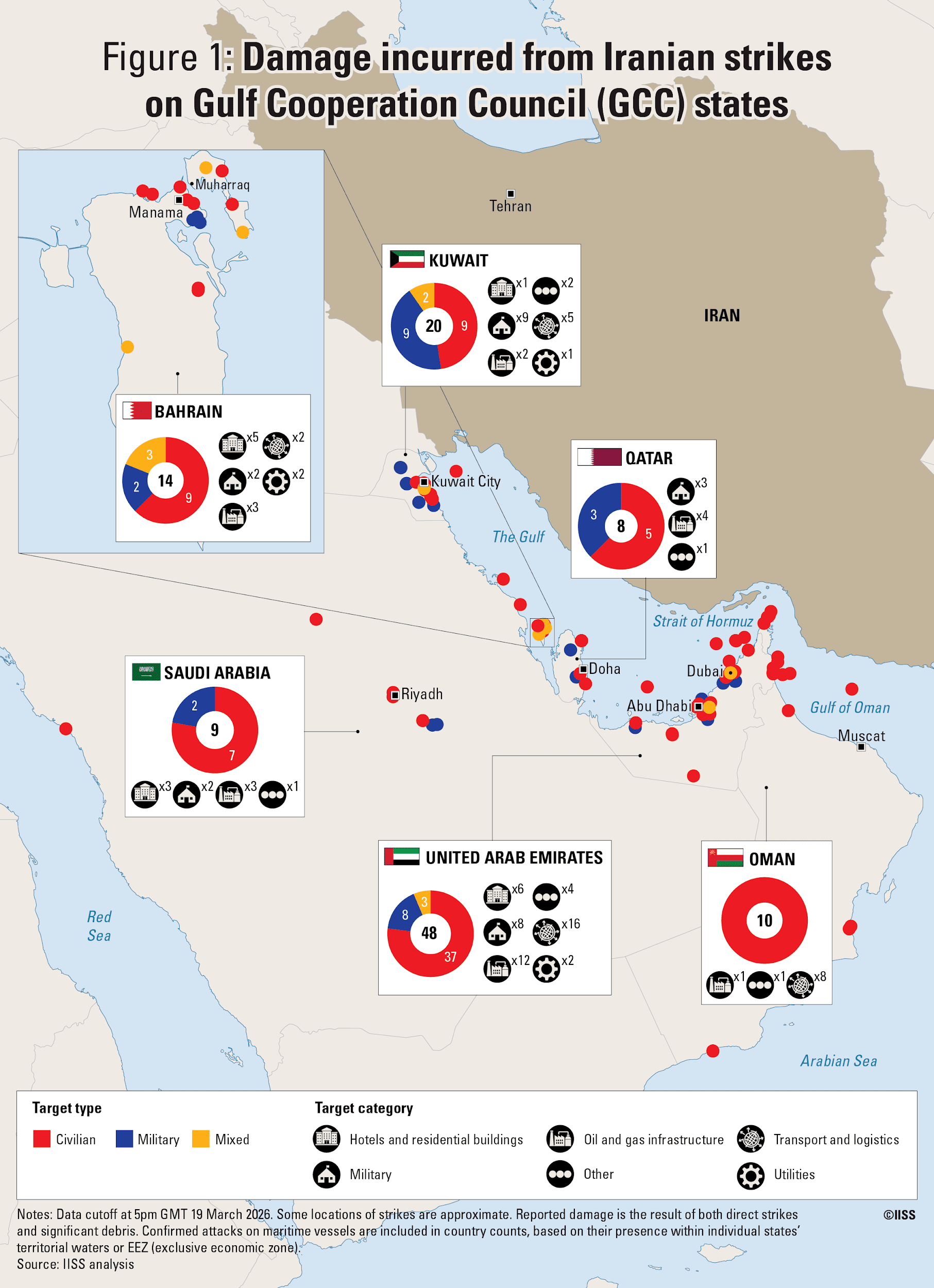
Image Source: International Institute for Strategic Studies
Iran retains the capacity to strike other Gulf states, yet the concentration of attacks on the UAE may deepen Emirati frustration not only toward Iran, but also toward neighboring Gulf countries that have remained largely untouched. While those states have no formal obligation to come to the UAE’s defense, particularly following the UAE’s withdrawal from OPEC, the perception of selective targeting could foster resentment within the Gulf bloc and weaken regional cohesion.
The UAE has Increasingly Become More Aligned With the US and Israel
Furthermore, the UAE has recently been more closely aligned with the United States and Israel and has cooperated on security and military matters. According to an analyst closely associated with the Iranian regime, this represents an “unprecedented hostile approach”. This attack may therefore send a message to other Gulf countries about the risk of aligning with the US and Israel.
Another factor in this decision was the launch of Project Freedom, intended to help escort merchant ships out of the Strait of Hormuz. In response, Iran has attacked multiple ships, and specifically an Emirati tanker in the Strait. The attacks have signaled Iran's continued contest in the Strait leading to a spike in oil prices and even more uncertainty in the markets.
The UAE’s Reported Attacks on Iran
According to a Wall Street Journal article, the UAE has covertly attacked Iran, marking a significant turning point in the conflict from purely defensive action from the UAE to quiet retaliation, which could potentially spark a larger war in the gulf. The UAE secretly targeted and attacked Iranian energy infrastructure such as the Lavan Island refinery, without ever making a formal acknowledgement of doing so. This allows the UAE to maintain strategic deniability, allowing it to respond to attacks from Iran without declaring war. A flaw here is that it creates the possibility of miscalculation and overestimation of escalation from Iran, as Iran may choose to use these attacks as justification for further greater scale attacks on UAE ports, tankers, or pipeline infrastructure. For oil markets, this makes the conflict more dangerous because the UAE is no longer just a victim of Iranian pressure, but an active participant in a wider Gulf infrastructure war.
Political Responses
Shortly after Iran's most recent attacks, nations around the world condemned the attack. Germany, Canada, France, and the United Kingdom condemned the strikes as unjustified and for escalation following the ceasefire agreed last month. Many of the Gulf countries also strongly denounced these attacks. Saudi Arabia, Qatar, Kuwait, Bahrain, and Jordan condemned Iran for threatening regional security, the UAE’s sovereignty. While these attacks have drawn strong condemnation, none of these nations has taken direct action to counter the Iranian aggression.
The attacks prompted a more direct response from the U.S., who retaliated with strikes both on Iranian ships as well as the Iranian mainland. Since the initial attack last Monday, fighting has ramped up between the U.S. and Iran, with more rounds of missiles launched at the UAE.
Our Analysis
The main consequence these attacks have had on energy markets is the disruption of commercial shipping through the Strait. Before the attacks, movement had been relatively constrained, with many ships opting to go dark to bypass the dual blockade still in effect in Hormuz. Therefore, this won’t have an outright effect on most shipping in Hormuz, as compared to before.
The most significant aspect that should be monitored is Iran’s continued attacks on the UAE and whether they will target the port of Fujairah. Fujairah is an Emirati port that has become the UAE’s economic lifeline since the closure of the Strait of Hormuz, allowing the UAE to continue exporting oil. Crude exports through Fujairah have increased 38% since the beginning of the war, averaging almost 1.62 million bpd. It is also the terminus of the Abu Dhabi Crude Oil Pipeline (ADCOP), which can carry around 1.5 million barrels of oil per day, meaning Fujairah was a key export route. However, the attack on May 4th caused a fire in an oil refinery in the Fujairah port region. This served as a reminder that the region is still quite vulnerable to Iranian attack and that disabling this port would significantly cripple the UAE and the world economy even further. Therefore, depending on Iranian action, and whether the UAE and the U.S. can defend against it, crude exports could be affected.
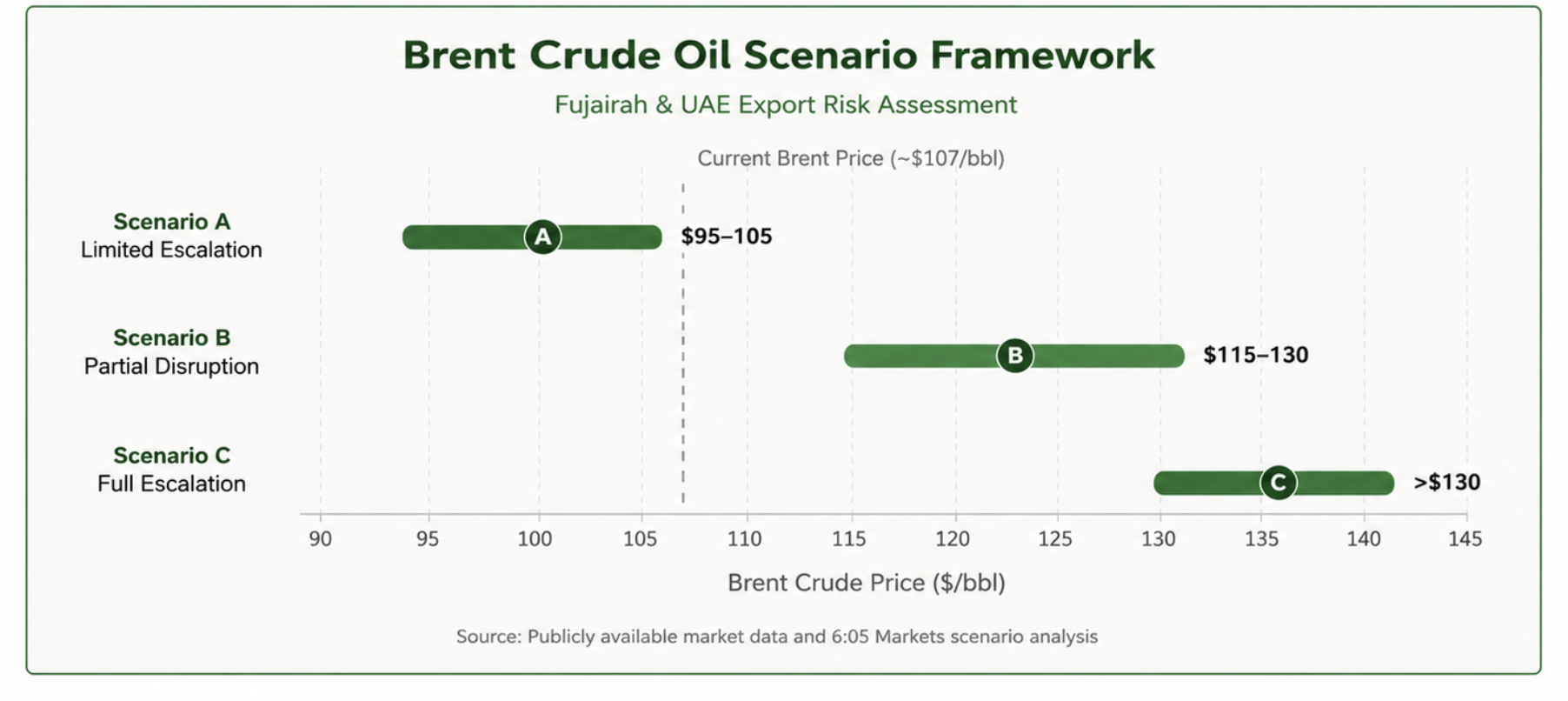
We offer three scenarios that would occur. First, Scenario A would be one where strikes on the Fujairah port region cease, de-escalation occurs, and this attack does not have consequences in the long-run. Scenario B would involve escalation of Iranian action, continued strikes on Fujairah, covert-small response from the UAE, and slightly increased crude prices. Scenario C would be one where the ceasefire completely collapses. The UAE would join in openly on attacking Iran, receive retaliatory strikes, potentially damaging the oil infrastructure of both the UAE, Kuwait, and other Gulf countries.
Scenario A:
Scenario A would involve no further escalation of conflict between the UAE and Iran. In the past couple of days of this writing, Iran and the U.S. traded blows, but there was no further damage done to the Fujairah port. If this scenario were to continue, the damage would be limited to the refinery that was set ablaze, not hindering the upstream and midstream operations that the Hormuz Crisis has put under pressure. Here, the ADCOP pipeline and the port would remain unharmed and operational. Crude exports would not decrease significantly and would eventually return to the operational capacity of 1.6 million bpd. We would expect traders and markets to come to this realization, and the price of crude would quickly correct from its ~$6 jump on Monday and stabilize at a range between $95-$105.
Recently, Iran’s Revolutionary Guard Corps (IRGC), proposed a new, expanded region of maritime traffic control that would include the port of Fujairah:
This scenario would be one where Iran fails to establish this region of control and presumably enforce a blockade on UAE exports. Additionally, no escalation would occur between the UAE and Iran, with this attack being a one-off message with some of the intentions discussed earlier. If all of these factors come together, then the energy markets will stabilize to the pre-attack state.
Scenario B:
This scenario would include further Iranian targeted strikes on the Fujairah region, partially limiting the crude export operations. The damage to infrastructure would also require weeks, if not months, to repair, effectively crippling crude exports from this port. This supply shock would likely drive Brent crude prices to around $115- $130, depending on the capacity still available to flow through Fujairah. Another situation could be that Iran attempts to enforce its proposed blockade with some success, attacking tankers that do not comply or that attempt to go dark to bypass it. Once again, the price of Brent would vary depending on the success of this Iranian strategy. Whether Iran is successful in enforcing its blockade or not, the implications remain clear: market uncertainty and the potential escalation of the war would sour global sentiment and push prices higher than a supply shock alone could.
Scenario C:
This scenario would involve a complete escalation of hostilities in the Middle East. As the UAE gets pushed further towards its limits and becomes increasingly aligned with the U.S. and Israel, the country decides to join in on attacks on Iran and break the ceasefire in effect. This would give Iran justification to cause immense infrastructural harm to the UAE, such as directly striking the ADCOP pipeline and cutting off its 1.5 million bpd export capacity. The effects would be immediate, potentially pushing Brent prices above $130. Also, the addition of another nation, a major crude exporting country as well, to this escalating conflict would push prices even further. Separately, a complete success of Iran’s proposed blockade could also induce this scenario. Since the blockade region includes Fujairah, Iran could cut off almost all maritime exports from the UAE, with a similar effect to destroying the ADCOP pipeline. Under any of these circumstances, this scenario would trigger a massive surge in crude oil prices and market uncertainty. Furthermore, these events would inevitably prolong the conflict and delay the timeline for restoring access to the Strait of Hormuz.
What we expect to happen
Our base case is Scenario B; we believe that the most likely outcome is persistent, but contained war in Iran and around the UAE and Strait of Hormuz. It is unlikely that either the US, Iran, or other affected countries will attempt to escalate things further into a full-scale regional war. That being said, Iran does have strong motivation to keep pressuring the UAE and infrastructure surrounding the shipping routes in order to maintain control and leverage over the oil markets. This means that there will likely be more drone strikes and missile attacks on infrastructure, tankers, or logistical assets connected to Fujairah.
We do not expect a complete collapse of UAE export capacity unless Iran chooses to strike ADCOP directly or successfully enforce a wider maritime control zone around Fujairah. Even considering that outcome, the market is unlikely to price this as a one-off event. The combination of damaged infrastructure, higher insurance costs, constrained shipping, and uncertainty over UAE retaliation will keep Brent trading in a higher band than before the attack.
As a result, we expect Brent to remain elevated in the near term, likely around the $110-$125/bbl range, with upside risk if Iranian attacks continue or if the UAE joins U.S. operations more directly.
Conclusion
Iran’s attacks on the UAE and related shipping infrastructure marks a new stage in this conflict and the story around flows in the Strait of Hormuz. Iran has moved away from threatening the Strait itself and instead has shifted to attacking related infrastructure and oil ports that served to reduce dependence on flows through the Strait. This makes the crisis even more dangerous and volatile for the energy market, because even partial disruption at Fujairah would weaken one of the few remaining outlets for Gulf crude.
The immediate price reaction reflects more than a short-term supply shock. It reflects a broader repricing of geopolitical risk across the Gulf, where traders must now account for damaged infrastructure, disrupted shipping, higher insurance costs, and the possibility of direct UAE retaliation. Even if the conflict does not escalate into a wider regional war, the perception of vulnerability will keep a risk premium embedded in crude prices pushing them up by at least $15/bbl.
The UAE’s covert strikes on Iranian energy infrastructure add another layer of risk, making de-escalation significantly less likely. Ultimately, Hormuz is no longer just a chokepoint risk. It is now a wider Gulf infrastructure risk. Unless Iran pulls back or the U.S. and Gulf states can credibly secure Fujairah and surrounding maritime routes, oil markets will remain exposed to further price spikes, with Brent likely to trade in an elevated range until the security of Gulf exports is restored.
Sources:
- Reuters — UAE accuses Iran of attacking empty ADNOC oil tanker in Strait of Hormuz
- Reuters — UAE says air defences engage missiles, drones as flights disrupted
- Reuters — Gulf’s fragile trade lifeline hangs on two eastern UAE ports
- Reuters — Iran now defines Strait of Hormuz as far larger zone, IRGC officer says
- Reuters — Three crude oil tankers exit Strait of Hormuz with trackers switched off, data shows
- Reuters — Strait of Hormuz disruption could push oil market recovery into 2027, Aramco CEO says
- EIA — Amid regional conflict, the Strait of Hormuz remains critical oil chokepoint
- IEA — Strait of Hormuz
- WSJ - UAE has Covertly Attacked Iran