
For much of 2022–2023, Russian Urals crude traded at a steep discount to Brent, reflecting sanctions, shipping constraints, and a shrinking pool of buyers. That discount became a defining feature of global oil markets, signaling both geopolitical fracture and logistical bottlenecks. Yet more recently, the gap has narrowed sharply, surprising many observers who assumed discounted Russian barrels were a lasting fixture.
This shift highlights a key reality: oil pricing is ultimately governed less by political intent than by physical flows and market demand. The rebalancing of Urals relative to Brent suggests that Russia has regained a degree of pricing power, even within a constrained trading environment.
Market Context - Urals Crude Moves Back Towards Brent
The global oil market has tightened amid steady demand growth and intermittent supply concerns. Asian buyers, particularly in India and China, have continued to absorb large volumes of Russian crude, integrating it into their refining systems and trading networks. At the same time, uncertainty surrounding Middle Eastern supply, driven by geopolitical tensions and production management by OPEC+, has reduced the availability of alternative medium sour grades comparable to Urals.
As a result, Urals has become less of a distressed asset and more of a competitive feedstock. Freight routes have stabilised, shadow fleets have expanded, and payment mechanisms have adapted, all contributing to smoother trade flows. In this environment, buyers are less able to demand steep discounts, especially when substitute barrels are either more expensive or less certain.
What Changed - From Deep Discount to Near-Parity
The narrowing discount reflects a convergence of three forces. First, demand resilience in Asia has created a reliable outlet for Russian exports, reducing the urgency to price aggressively. Second, supply side risks elsewhere, particularly in the Middle East, have elevated the value of available barrels, including those from Russia. Third, the logistical and financial frictions imposed by sanctions have, over time, been partially mitigated through parallel systems of shipping, insurance, and settlement.
Together, these factors have shifted Urals from a forced sale commodity to one priced more in line with global fundamentals. The discount has not disappeared entirely, but it has become more cyclical than structural. This suggests that the spread between Urals and Brent will continue to fluctuate, widening during periods of oversupply or heightened sanctions pressure, and narrowing when physical markets tighten and demand strengthens.
Analysis
While the Hormuz crisis served as the catalyst that ultimately spiked its price, the alleviation of the Urals discount has been apparent for years.
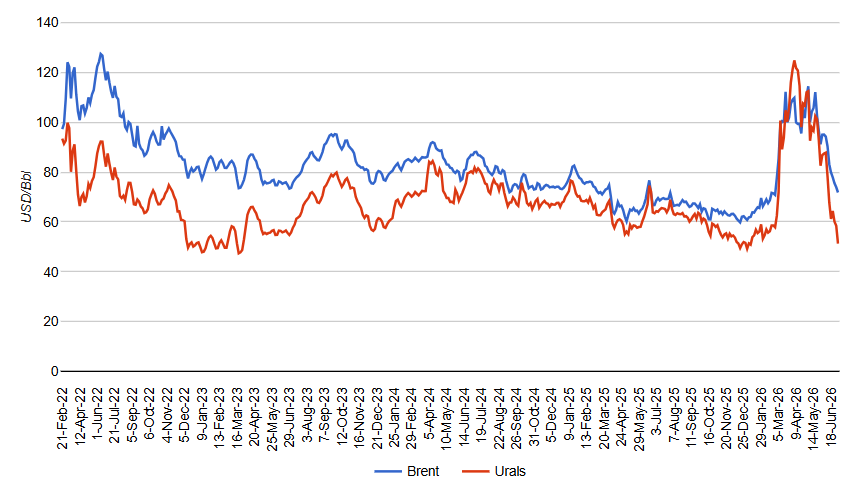
The graph above shows the price differential between Brent and Urals crude. As seen, the graph begins on February 21, 2022. Here, the Urals crude trades at only a slight discount (~$8), a natural difference given its heavier, more sour nature and logistical constraints compared to Brent crude. The subsequent rapid spike in Brent reflects the market’s reaction to the 2022 Russian invasion of Ukraine. This sparked the drastic price differential, as traditional Western buyers effectively “self-sanctioned” imports of Russian crude. Official international sanctions on Russian crude were then announced later in Dec. 2022, further widening the differential between Brent and Urals.
Since then, however, the two prices have slowly begun converging, especially in 2023-2024, reflecting the shifting of insurance capacity for western crude as well as increased shadow shipping activity in Russia. In addition, sanctions enforcement loosened during this period, and buyers, such as India and China, began importing Russian crude on a wider and more regular basis. All these factors tightened the differential, nearly bringing it back to the normal discount at which Urals crude trades.
This indicates that, despite the severe divergence in price differentials driven by geopolitical factors, it was ultimately a shift in logistics and demand priorities that brought the arbitrage back to normal.
2026 has been a wild year for Russian crude. Beginning the year at ~$49 and more than doubling to its peak, it is clear that global crude supply concerns fueled this dramatic change. Furthermore, the rapid drop in Urals oil between June and July, at a time when peace talks and a resurgence in traffic eased supply concerns, further strengthened the correlation between the two. Urals pricing has roughly followed the same path as Brent pricing, albeit with wider swings.
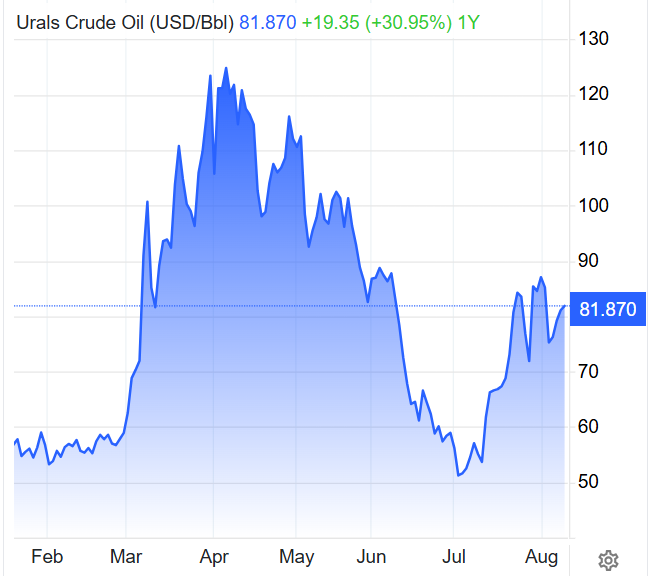
The difference in these changes is of special interest. Despite trading at an enormous discount, Urals oil traded just above a $10 premium to Brent during the Hormuz crisis. ($124.87 vs. $114.44). In addition, Urals pricing remained at a sustained high from late March to mid-April. Brent, on the other hand, was most elevated from late April to mid-May. One possible explanation for this was the Urals’ crude position. As a low-demand, sanctioned oil supply, Urals crude served as an alternative to the standard Brent crude.
When the Hormuz supply shock arrived, buyers were first concerned about the war's implications. Buyers massively increased demand for crude, naturally turning eyes towards cheaper, alternative sources, such as Urals crude. Faced with limited supply from Hormuz, they turned to Russian crude, which was readily available and logistically convenient. This was especially true for Asian buyers. India, for example, now imports over half of its crude from Russia.
Quantitatively, buyers’ overreaction shifted significant demand towards Urals crude, pushing its price even higher than Brent's. Greater availability further boosted demand, contributing to the Urals premium seen in the graph above. The subsequent price decrease, then, represents a natural market correction, a relief from the acute panic and disruption that Hormuz brought.
While demand has increased significantly for Ural crude, there have been significant changes on the supply side as well. Beginning in mid-2026, Ukraine intensified its attacks on Russian petroleum infrastructure, stressing the country’s production, refining, and logistics. This sudden supply shock sent the Urals price soaring, trading at nearly the same price as Brent, hovering around $75-85, for the beginning of August.
Events both leading up to 2026 as well as the critical ones this year have shown that even when limited by geopolitical constraints, it is the fundamental laws of supply and demand that pushed Urals crude to overcome the effects that created such a deep discount.
Market Implications — Who Benefits and Who Loses
The most direct beneficiary would be the Russian government, as well as major Russian oil companies. For the government, the effect is obvious. Russia’s state oil and gas revenue increased by 60% year-on-year during the month of July. As Urals crude remains elevated and shipping difficulties continue in Hormuz, keeping demand high, the Russian government will continue to see greater revenues.
While Russian oil majors should also benefit from the nonexistent discount, they are struggling due to the recent Ukrainian strikes on oil infrastructure. Oil production has already fallen since the beginning of the year, mostly due to damage to refineries. Most Russian oil majors, such as Rosneft, Lukoil, and Gazprom Neft, are vertically integrated. Damage to refineries results in accumulated repair costs for all these oil giants, both financial and in terms of time. An increase in the price of Urals crude also raises the opportunity cost of processing it in a domestic refinery rather than exporting it, especially when it is priced the same as Brent crude.
New importers, such as Asian buyers, will also be hurt by this narrowing discount. Because this convergence is driven by physical scarcity, all world benchmarks drastically increased. While Urals crude served as a reliable alternative fuel source, with many buyers profiting enormously from previously buying cheap Russian petroleum, the new narrowing discount erodes this advantage. Paradoxically, it is this great increase in demand that heavily contributed to this scenario. As a whole, importing economies will need to spend more on crude and petroleum products.
Ultimately, the Russian people become the biggest losers. Higher crude exports, driven by stronger pricing power, combined with lower production and refining, have led the country to start importing gasoline. Already, Russian citizens are experiencing fuel shortages. Continuing drone attacks will only further cripple domestic refining, and Urals crude will be elevated.
Our Position — The Russian Oil Discount Is Cyclical, Not Permanent
Bringing all of this together, we view the Urals-Brent discount convergence to be cyclical rather than permanently resolved. It is changes in market conditions, specifically those driven by supply and demand, that have brought the two benchmarks together. Future market, as well as geopolitical, changes will then likely determine the movement that Urals crude ultimately experiences.
The strongest evidence that points towards this is the events of 2026, allowing Russian oil to regain significant pricing power. The dramatic fluctuations highlight how the Urals-Brent pricing disparity didn’t stablise due to the changing geopolitical environment. Additional supply shocks in Russia, combined with buyers’ increased affinity for alternative crude sources, have created this temporary situation where the Urals discount to Brent is practically non-existent. Therefore, we assume that it is too soon to write off the Urals discount. Simple foreseeable off-ramps, such as a long-term Hormuz de-escalation, Russian infrastructure stabilization, increased sanctions, or demand changes, would likely lead to drastic changes, possibly widening the spread.
Recently, the U.S. Senate passed further aggressive sanctions against Russian petroleum. Most importantly, it allows the U.S. president to place tariffs of up to 100% on goods from the top five importers of Russian oil and gas. This may significantly change the demand profile of Russian petroleum. India, for example, may decide to import from other sources, easing the upward pressure on the price of Urals.
That said, we don’t believe that any reversion implies returns to extremes such as the deep discount seen in 2022-2023. This is because factors such as the shadow fleet and alternative insurance capacity will remain in place. Rather, we believe that once all the dust settles, there will be a lower, narrower cycling between $5-$15 in the Urals-Brent differential.
A variable that we must weigh heavily is the timing of physical infrastructure damage in Russia. Even if pricing normalises elsewhere, production and refining capacity destroyed in the country would take years to rebuild, keeping Urals crude elevated. Still, normalisation would widen the Urals-Brent disparity, incentivizing a less export-focused policy in Russia and possibly fast-tracking the repair process. This scenario would likely affect the long-term positioning of Russian crude.
Practically, though, we believe that it will be the resolution of the supply shock that alters the Urals-Brent differential, underscoring the cyclical nature of the price differential.
Risks to Our View - What Could Widen the Discount Again
The clearest risk is a normalisation of Middle Eastern supply. If traffic through the Strait of Hormuz recovers and Gulf producers restore exports, Asian refiners will have more alternative barrels available. This would weaken Russia’s bargaining position and probably widen the Urals discount.
Demand from India and China is equally important. Refinery maintenance, weaker margins or high inventories could reduce spot buying and leave Russian sellers competing for fewer customers. The sharp movement in July, when the delivered discount in India moved from more than $10 per barrel to approximately $1–2, demonstrates how quickly buyer leverage can change.
Higher Russian export availability could also pressure prices. Disruption to domestic refineries can reduce Russia’s internal crude consumption, releasing additional barrels for export even while its refining system remains under strain.
Finally, stronger sanctions enforcement could increase the cost and difficulty of transporting Russian oil. Restrictions on tankers, insurers, banks and third-country intermediaries would make buyers more cautious and encourage them to demand a larger discount as compensation.
Key Indicators to Watch
The most direct indicator is the Urals differential against Brent in India and China. Prices must be compared using the same delivery period and location because Russian-port FOB prices and delivered Asian prices include different freight and sanctions costs.
Indian and Chinese import volumes, refinery utilisation and spot tenders will show whether current demand is durable. Falling refinery purchases would indicate that buyers are regaining pricing power.
Middle Eastern supply conditions should also be monitored closely. Hormuz tanker traffic, Gulf export volumes and regional official selling prices will reveal whether competing barrels are returning to the Asian market.
Russian port loadings, refinery outages and export-infrastructure disruptions will determine how much crude is available for sale. Freight rates, shadow-fleet capacity, insurance costs and new vessel sanctions will show how much of the discount reflects logistics and compliance rather than crude quality or demand.
Conclusion - Supply Security Is Repricing Russian Crude
The narrowing discount does not mean Western sanctions have stopped mattering. It shows that their pricing effect depends on physical market conditions. When Asian refiners compete for reliable barrels outside the Hormuz supply chain, Russia gains bargaining power and the sanctions penalty becomes less decisive.
Our view is therefore that the Urals discount is cyclical rather than permanent. It should remain relatively narrow while Asian demand is strong and Middle Eastern supply is uncertain, but could widen rapidly if alternative supplies recover, Russian exports increase or sanctions enforcement strengthens. Supply security is repricing Russian crude; it has not removed the underlying risks.
Data Sources
- Wall Street Journal — “See How Ukraine Is Taking Out Russia’s Refineries,” July 13, 2026
- Reuters — Ukraine’s Attacks on Russian Energy Sites, updated August 11, 2026
- Reuters — Urals Discounts Widen in India, July 7, 2026
- Reuters — Urals Discounts Narrow in India, July 29, 2026
- International Energy Agency — Oil Market Report, May 2026
- Council of the European Union — Twenty-First Sanctions Package, July 23, 2026