
Introductory Summary
Total Energies presents a constructive stock-pitch opportunity because it combines near-term exposure to elevated energy prices with a clear shareholder-return framework. The company’s integrated model gives investors exposure across upstream oil and gas, LNG, refining, trading, power, and renewables, making it more diversified than a pure crude or refining play. This matters in the current market because uncertainty around Middle East supply flows through the Strait of Hormuz, and OPEC discipline has kept energy volatility high, creating upside for both production earnings and trading margins.
The recent Q1 results strengthen this case and at roughly 8x forward P/E and around 6x EBITDA, the stock offers a moderate valuation relative to its cash generation and capital return profile. Overall, TotalEnergies is best viewed as a diversified cash-return play on energy volatility, with upside from sustained oil and LNG strength, but key risks from commodity downside, refining-margin normalisation, and French political pressure.
Company Overview
TotalEnergies is a French global integrated energy major with operations across the full energy value chain, including oil and biofuels, natural gas and LNG, refining, trading, power, and renewables. It is structured as a multi-energy business, which means it is not just an upstream oil and gas company but one that can generate cash flow from production, processing, marketing, electricity, and low-carbon energy as part of the same platform
Its integrated model is a key strength because it helps diversify earnings, support resilience through energy cycles, and gives the company optionality as the energy transition evolves. TotalEnergies also has a growing electricity and renewables franchise, with emphasis on renewable generation, flexible power, storage, and trading, alongside its traditional hydrocarbons business.
The company operates in around 120 countries and employs over 100,000 people, giving it broad geographic reach and exposure to multiple energy markets. In practical terms, this makes TotalEnergies attractive to investors who want exposure to both near-term cash generation from oil and gas and longer-term growth from lower-carbon energy.
Investment Thesis
TotalEnergies offers a compelling integrated and diversified energy investment case because its earnings are spread across multiple parts of the energy value chain. Unlike a pure upstream producer, the company can benefit from higher oil and gas prices, LNG tightness, refining margins, and trading volatility. This gives the business greater resilience across different commodity-price environments.
The most attractive part of the thesis is TotalEnergies’ balance between cyclical upside and shareholder returns. Its upstream and LNG businesses provide exposure to elevated energy prices, while refining and trading can capture dislocations in product markets. At the same time, strong cash generation allows management to return capital through dividends and buybacks without making the stock dependent on aggressive growth assumptions.
Overall, the pitch is that TotalEnergies is not simply a bet on crude pricing, it is a diversified cash-flow position within the energy sector, offering exposure to oil, gas, LNG, refining, and trading while maintaining a clear capital return framework for shareholders.
Recent Catalysts for Projected Growth
Many catalysts are driving TotalEnergies' projected growth. However, the most important are:
Continued production growth:
New upstream projects for oil and gas in countries such as Brazil, Libya, and Angola demonstrate the company’s focus and expectations for continued production growth, which has been a significant driver behind recent success. The company expects production to grow around 4% year over year in 2Q25, excluding the impact of the Middle East conflict. However, production remains shut down in Qatar, Iraq, and offshore UAE, which constitutes 15% of TotalEnergies’ total production.
2. Focus on LNG & (electricity) Integrated Power
TotalEnergies is already the world’s 3rd largest LNG player. However, it has given itself an ambitious goal to increase LNG sales by 50%. This objective ultimately will aid in consistent revenue growth, supported by major projects in both Qatar and the U.S.
Another major goal for the company is to increase electricity production to 100 TWh/year. To do this, it has begun scaling its renewable capacity, including solar and onshore/offshore wind. Recently, TotalEnergies announced the development of a 440 MW solar project in the Philippines, in addition to its renewable projects in Kazakhstan, the UK, and other nations.
3. Continued uncertainty in the Middle East
While the Middle East crisis has completely halted production for TotalEnergies in the region, the uncertainty has driven prices higher, which was the main driver of the company’s success this past quarter. Prices will remain elevated now, and even after the war ends.
One word to sum up these catalysts for TotalEnergies is expansion. Its objective is to accommodate a greater amount of energy to meet what it perceives as an ever-increasing demand from a growing population and developing countries. These steps will translate well into long-term shareholder returns
Financial Performance & Current Valuation
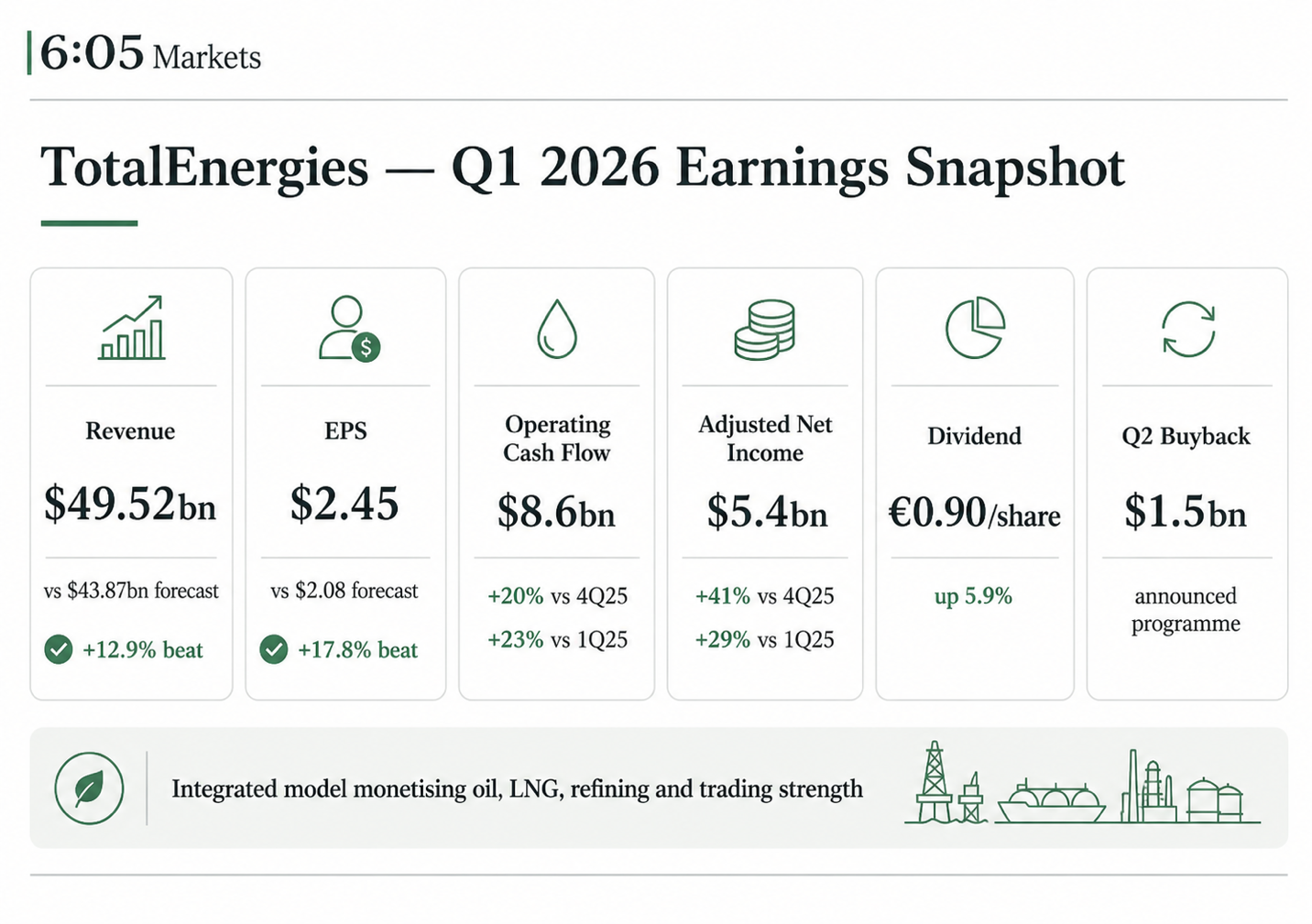
The first quarter of 2026 was a stand-out quarter for TotalEnergies. On April 29th, the company posted a revenue of $49.52 billion, approximately 12.88% greater than the forecasted $43. 87 billion. Earnings per share (EPS) were $2.45 exceeding its forecast of $2.08. This performance was extremely impressive compared to past performances, especially given the operational disruption of the Hormuz Crisis for the latter half of the quarter.
The company’s reported cash flow from operations (CFFO) was $8.6 billion, 20% greater than 4Q25 and 23% greater than 1Q25. This carried over to net income, which totaled $5.4 billion, a 41% and 29% increase from 4Q25 and 1Q25, respectively. Adjusted earnings before interest, taxes, depreciation, and amortization (EBITDA) also increased significantly compared to the previous quarters.
The substantial increase in cash flow, net income, and EBITDA suggests TotalEnergies’ ability to capitalize on the higher commodity prices brought about by the Middle East war. In addition, it highlights the company’s effective management and strategies throughout this past quarter. It is likely that retaining this same framework will put TotalEnergies in a more feasible position for any supply shocks in the future as well, and it can be expected that this strong financial performance will continue, given that commodity prices remain elevated for the time being.
Also important to note: TotalEnergies is increasing its dividend to €0.90/share, a 5.9% increase, and is also buying back $1.5 billion in shares in the second quarter, reallocating further profits back into shareholders’ hands.
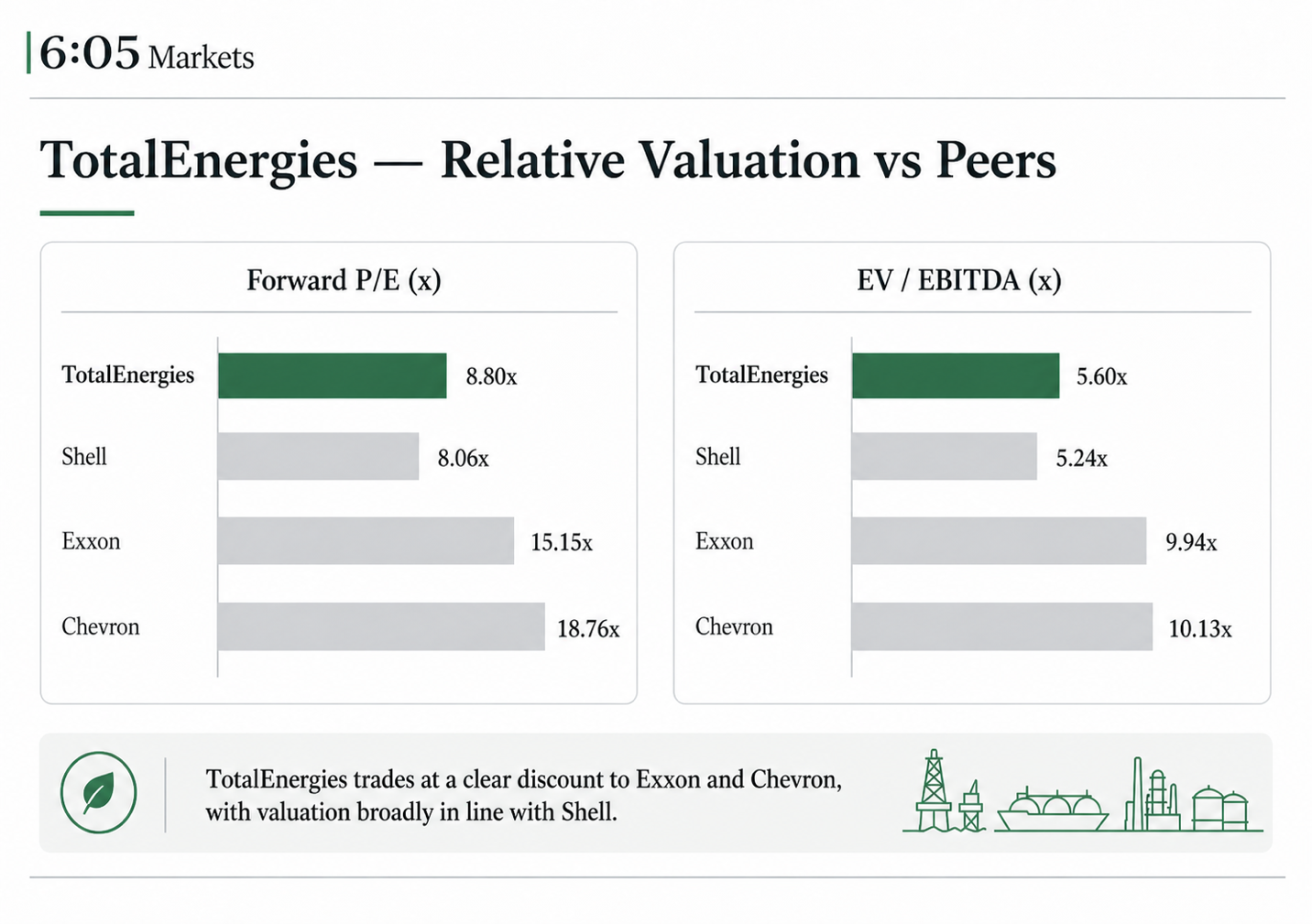
Currently, TotalEnergies trades at a Forward Price-to-Earnings (P/E) of 8.8x and an Enterprise Value (EV)/EBITDA ratio of 5.6x. Fellow supermajor Exxon trades at a Forward P/E of 15.15x and an EV/EBITDA of 9.94x, while Chevron trades at 18.76x and 10.13x, respectively.
Compared to these two big oil corporations’ valuations, TotalEnergies is significantly more undervalued. Shell has similar valuation metrics to TotalEnergies, with a P/E of 8.06x and an EV/EBITDA of 5.24x. As a whole, TotalEnergies trades at a discount to the rest of the Big Oil corporations, and its current undervaluation makes it a perfect addition to an investor's portfolio seeking to expand into Big Oil.
Segment Financial Analysis
Production of Oil/Gas:
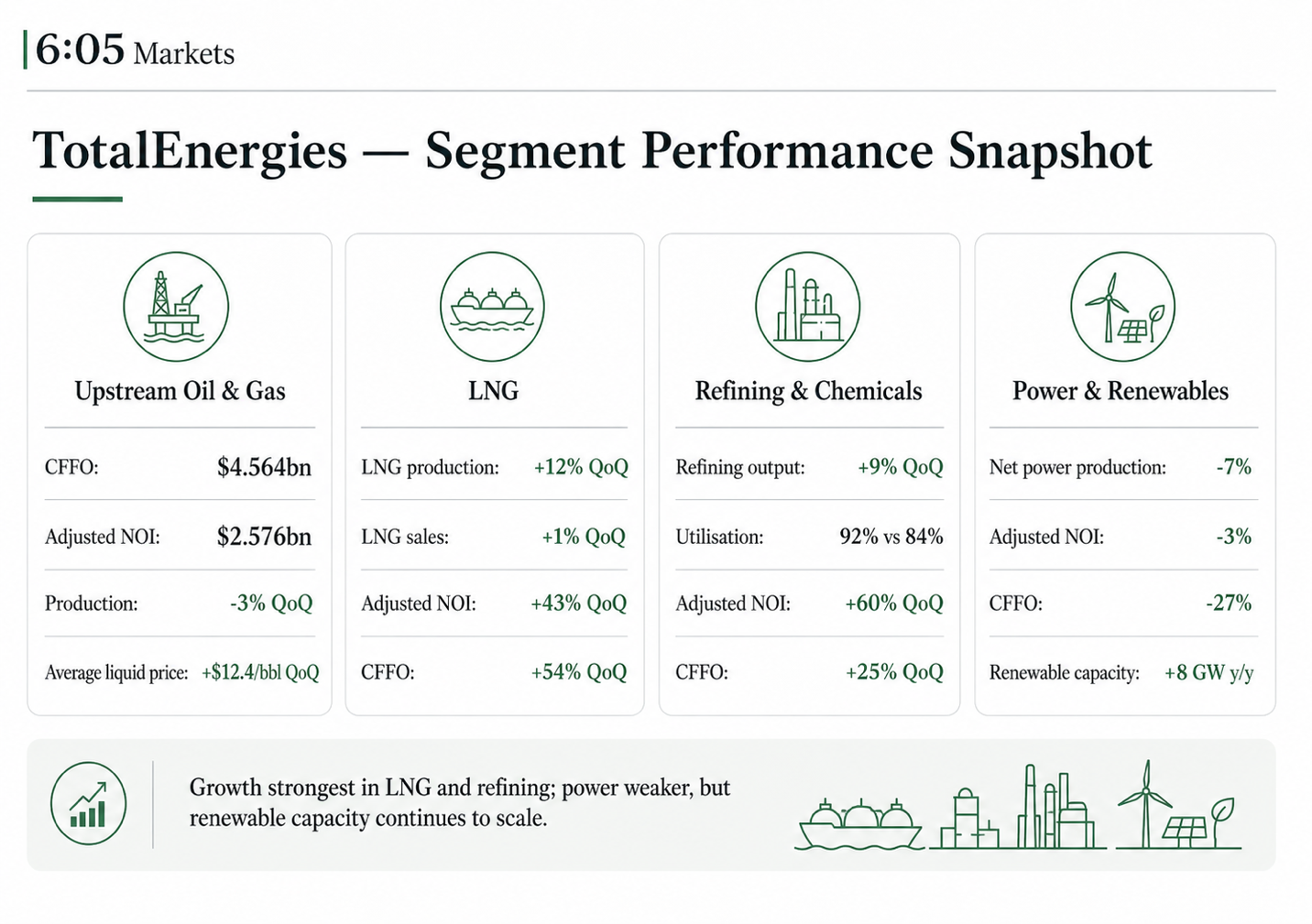
Hydrocarbon production has been a significant driver for TotalEnergies’ returns, yielding a CFFO of 4.564 billion and an adjusted net operating income of $2.576 billion, 43% higher than the previous quarter. Production has decreased by 3% compared to the previous quarter, due to a drop of more than 5% in liquids production. The profit, however, stems from an increase in the average liquid price (+$12.4 per barrel over the quarter). Interestingly, a 5% drop in production seems relatively low, given that 15% of the company’s output was stalled in the last month of Q1. Possibly, that suggests the increase in liquids production in other regions.
LNG:
LNG hydrocarbon production increased by 12% quarter to quarter, despite the stoppage of Qatari production, mainly because of growth in Australia, the U.S., and Malaysia. LNG sales also increased by 1% quarter-to-quarter, indicating that LNG sales remain stable and will likely continue.
Sales-wise, the net operating income from LNG has increased 43%, while CFFO has increased 54$ from the previous quarter. Again, much of this increase has been due to the market volatility for commodities.
Refining & Chemicals:
TotalEnergies’ refining has increased by 9% from the previous quarter, supported by a 92% utilization rate, up from 84%. This is due to the recovery of all refinery units, allowing them to reach their full operational performance. As these units remain operational, refining will maintain stable output.
Petrochemicals production, however, decreased by 4% for monomers and 2% for polymers.
Despite this, adjusted net operating income has increased by 60% from quarter to quarter, while
CFFO increased 25%.
Power and Renewables
Integrated Power is the only segment with negative results, resulting in a 7% decrease in Net power production (TWh). However, this decrease is due to lower production from gas-flexible capacities. The drop in this has been due to lower winter demand in Europe and the U.S. Renewable energy production has increased by 1%, and year-on-year, TotalEnergies has added almost 8GW of additional renewable energy capacity.
This decrease in volume has led to a 3% drop in adjusted net operating income and a 27% drop from 4Q25.
In general, TotalEnergies success cannot be fully attributed to the increase in prices during this past quarter. LNG and refining production, for example, have increased dramatically. Despite hydrocarbon production decreasing, it is due to the lack of production from the Middle East region, not operational issues. While Integrated Power production decreased, this was due to demand variability. Renewables, which the company is focusing on, saw an increase in production, and year-on-year, production has increased by 20%. Therefore, the company’s recent financial success is due to price volatility, but the underlying principle that is conventional for financial growth, production, is quietly but steadily growing.
Scenario Analysis
Bull Case:
In a bull case, oil prices stay elevated due to uncertainty about flows through the Strait of Hormuz and OPEC keeping strict quotas that don’t fall apart given the UAE’s recent exit. This would support upstream earnings and cash flow, building on the Q1 adjusted net income of $5.4bn and cash flow of $8.6bn. The upside case becomes stronger if refining margins also remain resilient over the next few quarters. Strong product cracks would allow TotalEnergies to benefit not only from higher upstream prices, but also from downstream expansion. In that scenario, management could sustain or even increase share buybacks beyond the announced $1.5bn Q2 programme, alongside strong dividend increases which would support earnings and shareholder returns.
Base Case:
In a base case, Oil and LNG prices settle but remain above pre-crisis levels. This would result in earnings normalizing compared to the Q1 high, but TotalEnergies diversified exposure to upstream, LNG, refining, and trading keeps cash flow resilient. LNG remains supportive through production growth and long-term demand for flexible gas supply. Refining margins may soften, but weakness in one segment can be partly offset by the integrated model.
The stock would remain attractive mainly through capital returns. While the dividend increase, $1.5bn Q2 buyback, provides support without requiring a major re-rating.
Bear Case:
In the bear case Oil and LNG prices fall sharply as geopolitical risk fades, demand weakens, and supply rises. This could occur if flows through a fully re-opened Hormuz are treated as reliable and low risk, the UAE leaving OPEC means they start putting out far greater supply into the market, closer to their 5 mbpd goal or if demand simply weakens due to a move to Europe’s move to clean energy as a means of economic sovereignty. This would pressure upstream and LNG earnings, reduce cash flow, and limit buyback capacity. Refining margins also compress. Since refining and chemicals were a major Q1 tailwind, weaker product cracks would materially reduce downstream profitability. Political risk then becomes more damaging. Windfall-tax pressure in France, combined with weaker earnings, could hit both cash returns and the valuation multiple.
Key Risks
The main risk is commodity-price downside. TotalEnergies remains exposed to oil and LNG cycles, so a sharp fall in prices would pressure upstream earnings, cash flow, and buyback capacity.
A second risk is refining-margin normalization. Refining and chemicals supported recent earnings, but margins could weaken if product demand slows, inventories rebuild, or crude/product spreads narrow.
There is also political risk. As a French energy major generating strong profits during a volatile period, TotalEnergies could face windfall-tax pressure, tighter regulation, or negative investor sentiment.
Finally, the energy-transition strategy carries execution risk. Investments in power and renewables need to scale profitably; otherwise, they could dilute returns rather than strengthen long-term value. Combined with the broader European equity discount, this could limit valuation upside even if the business performs well.
Investment View
The stock is attractive because it does not require a heroic thesis. TotalEnergies offers a balanced way to gain exposure to energy-market volatility. The company benefits from oil and gas upside, LNG tightness, refining strength, and trading dislocations, while returning cash through dividends and buybacks. Q1 2026 results strengthened the case, with earnings growth, robust cash flow, and higher shareholder returns.
At a forward P/E of roughly 8x and EBITDA around 6x, investors are paying a moderate multiple for a business with upstream, LNG, refining, trading, and power exposure. The dividend yield of roughly 4%+, combined with buybacks, creates a visible shareholder-return base.
Overall, TotalEnergies is best framed as a constructive long, not an aggressive high-growth equity. The investment case is strongest if oil and LNG prices remain elevated, refining margins stay resilient, and management continues returning cash. The main risks are political taxation, commodity downside, and refining-margin compression, but the current risk-reward remains favorable given the company’s cash generation and integrated model.
Data Sources
- Reuters — TotalEnergies raises dividend, buybacks and hackles over war-related profits
- TotalEnergies — First Quarter 2026 Results
- TotalEnergies — Q1 2026 Results Press Release
- TotalEnergies — First Interim Dividend of €0.90/share for Fiscal Year 2026
- TotalEnergies — Fourth Quarter and Full Year 2025 Results
- TotalEnergies — 2025 Universal Registration Document
- Yahoo Finance — TotalEnergies SE Valuation Measures and Financial Statistics
- StockAnalysis — TotalEnergies SE Statistics and Valuation
- MarketScreener — TotalEnergies SE Valuation Ratios and Analyst Forecasts
- Seeking Alpha — TotalEnergies SE Stock Price, Valuation, News and Analysis
Contributors
Research Team
| Analyst | Coverage | Contact |
|---|---|---|
| James Sahota Co-President & Head of Research | Energy | jsahota@uchicago.edu |
| Michael Wu Energy Analyst | Energy | mikew22@uchicago.edu |
| Benjamin Lozovsky Energy Analyst | Energy | blozovsky@uchicago.edu |
Editorial & Production
| Analyst | Coverage | Contact |
|---|---|---|
| Abraham Went Co-President & Head of Research | Editorial oversight & sign-off | awent@uchicago.edu |
Disclaimer
This report is published by 6:05 Markets for informational purposes only and does not constitute financial advice, an offer to buy or sell securities, or an investment recommendation. The information contained herein has been obtained from sources believed to be reliable, but 6:05 Markets makes no representation as to its accuracy or completeness. Past performance is not indicative of future results. Readers should conduct their own research and consult with a qualified financial advisor before making any investment decisions. This report is intended for the named recipient only. Unauthorised reproduction or distribution — in whole or in part — is prohibited without the prior written consent of 6:05 Markets.
© 2026 6:05 Markets. All rights reserved.
Website: 605Markets.com Linkedin:linkedin.com/company/6-05-markets