
Energy Policy, Market Reality, and Europe's Long-Term Energy Security
The European Union's decision to phase out Russian gas imports marks one of its most consequential energy policy decisions since Russia's full-scale invasion of Ukraine. After years of sanctions, emergency diversification efforts, and attempts to reduce dependence on Russian fossil fuels, the Council of the European Union formally adopted binding legislation in January 2026 that will gradually prohibit imports of Russian pipeline gas and liquefied natural gas through 2027.
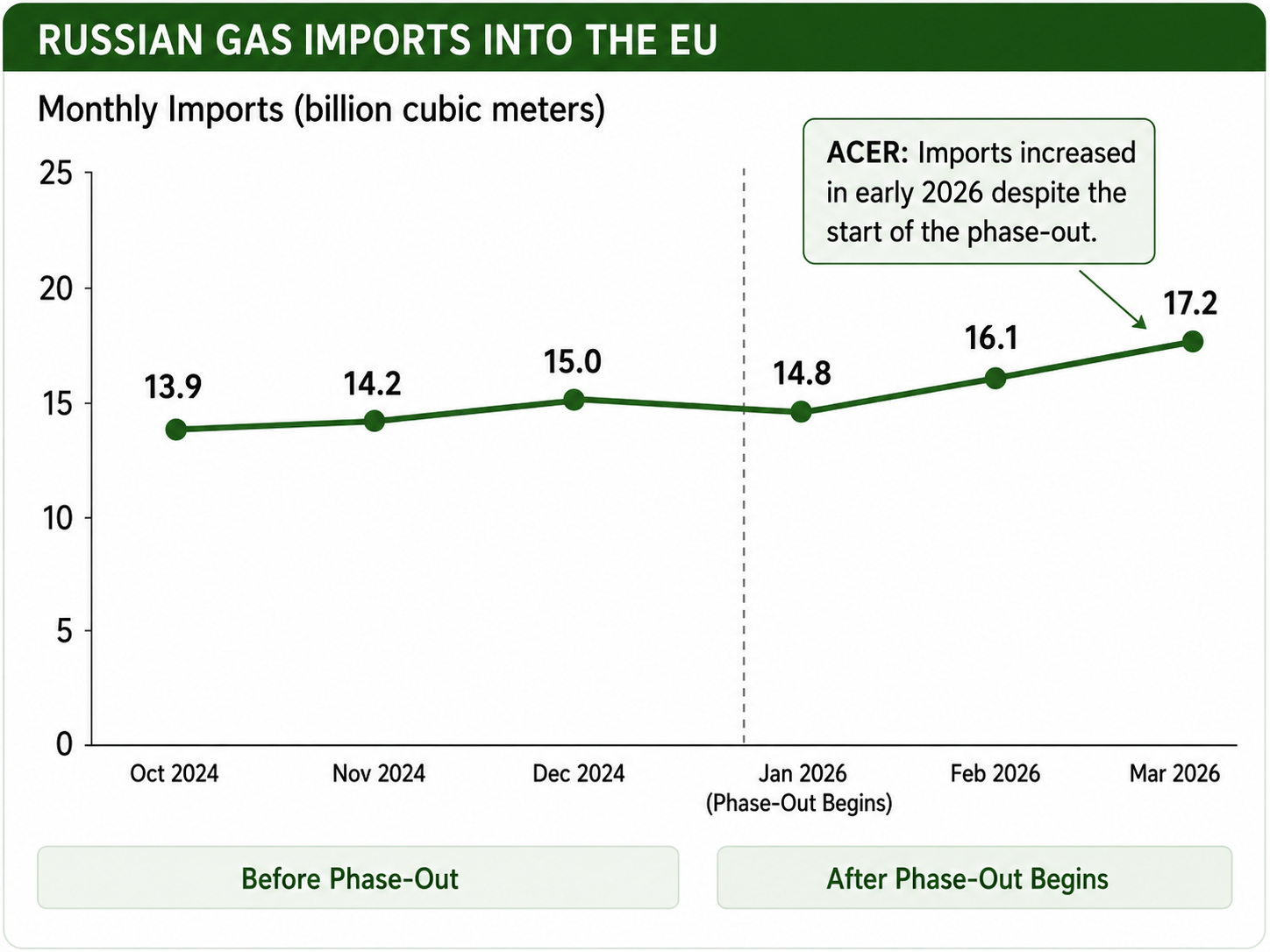
Yet the first months of implementation have produced an unexpected outcome. According to the Agency for the Cooperation of Energy Regulators (ACER), Russian gas imports into the European Union increased during the early months of 2026 despite the beginning of the phase-out process. At first glance, the increase appears inconsistent with the EU's objective of ending its reliance on Russian energy. In reality, it illustrates a broader challenge facing policymakers. Governments can change legislation quickly, but energy markets adjust far more gradually. Existing contracts, commercial incentives, infrastructure constraints, and broader geopolitical developments continue to shape Europe's energy market even as the legal framework changes. The first months of implementation therefore suggest that the success of the policy will depend not only on legislation, but also on whether markets can adapt quickly enough to support Europe's long-term energy security.
Why The New Policy Matters
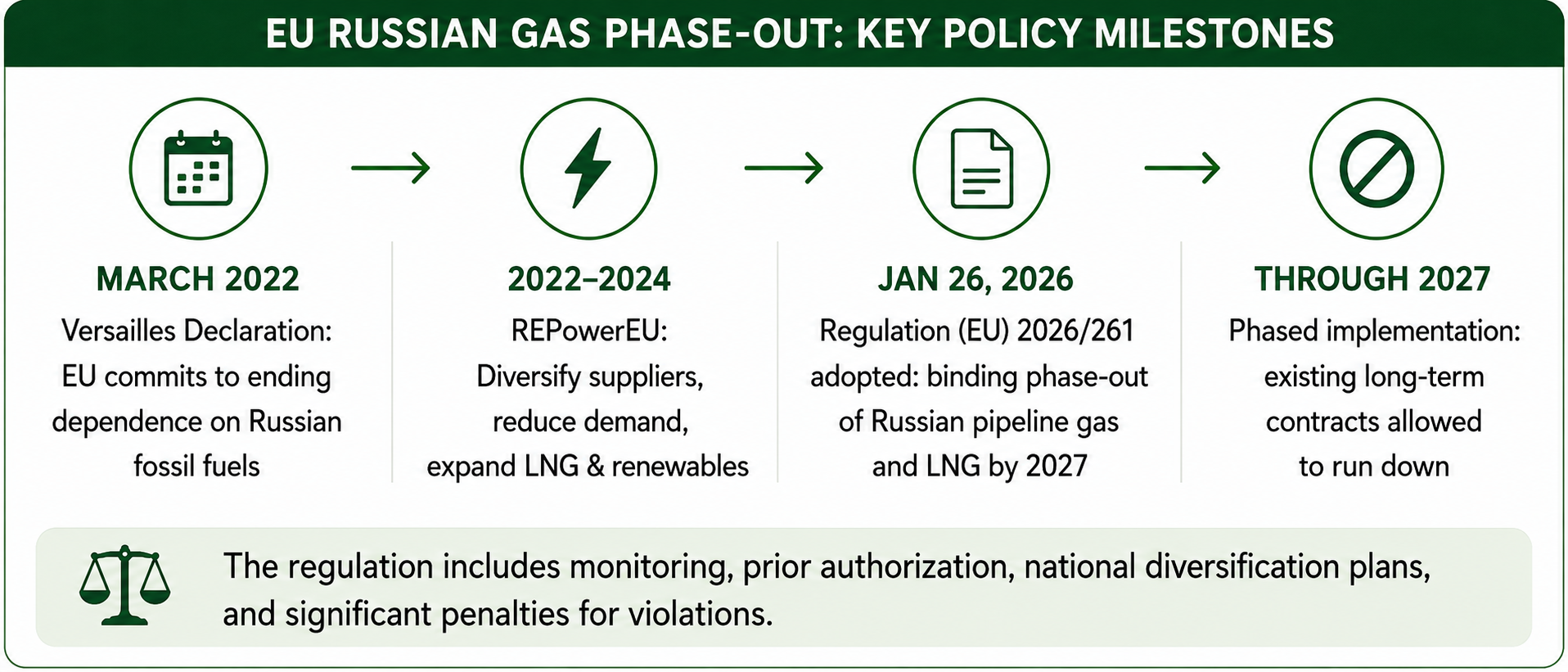
The European Union's decision to phase out Russian gas imports builds on a broader strategy that began shortly after Russia's invasion of Ukraine. In March 2022, EU leaders agreed through the Versailles Declaration to end their dependence on Russian fossil fuels as quickly as possible, recognizing that energy had become both an economic and geopolitical vulnerability. That commitment evolved into the REPowerEU plan, which focused on reducing gas demand, expanding renewable energy, increasing LNG imports, and diversifying energy suppliers across the bloc.
The adoption of Regulation (EU) 2026/261 on January 26, 2026 marked the next stage of that strategy by transforming a political objective into permanent law. Unlike the sanctions imposed following Russia's invasion of Ukraine, which required renewal every six months, the new regulation permanently changes the legal framework governing Russian gas imports. It establishes a phased ban on Russian pipeline gas and liquefied natural gas, introduces monitoring and prior authorization requirements for gas imports, requires member states to submit national diversification plans, and imposes substantial financial penalties for companies that violate the rules (Council of the European Union, 2026).
The phased implementation reflects the reality that Europe cannot eliminate Russian gas overnight without risking supply disruptions or significant price volatility. Existing long-term contracts are therefore permitted to continue through transition periods extending into 2027, allowing governments and businesses time to secure alternative suppliers and strengthen energy infrastructure (Council of the European Union, 2026). Rather than prioritizing speed alone, the regulation seeks to balance the EU's long-term objective of ending its reliance on Russian energy with the need to maintain stable energy supplies throughout the transition.
Markets Have Changed More Slowly Than Policy
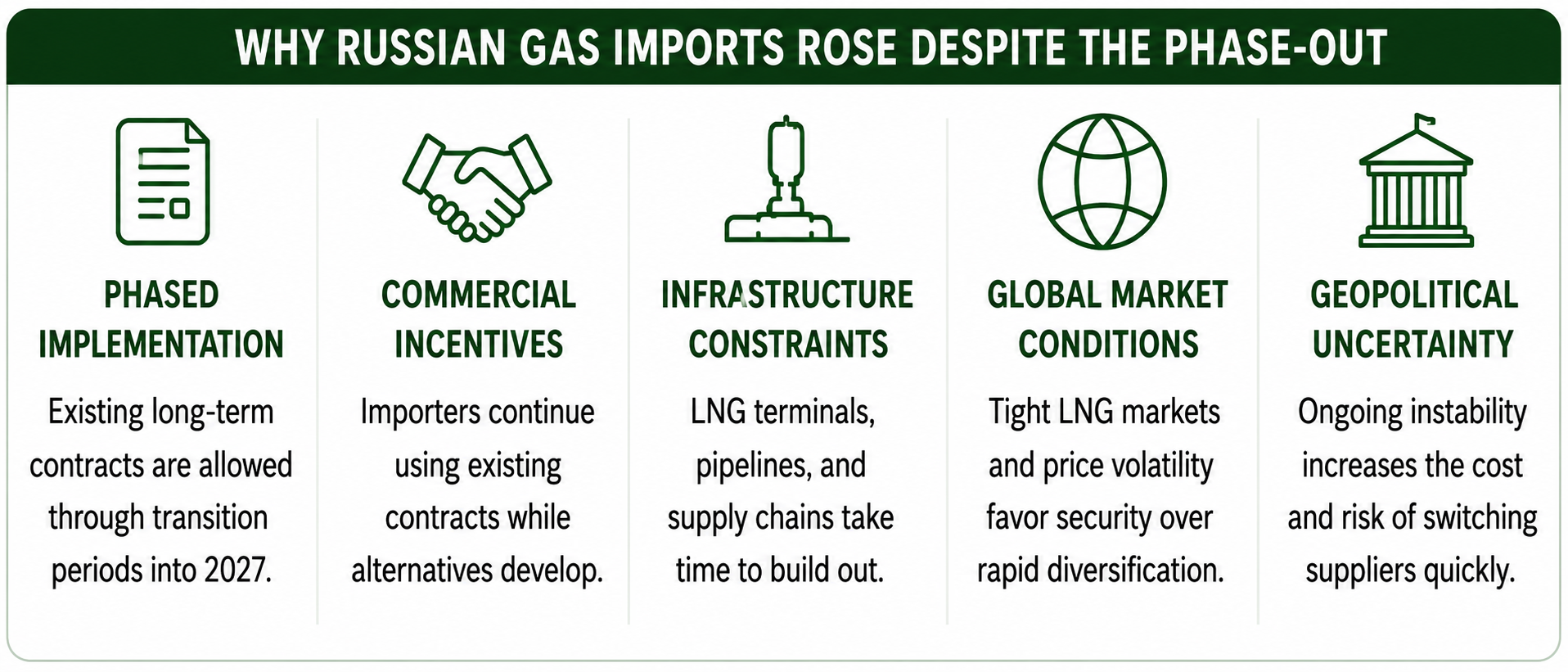
If legislation alone determined market outcomes, Russian gas imports into the European Union should already be falling. Instead, ACER's first monitoring report found that imports increased during the early months of 2026 despite the beginning of the phase-out process . One reason is the new regulation's phased implementation. While new short-term contracts are already prohibited, existing long-term contracts remain valid through transition periods extending into 2027 (Council of the European Union, 2026). This allows Russian gas to continue entering the European market legally while governments and businesses gradually diversify their energy supply. The phased approach was designed to reduce the risk of supply disruptions and avoid sharp increases in energy prices during the transition.
Commercial incentives have also slowed the adjustment. According to ACER, importers have continued to rely on existing contracts while alternative infrastructure and supply relationships develop (ACER, 2026). Global LNG markets have remained tight, and ongoing geopolitical uncertainty has encouraged buyers to prioritize supply security over rapid diversification (IEA, 2026). These factors demonstrate that energy markets respond not only to legislation but also to infrastructure, pricing, contractual obligations, and broader geopolitical developments. The early increase in Russian gas imports should therefore not be interpreted as evidence that the policy has failed. Rather, it reflects the time required for markets to adapt to a new regulatory environment. The legislation has fundamentally changed the direction of European energy policy, but reshaping supply chains and investment decisions will take considerably longer than changing the legal framework itself.
What This Means for Europe's Energy Security and Competitiveness
The first months of implementation suggest that the regulation should not be judged by short-term import figures alone. Russian gas had already fallen from roughly 45% of EU gas imports before Russia's invasion of Ukraine to around 13% by 2025, meaning much of Europe's diversification had already occurred before the regulation was adopted (European Commission, 2025). The regulation is therefore intended less to produce an immediate decline in imports than to prevent Europe from returning to Russian gas once market conditions stabilize. As Heuck, Kreysel, and Schiffer (2025) argue, Europe's challenge is no longer simply reducing dependence, but ensuring that its replacement energy system remains resilient, diversified, and economically sustainable. Reducing reliance on Russian gas does not eliminate Europe's dependence on imported energy. Instead, it changes where that dependence lies. As Russian supplies have declined, the EU has increasingly relied on LNG imports from the United States alongside pipeline gas from suppliers such as Norway, Algeria, and Azerbaijan.
These tradeoffs have important implications for European competitiveness. Higher and more volatile energy prices increase costs for energy-intensive industries, affecting investment decisions, export competitiveness, and long-term manufacturing growth across the European Union. Stable and affordable energy supplies therefore remain essential for industries such as chemicals, steel, fertilizers, and manufacturing, all of which depend on predictable energy costs. While the phased approach is designed to minimize disruption, prolonged price volatility or tighter global LNG markets could reduce investment and weaken the competitiveness of European manufacturers.
The policy also addresses a broader strategic concern. The 2022 energy crisis demonstrated the risks of relying heavily on a supplier willing to use energy as political leverage. According to the UK Energy Research Centre, European governments spent an estimated €650 billion protecting households and businesses from soaring energy prices following Russia's reduction of gas supplies. At the same time, Russia's gas export revenues have continued to decline as pipeline exports to Europe have fallen sharply, reducing one of the Kremlin's most important sources of external revenue.
The regulation therefore reflects that energy policy is no longer focused solely on securing the cheapest available fuel. It is increasingly viewed as an instrument of economic security, industrial resilience, and geopolitical strategy. Although markets are adjusting slower than policymakers anticipated, the legislation was designed to shape long-term behavior rather than deliver immediate results. Its success will ultimately depend not on short-term fluctuations in import volumes, but on whether Europe can permanently reduce its reliance on Russian gas while maintaining affordable energy, industrial competitiveness, and long-term energy security.
Data Sources
- Intereconomics — Geopolitics and Europe’s Natural Gas Supply: Aspects and Consequences from a Gas and Electricity Markets Perspective
- IEA — Gas Market Report, Q2 2026
- ACER — Gas and Electricity Market Key Developments, 2026
- European Commission — Security of Gas Supply
- Reuters— Russia’s Gas Export Revenues Set for Third Straight Year of Decline
- UKERC — Future of Russian Gas Looking Bleak as Ukraine Turns Off Taps and Europe Eyes Ending All Imports
- Council of the European Union — Council Agrees Its Position on Rules to Phase Out Russian Gas Imports Under REPowerEU