
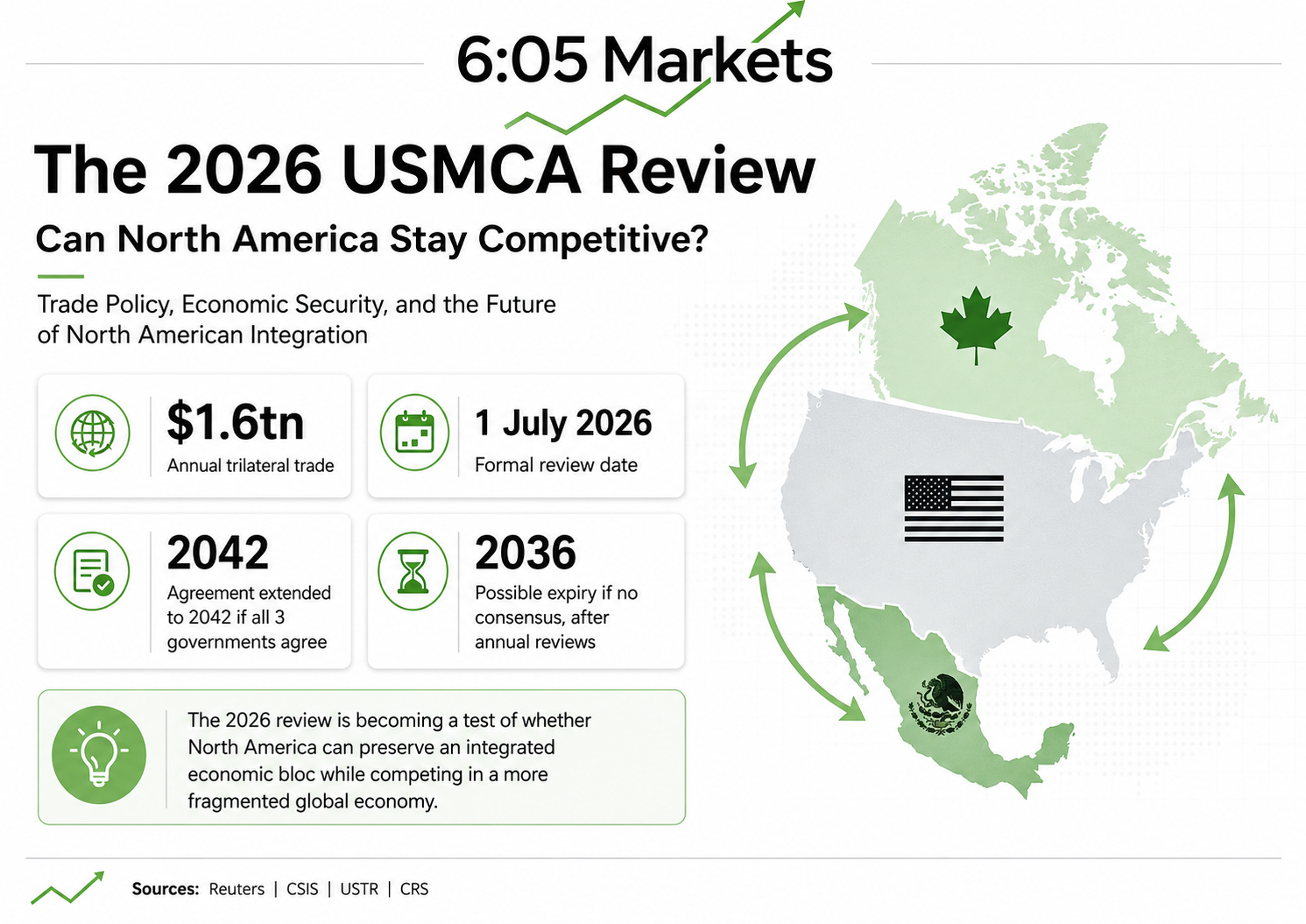
The 2026 USMCA review is being framed as a routine procedural requirement, but it is increasingly becoming a test of North America’s economic competitiveness. Since entering into force in 2020, the agreement has supported roughly $1.6 trillion in annual trilateral trade and anchored deeply integrated supply chains across manufacturing, energy, agriculture, and technology. With President Trump questioning renewal and governments globally prioritizing industrial policy, economic security, and domestic manufacturing, the review will help determine whether North America can preserve an integrated economic framework in a more fragmented global economy.
A Trade Agreement Under Review
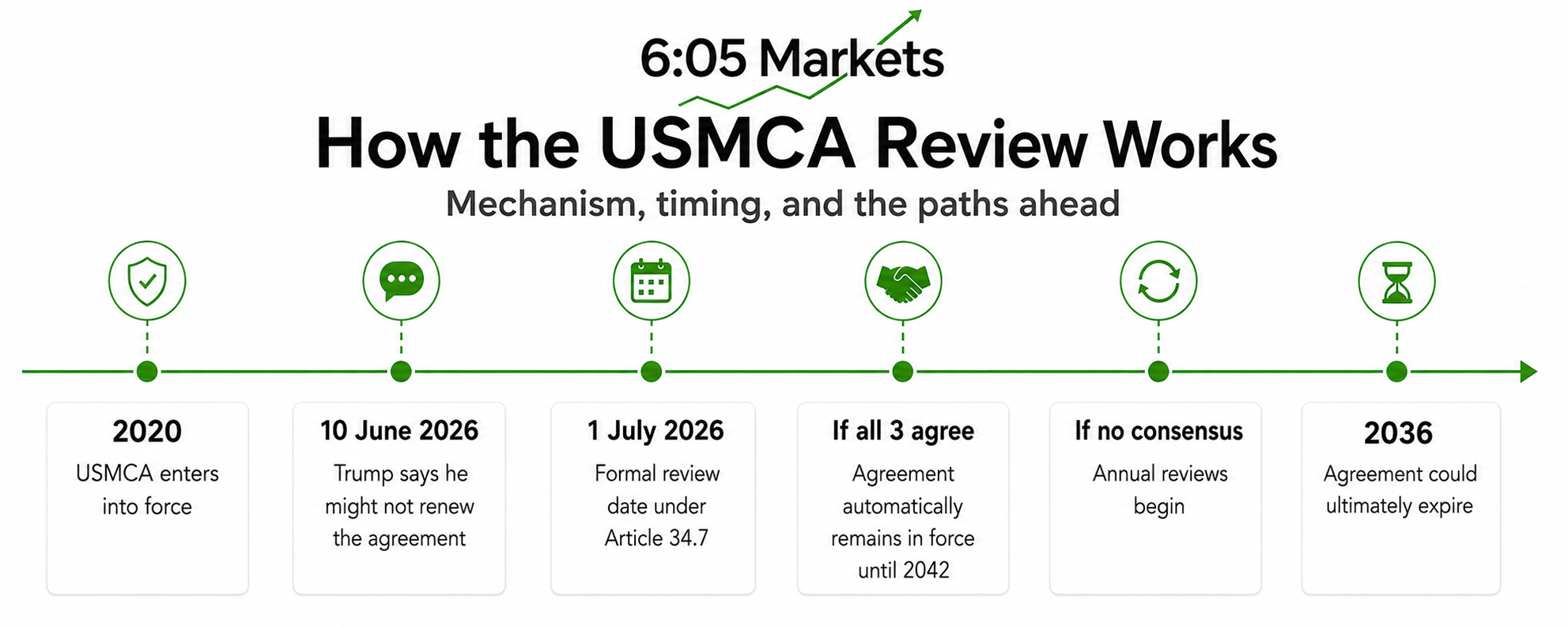
The USMCA's review mechanism was designed to prevent the agreement from becoming politically stagnant. Under Article 34.7, the three governments must periodically evaluate whether the agreement continues to serve their interests and whether it should be extended beyond its initial term (CRS, 2026). If all three parties agree during the July 2026 review, the agreement will automatically remain in force until 2042. If they fail to reach consensus, annual reviews begin and the agreement could ultimately expire in 2036 (CRS, 2026).
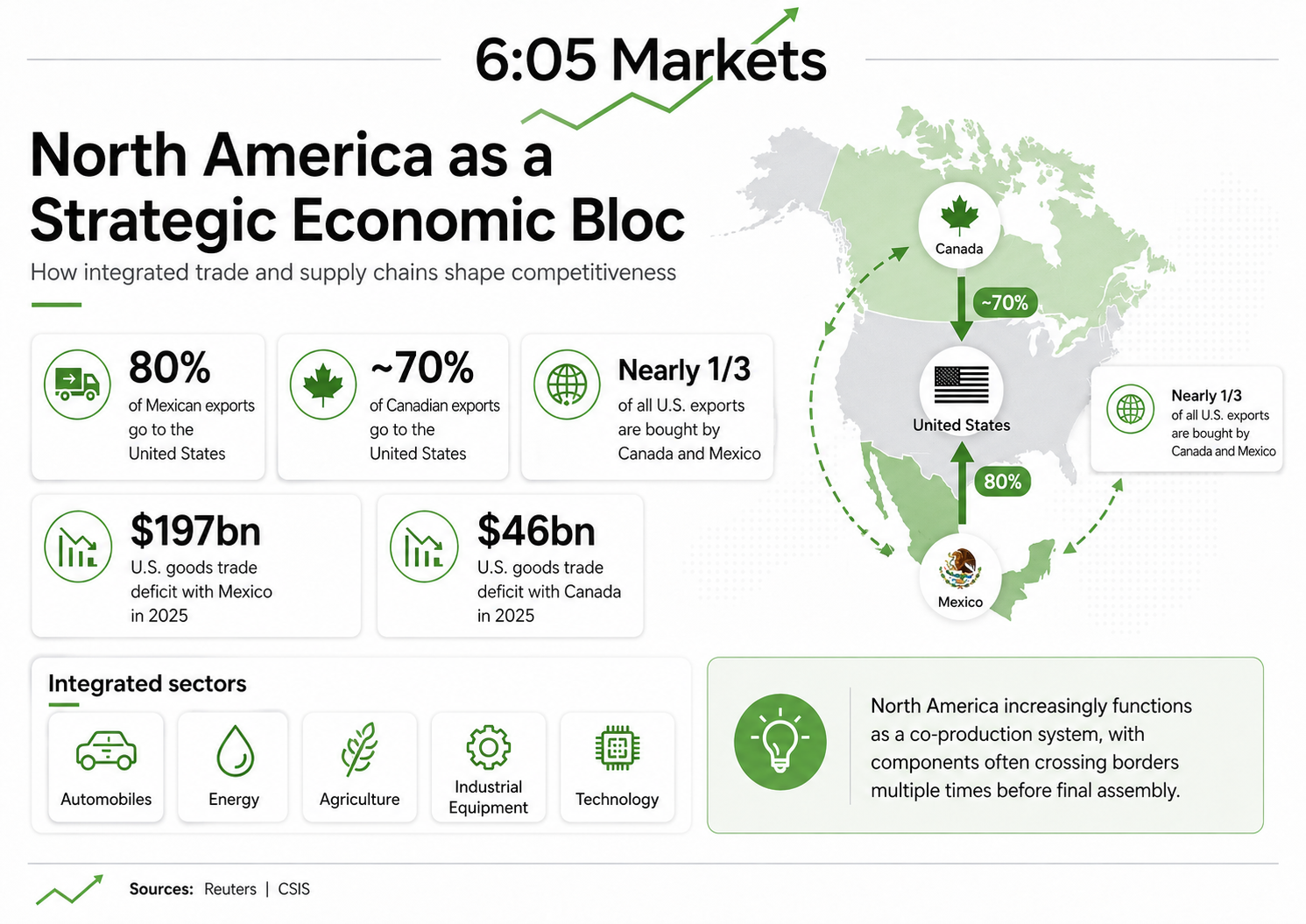
What makes this year's review significant is the political environment surrounding it. Trump's criticism of the agreement is largely tied to persistent trade deficits. According to Reuters, the United States recorded a $46 billion goods trade deficit with Canada and a $197 billion goods trade deficit with Mexico in 2025 (Reuters, 2026). Supporters of renegotiation argue that the review provides an opportunity to address perceived imbalances, while critics warn that prolonged uncertainty could discourage investment throughout the region. Trump's comments questioning renewal have introduced uncertainty into a framework that businesses have largely treated as stable for the last six years (Reuters, 2026). At the same time, negotiations between the United States and Mexico are already taking place, while Canada continues discussions with Washington over the future direction of the agreement (Reuters, 2026). Despite the rhetoric, most analysts do not expect the agreement to collapse. CSIS argues that the central question is no longer whether the USMCA survives, but what concessions each country will seek and what form North American integration will take over the next decade (CSIS, 2026). The review therefore represents less of an existential threat and more of a negotiation over the future structure of regional trade.
North America as a Strategic Economic Bloc
The importance of this framework has grown as companies attempt to diversify supply chains away from China. Following years of tariffs, export controls, geopolitical tensions, and disruptions caused by the pandemic, firms have increasingly prioritized resilience alongside efficiency. Rather than concentrating production in a single country, companies are seeking locations that provide access to the U.S. market while reducing geopolitical risk.
Mexico has emerged as one of the primary beneficiaries of this trend. The more integrated the region becomes, the more attractive it is to firms seeking resilience, market access, and geopolitical stability. The country's proximity to the United States, lower labor costs, and access to the USMCA framework have made it an attractive destination for manufacturers seeking alternatives to China (CSIS, 2026). As a result, nearshoring has become one of the defining economic trends of the post-pandemic period. For many companies, Mexico is no longer simply a low-cost production hub. It is increasingly viewed as a strategic component of North American supply chains.
As a result, the review is increasingly becoming a question of whether North America can remain competitive in global manufacturing and maintain a highly interconnected regional economy capable of competing with China and other major manufacturing centers over the next decade.
What This Means for North American Competitiveness
The most likely scenario remains some form of negotiated extension, although negotiations may prove lengthy and politically contentious (CSIS, 2026). Such an outcome would preserve the broader framework that has supported regional manufacturing growth while allowing governments to address emerging concerns related to market access, rules of origin, and industrial policy.
A second possibility is that the agreement enters a prolonged period of annual reviews. While the USMCA would remain in force, businesses could face greater uncertainty regarding future trade rules and regulatory frameworks (CSIS, 2026). For manufacturers making long-term investment decisions, uncertainty itself can become a meaningful cost. Companies are generally willing to invest under difficult conditions, but they are far less willing to invest when the rules governing future trade relationships remain unclear.
The industries most exposed to prolonged uncertainty are also some of North America's most important. The automotive industry provides perhaps the clearest example. A vehicle assembled in North America may contain components that cross the U.S., Mexican, and Canadian borders multiple times before final production. Even modest changes to trade rules or rules-of-origin requirements can therefore have significant implications for costs, investment decisions, and production planning. The automotive sector is particularly exposed because production decisions are often planned years in advance and depend on predictable trade rules throughout the region. Energy producers rely on predictable cross-border infrastructure and investment flows. Manufacturers of industrial equipment, electronics, and advanced technologies increasingly depend on regional supply networks developed under the USMCA framework. Even relatively small changes to trade rules can affect investment decisions involving billions of dollars.
The broader significance of the review extends beyond North America. As governments increasingly view trade policy through the lens of economic security, the USMCA has become a case study in how regional blocs may compete in a more fragmented global economy. The agreement was originally designed to facilitate trade. Today, it is increasingly expected to support supply-chain resilience, manufacturing competitiveness, and strategic economic priorities.
Conclusion
The question facing policymakers is therefore not simply whether the USMCA should be renewed. The larger question is whether North America can maintain the integrated economic framework that has emerged over the past three decades while adapting to a world increasingly shaped by industrial policy, geopolitical competition, and economic security concerns.
Regardless of the outcome, the review has become an important reminder that trade policy is no longer just about tariffs and market access. Increasingly, it is being used to advance broader strategic objectives related to industrial policy, supply-chain resilience, and economic security. The decisions made over the coming months will help determine whether North America continues to attract manufacturing investment and deepen regional integration, or whether uncertainty begins to undermine the competitive advantages that have fueled the region's recent growth. In that sense, the 2026 review is not simply a debate over the future of the USMCA. It is a debate over the future competitiveness of North America itself.
Data Sources
- Reuters — Trump says US might not renew North America trade deal
- CSIS — USMCA Review 2026: Six Scenarios for North America’s Future
- USTR — United States-Mexico-Canada Agreement
- CRS — USMCA Joint Review: Process and Role of Congress