
Introduction
In meetings from May 8-9, 2026, all Australian state and federal energy ministers, except the representative from Queensland, agreed that new data centers should fully offset their electricity demand through investments in new renewable generation and energy storage. This decision comes amid growing global concerns that AI infrastructure’s rapid expansion could place significant pressure on a nation’s electricity grid and emission targets. In response, policymakers have begun to consider the “Beneficiary-Pays” model in which technology firms help finance the renewable generation and storage needed to support AI’s growth. Although Australia’s position as a possible regional AI hub makes its policy decisions particularly consequential for the broader energy transition, laws that have already been passed in Ireland and Amazon’s voluntary investment both suggest that a new international model may already be emerging in which the companies driving AI demand also become major drivers of the energy transition.
Why Governments Want Regulation
Artificial intelligence’s growth has led governments and technology companies to build new data centers that have caused and will continue to cause a massive and rapid increase in electricity consumption. In Australia specifically, McKinsey has argued that the nation could become a major AI computing hub for the Asia-Pacific region due to its combination of political stability, available land, and renewable-energy potential. As a result, McKinsey projected that Australia's data center capacity could more than triple in just five years (from 1.5 GW in 2025 to 5 GW in 2030). Even conservative estimates that do not assume Australia becomes a regional AI hub still project capacity more than doubling to 3.9 GW by 2030. For scale, 1 GW of electricity capacity is enough to power between 300,000 and 750,000 homes, and Australia’s utility-level capacity typically only grows by 2-4 GW per year pre-AI boom.
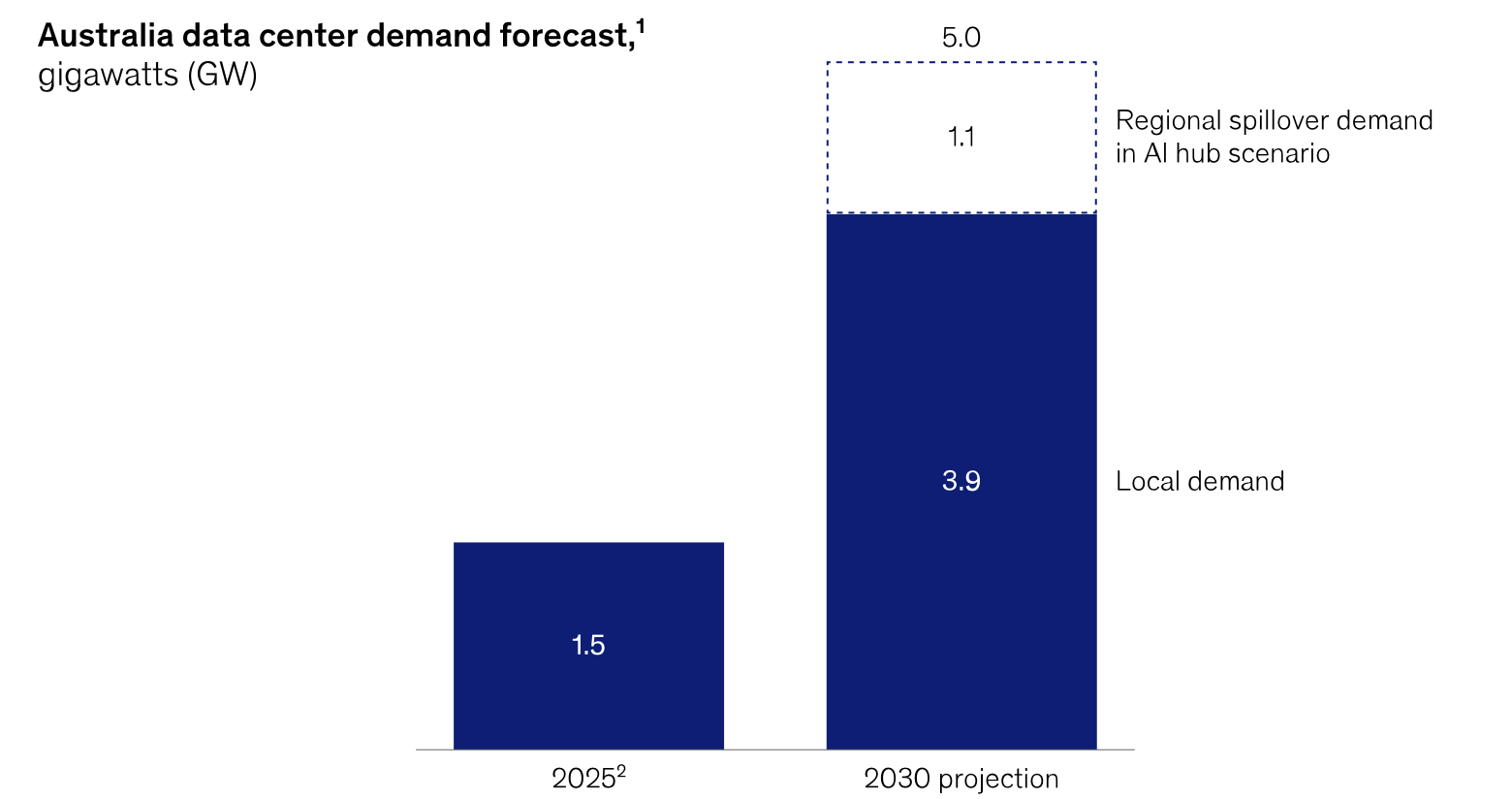
Source: McKinsey
via: https://www.mckinsey.com/au/our-insights/australias-ai-moment-building-asia-pacifics-compute-hub
Furthermore, the Australian government is concerned that unrestricted data center expansion could threaten the nation’s net-zero goals. The IEA projects that because data centers require a constant 24-hour energy supply, rising demand will likely increase reliance on natural-gas generation to maintain grid reliability. Meanwhile, the Australian Energy Market Operator (AEMO) estimates data centers could consume 6% of Australia’s grid electricity by 2030 and reach up to 11% by 2035. The possible scale of increased reliance on fossil fuels could thus put the Australian government’s net-zero greenhouse gas emissions by 2050 and 43% reduction in emissions from 2005 levels by 2030 in jeopardy.
These concerns led Australian state and federal energy ministers, barring Queensland, to agree that new data centers should fully offset their electricity demand through investments in additional renewable generation and energy storage. This notion has gained traction as policymakers have begun considering proposals that would require hyperscale operators to either source or finance 100% renewable-energy offsets as a condition of approval. In practice, offsetting means operators must directly fund renewable energy projects, purchase long-term renewable purchasing agreements, or invest in battery storage infrastructure at the scale needed to match projected demand growth. The private sector has already begun to anticipate these changes, as Amazon recently announced nine Australian renewable-energy projects adding 430 MW of wind, solar, and battery capacity to support expanding operations to help offset its broader AU$20 billion Australian data-center investment program through 2029.
The Conflict Over Who Pays
In truth, the debate over data centers and renewable energy is really a debate over cost. AI data centers are becoming massive electricity users, and governments are starting to ask whether ordinary households should pay for the grid upgrades that these companies require. The aforementioned McKinsey projected growth is not a marginal change. The consequence of additional pressure could lead to more competition for electricity, in which case reliance on gas or coal is likely once renewables cannot keep up.
Essentially, our view is that multinational technology companies should pay, or at least be part of the solution. These firms are not passive electricity users. Regulators are worried that data centers could push grid costs onto ordinary customers, which is why policymakers are considering a “beneficiary pays” model. This is fairer than socialising the cost across all ratepayers. Moreover, Amazon's recent Australian renewable-energy projects create an important precedent: if one multinational can link its AI growth to new renewable investments, then the broader industry can be expected to do the same.
The main risk is that if Australia makes the rules too strict, data-center developers may redirect investment to markets with cheaper or less restrictive grid access. This could weaken Australia’s position as a regional AI-hub. However, the alternative is also costly. Without some obligation on hyperscalers, households and ordinary businesses may end up funding the grid upgrades required by AI infrastructure. The policy challenge is therefore how to match AI growth with new energy investment.
International Comparisons and the Future
Australia is not alone in this challenge, as the IEA projects that global data-center electricity consumption could more than double from 415 TWh in 2024 to 945 TWh by 2030. For context, this exceeds Japan’s entire current annual electricity consumption. In the United States specifically, the Electric Power Research Institute estimates data centers could account for between 9% and 17% of total national electricity generation by 2030.
Ireland provides one of the strongest examples of governments moving toward mandatory infrastructure obligations for data centers. Data centers already accounted for 22% of Ireland’s national electricity demand in 2024, a figure that could exceed 30% within the next decade if growth continues unchecked. In response, Ireland now requires new data centers to meet at least 80% of annual demand from additional renewable generation. Ireland, and now seemingly Australia, have begun to provide a framework for governments to require technology companies reliant on data center expansion to help fund the energy transition.
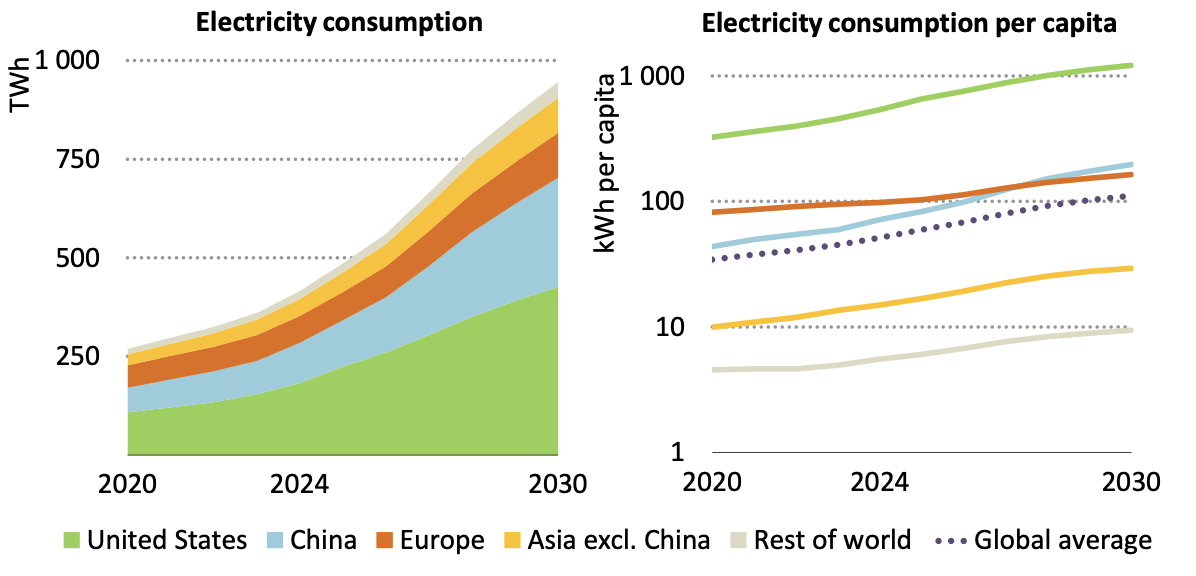
Source: IEA
Via: https://iea.blob.core.windows.net/assets/de9dea13-b07d-42c5-a398-d1b3ae17d866/EnergyandAI.pdf
Conclusion
Australia’s data-center boom shows that the energy transition is no longer a government problem. It is becoming a corporate responsibility as well. Data centers can bring real economic value, but they also depend on an energy system that is already under pressure. If governments allow this growth without rules, the costs may fall on the public while the benefits remain privatised. A fairer approach is to make the companies driving this demand part of the solution by requiring them to support new renewable generation, storage, and grid capacity. Done properly, the AI boom does not have to conflict with the energy transition. It can help fund it.
Data Sources
- IEA — Energy and AI
- McKinsey — Australia’s Big Moment
- Amazon— Amazon Australia signs nine new renewable energy deals
- KPMG-Ireland’s Data Centre Policy Reset
- Clean Energy Council— Clean Energy Australia Report 2025