
Introduction
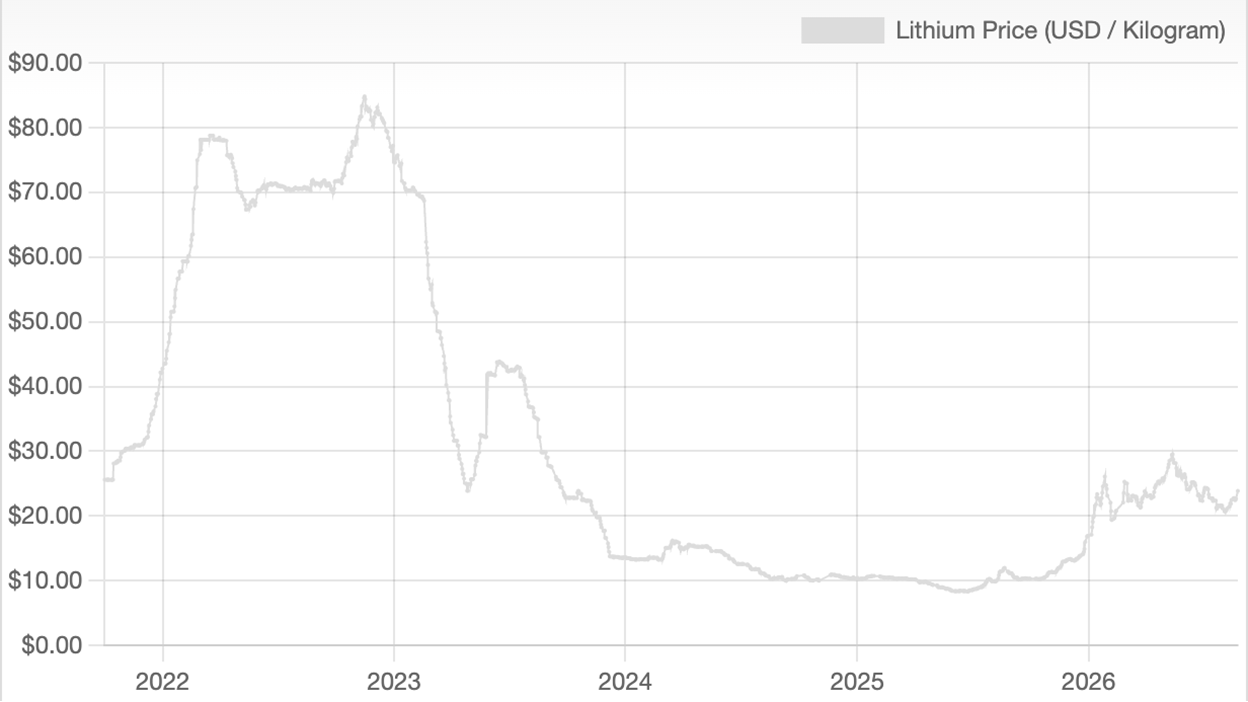
Lithium prices have experienced an extreme boom-bust cycle over the past 4 years. Lithium carbonate prices peaked in November 2022 at roughly CNY 597,500/t (roughly $88,000/t) before going on a prolonged slide to CNY 59,900/t (roughly $8,910/t) in June 2025, falling nearly 90% in the process. Lithium spot prices then rebounded sharply, rising 180% between June 23, 2025 and February 28, 2026, before futures fell to a five-month low by July as the market began pricing the risk that restarted mines could return supply to surplus in 2027. Importantly, this volatility has not been driven by collapsing demand: lithium demand has increased by roughly 25% annually on average over the past two years, while S&P Global projects global demand to grow 80% between 2025 and 2030. Supply, however, has expanded faster than demand.
The key takeaway from this volatility is that the supply chains supporting the energy transition remain highly unstable. As renewable generation expands, the constraint is increasingly shifting from the ability to generate clean electricity towards the infrastructure and materials required to store and transmit it. The result is a chain of bottlenecks: drastic changes in lithium prices expose underlying supply constraints; those constraints become more significant as storage and grid infrastructure expand; China’s dominance of refining gives it leverage over these supply chains; and the U.S. response, amplified by the Iran war, shows how the shift to renewable energy is becoming increasingly tied to geopolitics.
Why Lithium Prices Crashed and Rebounded
Lithium's price collapse was primarily a supply-side response to the shortage that preceded it. By November 2022, Lithium carbonate prices had risen over 600% from around $5/lb in 2021 to $38.34/lb as 2022 saw production of 713,000 tonnes LCE trail consumption of 766,000 tonnes LCE. However, these high prices led miners and investors to rapidly expand capacity across major producing countries including Australia, Chile, Argentina, Mali, and Zimbabwe. A significant burden is that mining projects take years to plan and develop, causing a substantial lag in the industry’s response to demand.
This caused 2023 production to grow 39% in a year while consumption only grew 26%. By 2024, production had reached 1.3 million tonnes of LCE and forced a surplus of nearly 100,000 tonnes of LCE. This led to the average spot price falling from $70,000/t in 2022 to $12,420/t in 2024. Therefore, the price collapse was not a function of demand disappearing but a delayed response to producers reacting to high 2022 prices.
The problem then flipped as low prices helped encourage mining shutdowns, such as CATL's Jianxiawo mine, which was suspended in August 2025, and caused the most active lithium carbonate futures to rise 8% to hit the exchange’s upper price limit. However, this recent rally does not mean there is a sudden increase in demand, as low prices have pushed producers out of the market and discouraged new investment, which will tighten future supply. As mining projects often take years to develop, the reduction in investment during this downturn could create tighter supply conditions in the years ahead. At the same time, the restart of suspended mines could push the market to move back into surplus by 2027. The result is a two-speed market: near-term oversupply alongside a growing risk of longer-term shortages.
Storage & Grid Infrastructure — The Actual Bottleneck
Electricity generation is not necessarily as big a constraint to the renewable transition as the grid’s ability to connect and deliver that electricity. More than 2,500 GW of renewable generation, storage, and large-load projects (including data centers) are currently sitting in queues awaiting grid connection worldwide, highlighting a bottleneck that goes beyond production.
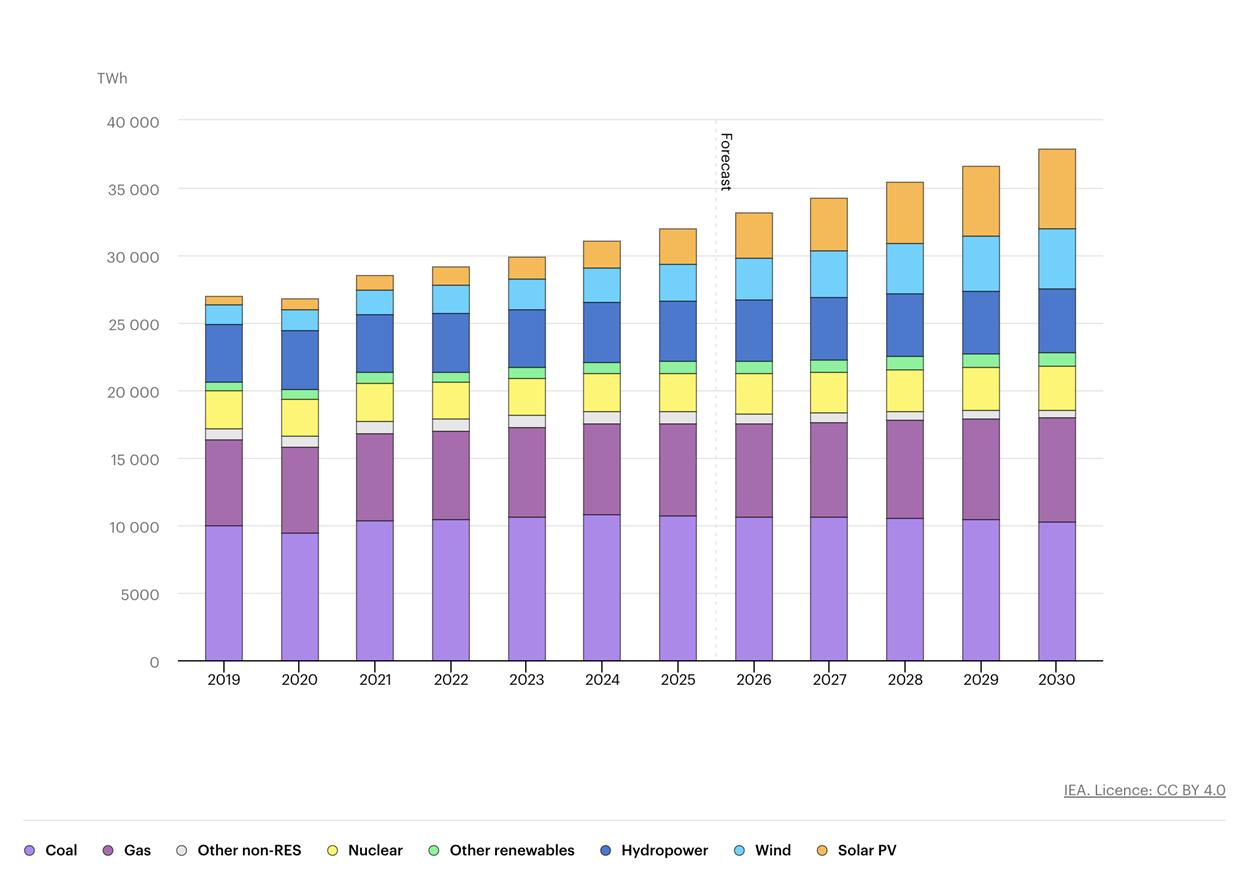
Simultaneously, the grid is undergoing a rapid shift to renewable generation, especially variable renewables such as solar and wind, whose electricity output fluctuates based on weather and other natural conditions. Solar and wind are an ever-growing part of global power generation, with their combined share of global generation rising from 17% in 2025 to a projected 27% by 2030.
This creates a timing mismatch, as the process of planning, permitting, and building infrastructure projects can typically take 5-15 years, while renewable generation projects take 1-5 years, and data centers are often completed in just 1-3 years. Additionally, current global grid investment is around $400 billion, while the IEA projects that a 50% increase to about $600 billion by 2030 is required to meet growing demand. In effect, the investment and regulatory system has become better at adding new generators and large electricity users than at building the infrastructure that connects them.
Battery storage sits at the center of these two problems: the grid’s inability to deliver electricity and the variability of renewable generation. As variable renewables grow, battery storage is key infrastructure that allows electricity generated during periods of peak solar and wind output to be shifted to periods of peak demand. These batteries are therefore crucial to reducing mass curtailment, which is a problem across multiple markets. This year has already seen China curtail 360 TWh of clean energy, and Britain placed a massive solar farm offline at the beginning of the summer as its grid struggled to absorb the energy generation. These examples show that adding generation does not necessarily guarantee the system can utilize that electricity.
That problem is affecting storage itself. A similar story is threatening to play out in the U.S. as Consolidated Edison, the primary electrical utility in New York City, has seen a 300% increase in the battery-storage queue of 5 MW or less projects to 2.5 GW in the past two years, about 25% of peak demand in 2024. As a result, 20 out of 63 of its substations are at or near their capacity limits. Essentially, even technology designed to make the grid more flexible is being constrained.
Solving the grid bottleneck introduces another constraint further upstream: securing the materials required to build the batteries themselves. Global grid-scale battery storage is expected to grow at a 38% compounded annual growth rate through 2030, while the expansion of the lithium supply is expected to lag at 15-18% per year. One forecast projects lithium demand to grow from 1.5 Mt of lithium carbonate equivalent (LCE) in 2025 to 3.4 Mt by 2035, with a projected 1.3 Mt LCE supply gap, which is about 38% of demand, by 2035. Therefore, expanding renewables is no longer simply about power generation or even grid connection, but whether enough batteries and battery materials can be acquired to facilitate that buildout. And increasingly, that buildout is dependent on China.
China's Export Controls on Rare Earths & Batteries
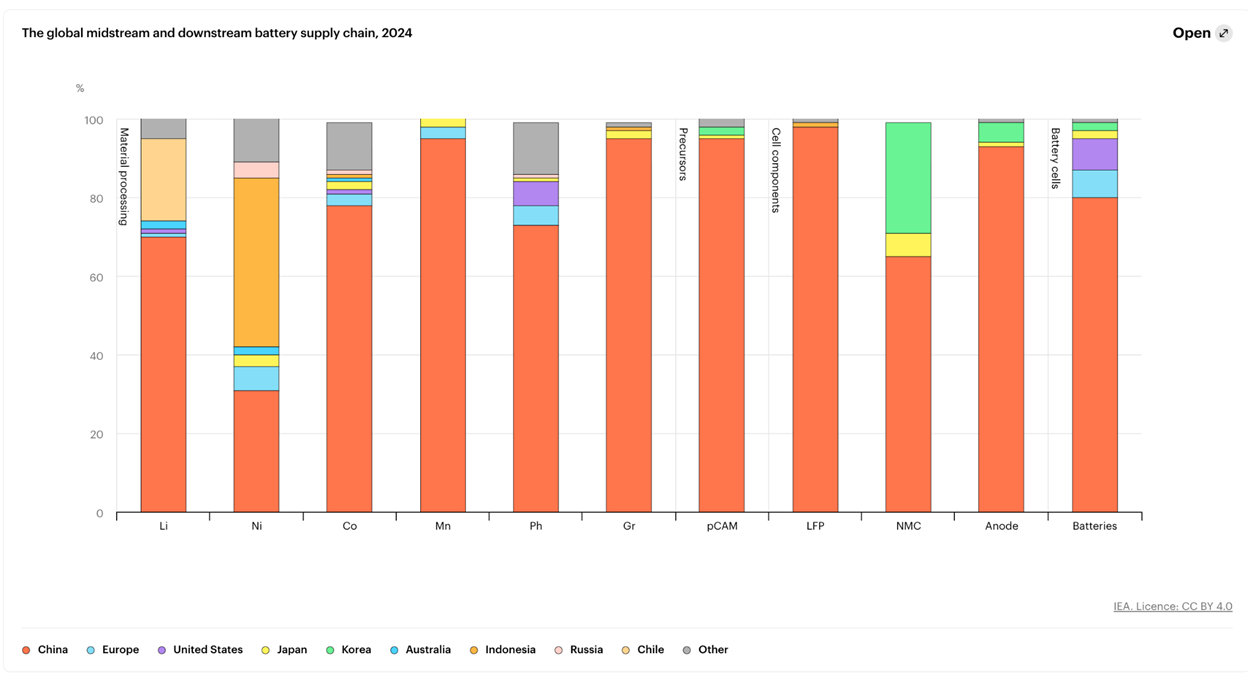
But that buildout is not only reliant on physical supply, but also on who controls the processes to turn raw materials into usable outputs. That concentration is most pronounced in China, which is not only a major miner, but the leading refiner for 19 out of 20 strategic minerals tracked by the IEA, occupying on average a 70% refining share. China therefore owns critical chokepoints both in production and processing.
This refining dominance has become a political tool when China restricts access to it, as seen in October 2025, when China’s Ministry of Commerce (MOFCOM) announced that its export rules extend beyond its borders to certain foreign-manufactured products. The rules required licenses for certain products where Chinese materials represent at least 0.1% of the product’s value. The significance is that China showed its control goes beyond upstream materials into foreign manufacturing. Furthermore, this fits with China’s broader expansion of export controls, as the number of mineral tariff codes subject to Chinese export controls has tripled since 2023.
And although those October controls were suspended a month later as part of a broader US-China trade agreement, the temporary hiatus showed that China can leverage access to its minerals and refining capacities as a negotiating tool. Furthermore, the gaps in price between minerals inside and outside of China persisted after the November agreement, with some rare-earth prices in Europe reaching as much as six times Chinese prices. China’s advantage therefore lies not simply in abundant or low-cost supply, but in its control over processing capacity that alternative supply chains cannot quickly replicate. As the world continues to move towards renewable energy, this creates increasingly important geopolitical leverage.
US Mineral Stockpile & the Iran War's Impact on China's Strategy
America’s answer to mineral dependence is Project Vault, a $12 billion public-private stockpile designed to protect American manufacturing from supply chain disruptions, established on February 2, 2026. The structure is unusual but practical given the geopolitical landscape and current affairs. The stockpile consists of a $10 billion loan from the US Export-Import Bank, alongside approximately $2 billion from private participants such as General Motors, Boeing, and GE Vernova. All of whom are major participants in EV’s, grid, and renewable-energy infrastructure.
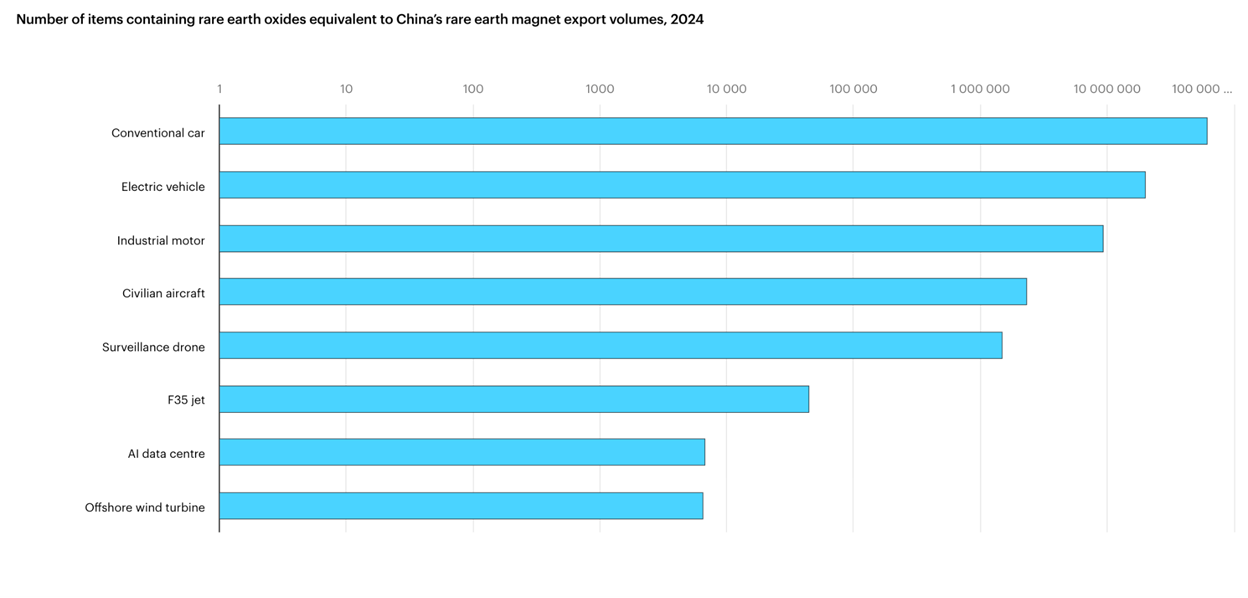
The Iran war made the vulnerability difficult to ignore. China controls over 90% of refined rare-earth metal production and almost 90% of permanent-magnet production, an evident monopoly of the industry. Military equipment and America's defense industry have a drastic dependence on rare earth metals, as they are crucial in technologies such as missile-guidance systems, fighter aircraft, drones, and so on, giving China an incentive to monopolize such an industry. Yet, in the scope of renewable energies, these same rare-earth metals are crucial; notably, wind turbines and EV motors rely heavily on permanent magnets. Project Vault thus aims to cushion this dependence on China’s exports, yet it doesn’t create the technical expertise to refine rare-earths, nor does it eliminate America’s dependence on China.
On the other hand, the closure of the Strait of Hormuz may strengthen China’s renewable-energy strategy, as it has pushed oil-dependent countries to accelerate their investment in renewable energies. China is perfectly positioned to meet this demand, since it is the leading refiner of 19 out of 20 strategic minerals, has an average market share of 70%, and its share exceeds 80% across many parts of the battery supply chain.
China can exploit this opportunity because it is better insulated from the immediate oil shock than many of its competitors. Before the war, approximately 5.4 million barrels traveled through the Strait of Hormuz per day to China. However, Beijing had accumulated an estimated 1.2 billion barrels of petroleum reserves by early 2026. This buffer allows China to withstand short-term supply shocks, whilst exporting its renewable technologies. Together, these positions give China greater resilience to near-term oil shocks while preserving significant leverage over the technologies required for longer-term energy diversification. Project Vault, on the other hand, is a necessary response, but unless paired with domestic refining, magnet production, and manufacturing, it remains a hedge against Chinese leverage.
Conclusion
We may interpret the 180% spot price jump of Lithium between June 2025 and February 2026 as a warning of the deeper problem with renewable energy: that the generation is expanding faster than the infrastructure required to store and transit the output. More than 2500 GW of renewable storage and projects are already waiting in grid queues, while annual grid investment must rise approximately 50% from its present $400 billion level by 2030. Cheap solar panels and plentiful lithium are of limited use if batteries cannot connect to the grid, or if minerals cannot be refined outside China.
The broader conclusion is clear: the energy transition is not eliminating geopolitical dependence; it is relocating it. America’s $12 billion stockpile is a sensible hedge, but warehouses cannot substitute for mines, refineries and industrial expertise. Meanwhile, China’s 70% average refining share across 19 strategic minerals gives it leverage to restrict supply and to sell technologies countries need to escape the oil supply shocks. Unless the US and its allies build genuine processing capacity before Beijing tightens exports again, the transition will remain cleaner, but not necessarily more secure.
Data Sources
- Kallanish Battery Materials — Will Lithium Benefit from China’s Anti-Involution Campaign?
- Utility Dive — Battery developers, local officials ask New York to roll back Con Edison BESS methodology
- IEA — Electricity 2026
- IEA — Global Critical Minerals Outlook 2026