
Introduction
The proposed NextEra-Dominion merger is a large utility deal, a response to a new phase in American electricity demand. Artificial intelligence, data centers, and cloud infrastructure are turning electricity from a predictable input to a bottleneck. By acquiring Dominion, NextEra would gain access to Northern Virginia’s data center concentration. The combined company would serve roughly 10 million customers across Florida, Virginia, North Carolina, and South Carolina, with a current generation capacity of 110 GW and a projected capacity of 260 GW by the year 2032. The merger is a wager that AI-driven growth will define the future of U.S. power.
Deal Structure and Scale
The overall deal is worth $67 billion in an all-stock transaction. Dominion shareholders will receive a little over 0.8 NextEra shares per Dominion share, meaning they received a 23% premium over the prior closing price. The resulting ownership share will result in current NextEra shareholders owning almost 75% of the combined company, with current Dominion shareholders owning the remaining fourth. The deal is expected to close within 12-18 months.
The combined company will have an enterprise value of about $420 billion and is expected to spend nearly $59 billion annually on infrastructure investment from 2027 to 2032. The significant scale is crucial to the company's long-term strategy, as it gives the utility access to larger capital pools needed to expand generation, transmission, renewable integration, and AI-related load growth. The end result is a single entity that will be the largest U.S. power generation company, the largest natural gas power operator and the second largest nuclear operator in the United States, as well as, on a global level, one of the leaders in renewable energy and battery storage.
AI and Data Center Demand as the Core Driver
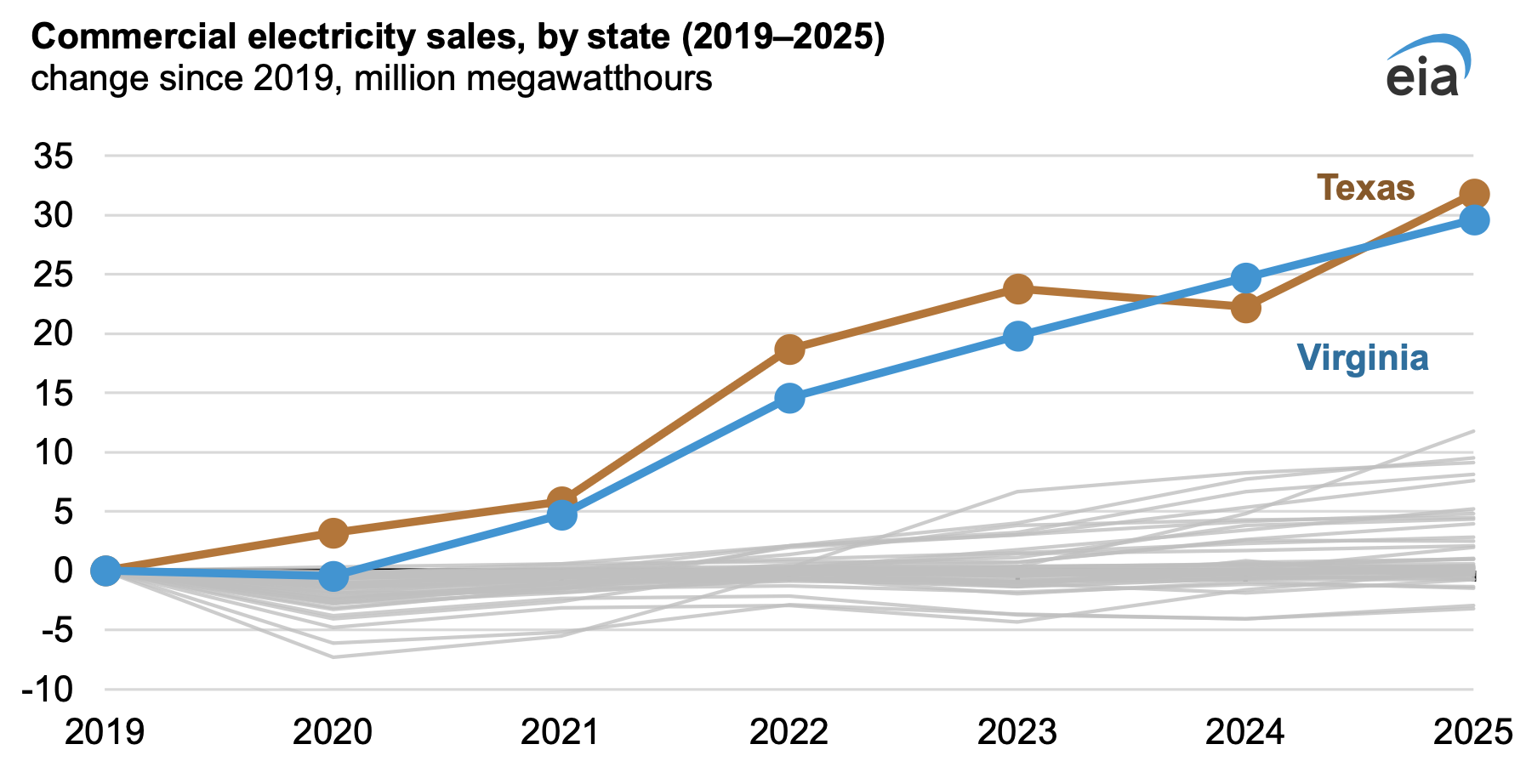
Virginia is a strategically important electricity market in the US, and to an extent, globally, because of its significant concentration of data centers. Commercial electricity sales in Virginia have risen sharply since 2019, with data centers identified as a major driver of that increase. Virginia is alongside Texas for commercial electricity sales growth (please reference figure 3 below). What makes Dominion’s service territory especially valuable is Northern Virginia’s Data Center Alley, where large multinationals like Amazon, Microsoft, Meta, Alphabet, Equinix, CoreWeave, and CyrusOne are tied to nearly 51 GW of data center capacity. It should be noted that of the 51 GW capacity, a proportion is still in the authorization and contracting stage. Therefore, the merger is not only about today’s demand, but about locking in position before AI-related growth fully arrives.
AI changes the utility business because it turns electricity supply into a constraint. Data centers require significant and reliable power, presenting a “structural inflection” in U.S. electricity demand. This means that the change is not cyclical or temporary. PJM, the largest U.S. power grid operator, serves approximately 65 million people across 13 states and Washington, D.C., but has reported facing transmission bottlenecks and concerns that the existing generation and transmission capacity will not suffice for the projected AI growth. In this context, Dominion gives NextEra a strategic advantage, immediate access to the most important U.S. region for AI-related electricity demand.
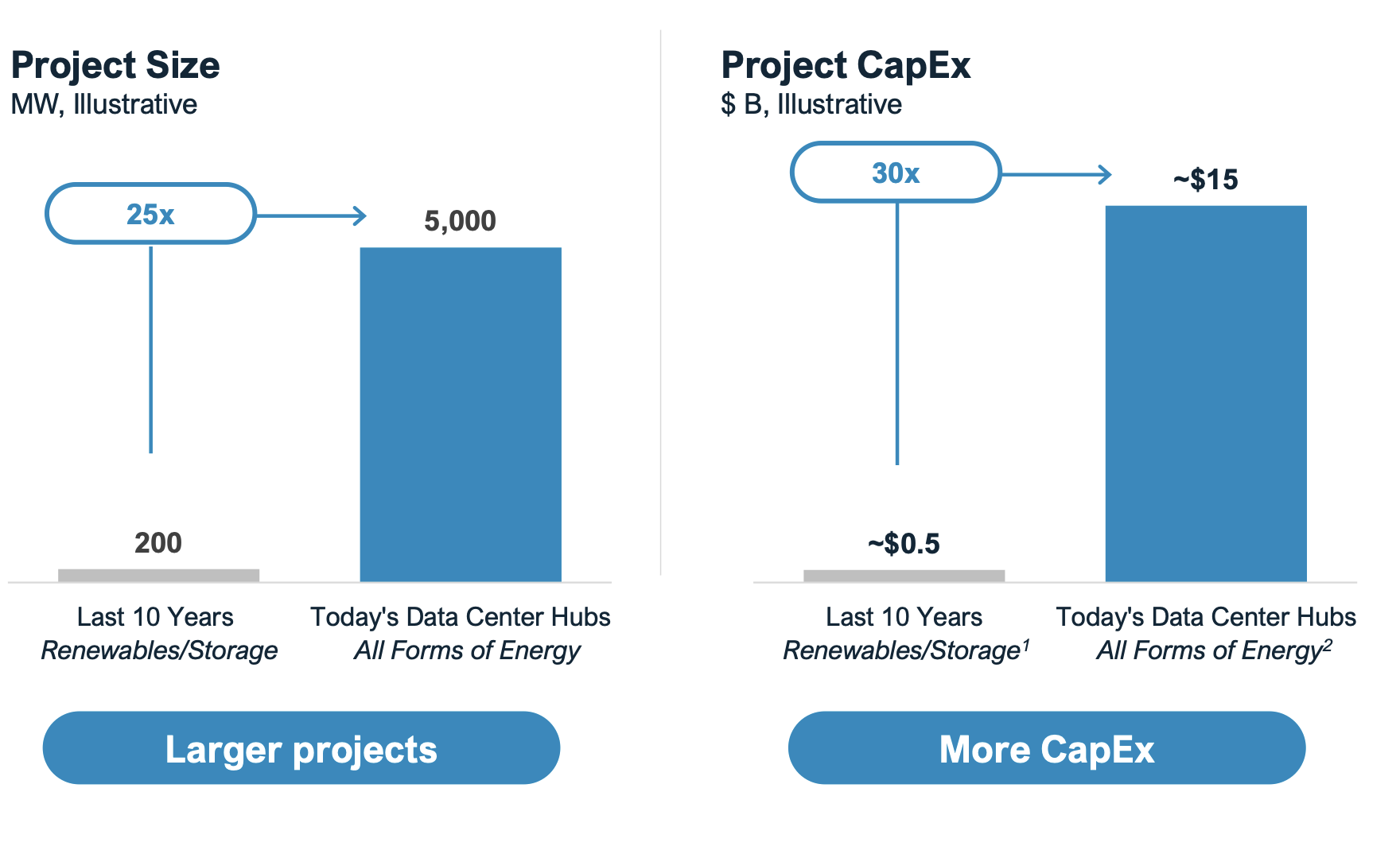
The deal also reflects the rising capital intensity of the power business. Today’s data center-related projects are dramatically larger than prior renewable and storage projects. Over the last 10 years, typical renewable or storage projects were around $0.5 billion in capex, whilst today’s data center projects are around $15 billion in capex. Hence, marginal generation increases no longer satisfy the scope of the modern growth rate of these projects; stakeholders in these industries are looking for new ways to finance enormous projects. NextEra’s advantage is that it brings financial scale, while Dominion brings the geography and demand. Together, the companies are positioning themselves to become not just a larger utility, but a power-infrastructure platform built for the AI era.
Figure 1: The new projects needed to serve new load demands are growing significantly in size and needed capex, giving greater justification for the need for bigger utility companies.
Renewable Energy Expansion and PJM Access
NextEra is already the largest wind and solar developer in North America and the third largest renewable-energy operator by 12-month trailing (TTM) revenue globally, with 40.6 GW of its 73 GW pre-merger total generation capacity coming from solar or wind. This is important to understanding the logic of the merger, as renewable expansion historically requires significantly higher upfront capital expenditures compared to fossil fuel projects. As a result, utilities with greater access to capital, such as the resulting combined company, are better positioned to increase renewable deployment at the pace required by AI-driven electricity demand.
Through this merger, NextEra gains access to high-growth electricity markets in the eastern United States, particularly the aforementioned “Data Center Alley.” PJM has recently been facing transmission bottlenecks, delayed renewable interconnections, and capacity shortages caused by AI demand growth. These constraints create favorable conditions for a new entrant, such as NextEra, that is gaining an existing footprint via Dominion, but is capable of rapidly deploying renewable generation and storage assets. As electricity demand grows in PJM due to data center expansion, the merger positions NextEra to capitalize on one of the most supply-constrained markets in the United States.
Figure 2: Virginia has, along with Texas, been in a league of their own over the past 5 years when it comes to electricity sales growth, creating an attractive market that was a major factor in NextEra’s logic behind acquiring Dominion.
Financial and Regulatory Challenges
From a financial standpoint, NextEra has nearly four times the market cap, cheaper equity, and a slightly higher credit rating than Dominion. As utilities fund infrastructure primarily through debt and equity issuance, even modest reductions in financing costs can noticeably improve the economics of large-scale generation and transmission projects. The result is greater financial flexibility to fund infrastructure projects and protect ratepayers from long-term cost increases.
Additionally, the deal will likely face regulatory challenges. NextEra is no stranger to deals being blocked by regulators, as both attempted acquisitions of Hawaiian Electric Industries Inc. in 2014 and Oncor Electric Delivery Co. LLC in 2016 were eventually blocked by state regulators over concerns the mergers would increase electricity prices. This time, faced with similar opposition, NextEra and Dominion have proposed $2.25 billion in customer bill credits over two years, a move analysts believe gives the deal a better chance than not of approval.
Conclusion
Ultimately, the NextEra-Dominion merger shows how quickly the U.S. power industry is being reshaped by AI, data centers, and the rising cost of building energy infrastructure. What makes the deal important is not only its size but the synergy between the two companies and what they both have to offer. Dominion gives NextEra access to Northern Virginia, one of the most valuable electricity markets in the country, because of its concentration of data centers and connection to PJM. NextEra brings the financial scale. The deal also reflects a broader shift in project scale, from hundreds of millions to tens of billions of dollars. Marginal additions to the grid are no longer enough. Nonetheless, the merger is not without risk. Regulators and consumers will be focused on whether the promised infrastructure buildout can happen without pushing electricity bills higher, or giving one company too much control or a monopoly over a critical market.
Sources
- NextEra Energy — Forming America’s leading utility
- EIA — Commercial electricity sales have soared in Virginia
- Reuters — NextEra plans to buy Dominion Energy
- The Guardian — NextEra to buy Dominion in $67bn deal creating US utility giant
- Investopedia — 10 Biggest Renewable Energy Companies in the World