First Solar’s Q3 Earnings Hurdle: Why We Expect a Miss
We expect First Solar to miss the consensus Q3 EPS estimate of $4.67, with our base-case estimate lying at $4.25-4.60 (point estimate $4.37). The demand picture for the company appears to be faring well, however what concerns us is that the consensus figure presumes a profitability level that the company is unlikely to sustain going into the third quarter.

We expect First Solar to miss the consensus Q3 EPS estimate of $4.67, with our base-case estimate lying at $4.25-4.60 (point estimate $4.37). The demand picture for the company appears to be faring well, however what concerns us is that the consensus figure presumes a profitability level that the company is unlikely to sustain going into the third quarter.
To meet the figure pushed by analysts, approximately $503 million in net income is required, a 19% ramp-up in relation to Q2. Meanwhile, revenue is projected at only $1.28 billion, a 20% decrease YoY. This means that the significant increase in net income would have to be derived from margin gains or manufacturing credits rather than through organic volume.
Section 45X credits provide First Solar with a source of earnings support which is uncorrelated with module pricing. Conversely, tariff expenses, the fading of Q2’s logistics-cost tailwind, and delayed shipments counteract said credits. As such, we believe that cost pressures may have been underrepresented in analyst projections.
There is also the matter of the conversion rate of adjusted EBITDA into net income. The consensus EPS requires a conversion of 71.9% at the $700 million guidance midpoint, while in recent quarters First Solar’s figures have resolved around the mid-to-high 60s. Reaching $4.67 therefore requires either adjusted EBITDA near the top of guidance or an unusually high conversion rate.
Key Numbers
| Consensus EPS | Our base-case EPS | Adjusted EBITDA needed at Q2 conversion | Guided US made sales |
|---|---|---|---|
| $4.67 | $4.37 | $766M | 3.2-3.7 GW |
Sources: First Solar Q2 2026 earnings release and 10-Q; company Q3 guidance; consensus per MarketWatch, as of October 17, 2026; 6:05 Markets estimates.
The Earnings Hurdle
Wall Street’s consensus projects a Q3 EPS of $4.67 and Q3 revenue of $1.28 billion. That EPS would require a 19.1% gain from Q2’s $3.92 EPS and revenue to grow approximately 21% quarter over quarter (although still down 20% year over year). Assuming shares outstanding remain at 107.7 million diluted shares, the Q3 EPS implies an approximately $503 million in net income. Measured against the company's adjusted EBITDA projections of $625-775 million, the consensus EPS implies an 80.5% net income / adjusted EBITDA for the low end, 71.9% for the $700 million midpoint, and 64.9% for the $775 million guidance high.
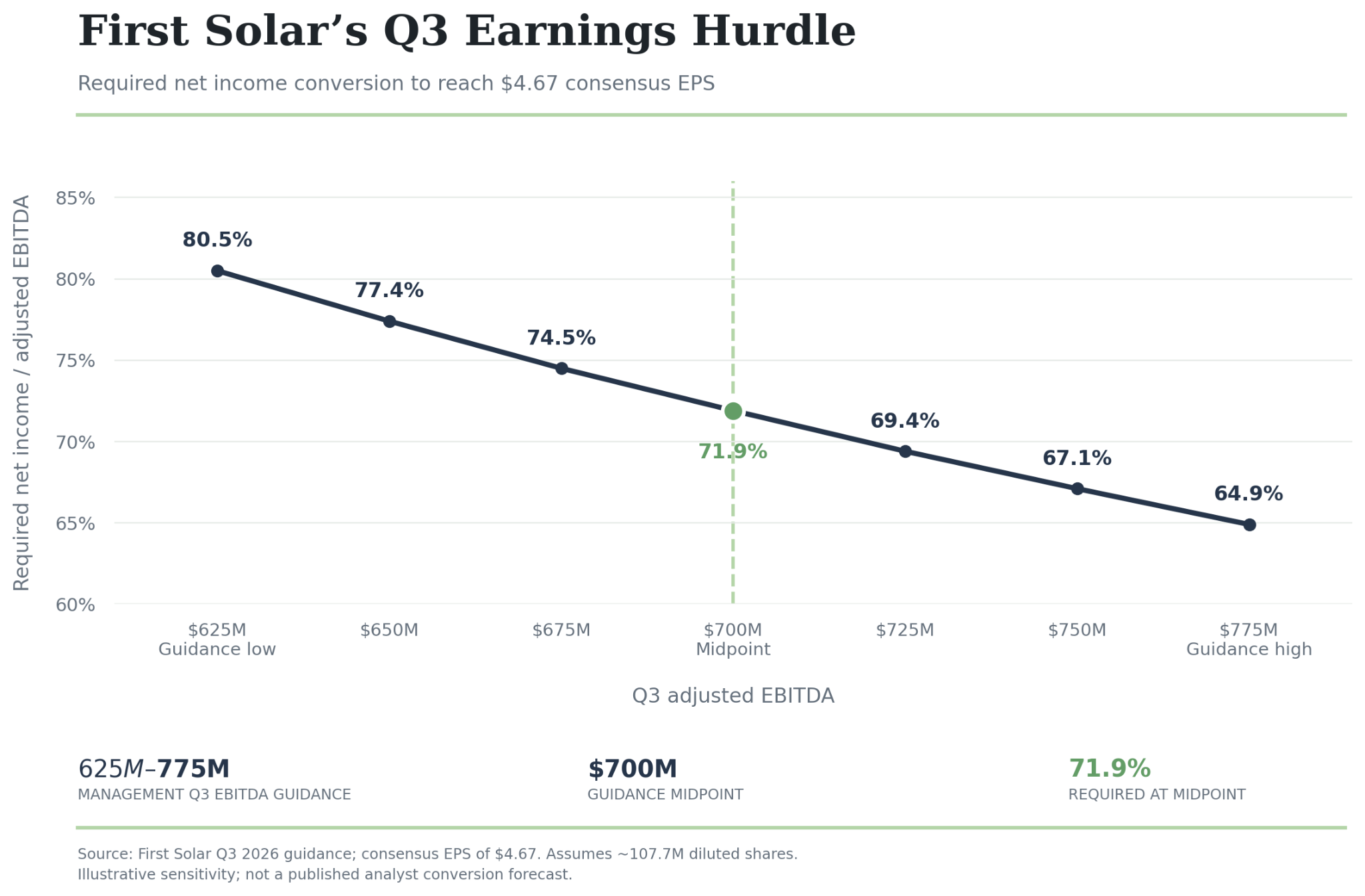
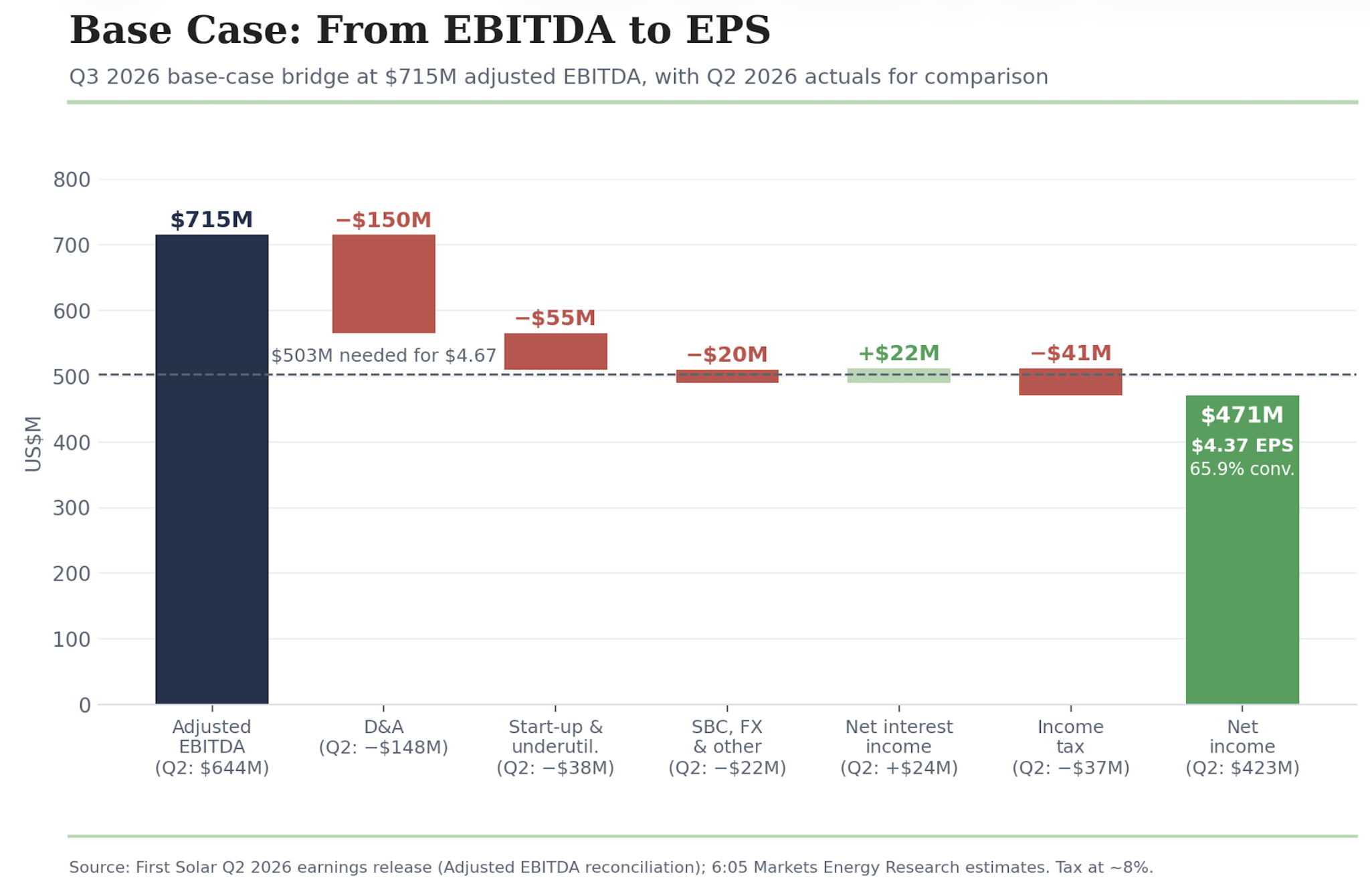
Achieving the midpoint conversion ratio would require a noticeable improvement over recent quarters. The past four quarters show H2 2025 had a combined 68.7% conversion rate, Q1 2026 had a 66.7% conversion rate, and Q2 2026 had a 65.7%. Although a higher conversion rate is not impossible, depreciation has remained steady at $141 million a quarter for the second half of last year and $148 million a quarter through H1 this year. At the $700 million EBITDA midpoint, First Solar would need the total deductions between adjusted EBITDA and net income to decline from approximately $221 million in Q2 to $197 million in Q3. Assuming depreciation stays at Q2 levels, this would require a $24 million improvement across other net deductions, or one-third of Q2's net non-depreciation deductions.
That change is certainly possible. Income tax expenses have ranged from $4.4 million in Q3 2025 to $36.8 million in Q2 2026, while GAAP production start-up expenses declined from approximately $36.7 million in Q3 2025 to less than $1 million in Q4 before rising again through 2026. Furthermore, start-up and underutilization costs are additional non-depreciation deductions, and full-year start-up guidance implies a step-up in H2.
Alternatively, First Solar could have very strong adjusted EBITDA relative to its predictions. First Solar’s management guidance was $400-500 million for both Q1 and Q2 of this year, but the company reported $520 million and $644 million for those quarters respectively. Although this outperformance suggests management's guidance may have been conservative, Q2 benefited from an $89 million net benefit from expected refunds of IEEPA tariffs that may not recur. Regardless, at Q2's 65.7% conversion rate, First Solar would need approximately $766 million in adjusted EBITDA to meet the $4.67 EPS consensus, placing it near the upper end of management's $625–775 million guidance range. Because depreciation costs are largely fixed, additional EBITDA converts to net income at a much higher marginal rate, so the true threshold is somewhat below $766 million. Either way, it requires EBITDA well above our $715 million base case.
The Cost of Delivering Solar Modules
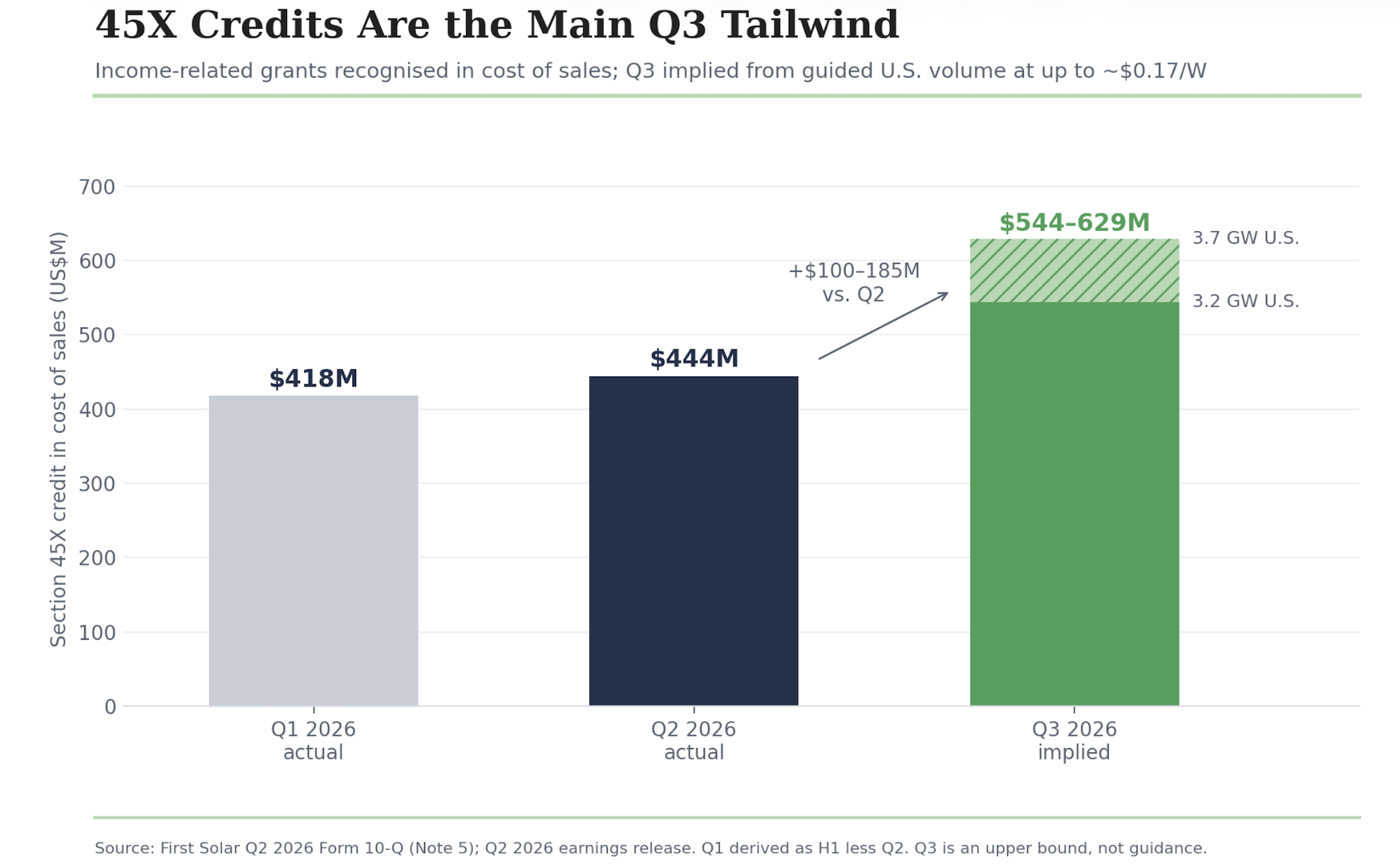
First Solar’s Q3 profit depends less on the price of a module than on where it was actually made and how it reaches customer. For instance, Section 45X pays up to roughly 17 cents per watt for each module fully produced in the US and sold to a third party, and the credit is booked against cost of sales in the quarter of the sale. Management guides 3.2-3.7 GW of US-made modules sold in Q3, which at the 17-cent ceiling, would be worth up to $544-629 million in credits against $444 million recognized in Q2. This increase is the main reason the consensus looks reachable on lower revenue, and it is why we do not dismiss the bull case.
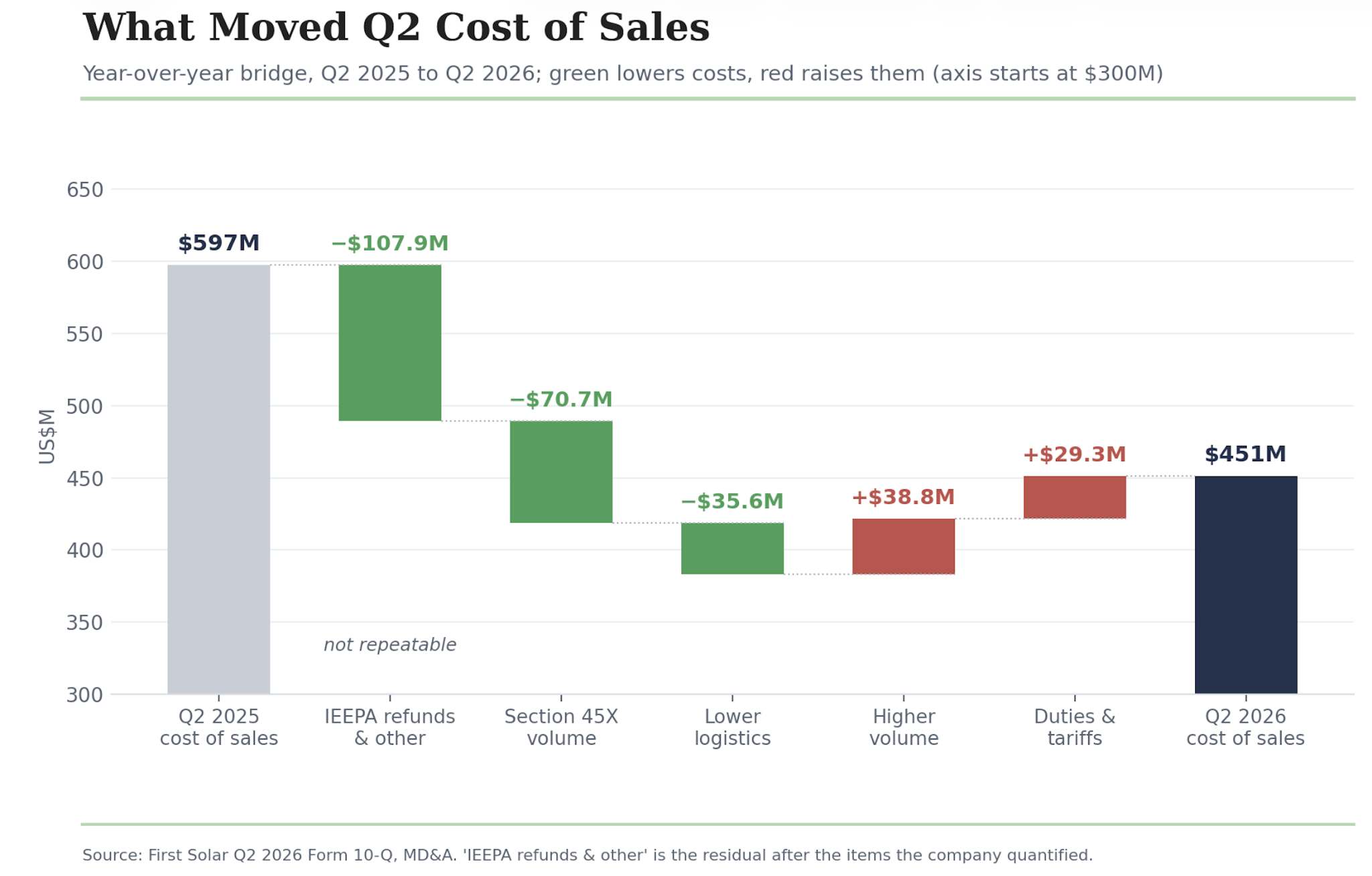
The offset sits further down the cost stack. Q2 cost of sales fell $146 million year over year, but only part of that was operational. Higher 45X volume accounted for $70.7 million and lower logistics costs for $35.6 million, while most of the remainder came from the IEEPA refund. Higher duties and tariffs added back $29.3 million in the same quarter. The full-year net tariff assumption of $60-80 million already nets the IEEPA recovery against Section 301 duties that are now applied to modules from Malaysia, India and Vietnam. Put simply, the logistics tailwind that flattered Q2 is unlikely to repeat.
Timing is the third variable that we should consider. Finished-goods inventory rose from $439 million to $729 million over the first half as First Solar built stock for H2 deliveries, and guidance assumes permitting timelines stay at historical levels. Because 45X credit is only recognized on sale, a deferred shipment moves both the revenue and the credit out of the quarter. A module finished in September but delivered in October does nothing for Q3 EPS.
Our Position, Consensus Expectations, and Risks
Our position is First Solar will miss the consensus expectation of $4.67 EPS. Our base case is an adjusted EBITDA of $715 million and net income of about $471 million, implying $4.37 per share, and a 65.9% conversion in line with Q2’s 65.7%. We are not stating that First Solar is a deteriorating company, but rather that the consensus requires either stronger operating performance or more favorable accounting outcomes than our base case assumes.
The primary reason for pause surrounds First Solar's recent adjusted EBITDA outperformance. Although management exceeded its quarterly adjusted EBITDA guidance in both Q1 and Q2 2026, Q2 included approximately $89 million in net benefits related to expected IEEPA tariff recoveries. Without this benefit, adjusted EBITDA would have been approximately $555 million, still above management's guidance but representing a much smaller beat. We therefore hesitate to forecast Q2's outperformance into Q3, especially considering management has a significantly higher Q3 adjusted EBITDA guidance of $625–775 million.
We also see little reason to believe that First Solar will achieve the alternatively needed improvement in EBITDA-to-net-income conversion. Depreciation and amortization have been stable at $141-148 million per quarter over the last four quarters, so we assume about $150 million in Q3. Start-up expense is a clearer swing factor as full-year guidance of $90-100 million against about $35 million in H1 implies $55-65 million in H2. That step-up limits how much conversion can improve from Q2’s level.
Either way, there are several factors that could lead to a beat. First Solar’s management expects 3.9–4.5 GW in sales of modules in Q3, including 3.2–3.7 GW from U.S. manufacturing operations. Those higher domestic sales could then support additional Section 45X manufacturing credits, leading to gains in gross profit and adjusted EBITDA. Additionally, the company has already shown it can exceed management guidance through both quarters of 2026. At Q2's 65.7% EBITDA-to-net-income conversion ratio, an adjusted EBITDA of $766 million would meet consensus and is within management's guidance range. Overall, stronger shipments, improved manufacturing efficiency, or lower-than-expected deductions could all lead to an EPS beat.
However, we believe the balance of risks make a slight earnings miss the most likely case, projecting $4.37 versus $4.67. Our $715 million sits slightly above the $700 million midpoint because of the larger 45X volume, but we do not extrapolate Q2’s tariff-driven beat.
Scenarios and Expected Outcomes
Each scenario uses the same bridge as The Earnings Hurdle. We start from adjusted EBITDA, subtracted depreciation of about $150 million, start-up and underutilization costs, and other non-cash items, then added net interest income and tax the result at the recent single-digit effective rate. The scenarios differ mainly in two things: how much of the 45X uplift survives freight, tariffs and timing, and how much EBITDA makes it to net income. Demand is largely pinned down by guidance and backlog. It's worth noting that full-year guidance of $90-100 million in start-up expense and $115-135 million in underutilization compares with roughly $35 million and $27 million booked in H1, so both step up in the second half.
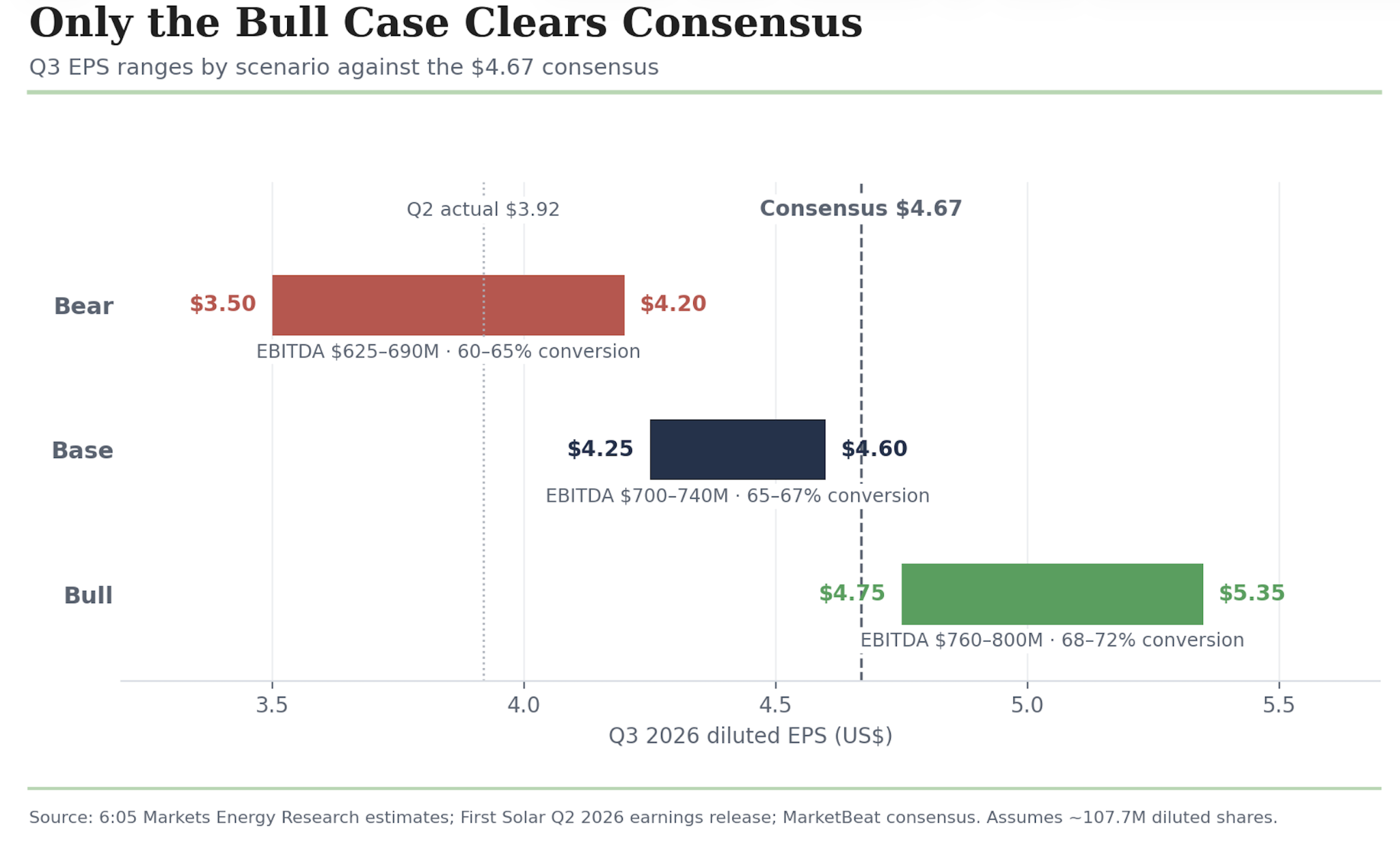
At $715 million of adjusted EBITDA, our base case gives net income of about $471 million, or $4.37 per share. That is a 65.9% conversion, essentially Q2’s 65.7%. The gap to consensus is roughly $32 million of net income. A strong quarter could close that gap, but only with EBITDA near $766 million, the top of guidance, and without another tariff refund. As a rule of thumb, every $10 million of adjusted EBITDA moves EPS by about $0.09, and each point of conversion at the midpoint is worth about $0.07.
What Would Change Our View?
Our thesis hinges on a specific, testable claim: First Solar will not report Q3 EPS of $4.67 or above, as it most plausibly reaches that figure with adjusted EBITDA near $766 million or conversion well above its recent 65–69% range.
Some signals may strengthen our confidence in our thesis:
- Reports of significant delays in projects
- Increase in domestic freight costs or other logistics complications
- Indication that the US-made module sales fall below the guidance figure of 3.2-3.7 GW.
Other signals would weaken it:
- Stronger evidence of US production due to the correlation with 45X credits
- Indication of further tariff refunds that boosted EBITDA in the previous quarter
Conclusion
In summary, we expect a Q3 EPS of roughly $4.25-4.60 to be reported by First Solar, below the $4.67 market consensus. The company has demonstrated a plausible path towards achieving a net income of about $503 million, although we are not sufficiently confident in the feasibility of this figure given it places adjusted EBITDA near the top of the guidance figures and relies on conversion rates that would be unusual for First Solar’s operations. Consensus may be extrapolating Q2’s beat, which included a non-recurring $89 million tariff benefit, while the larger 45X volume is what keeps $4.67 within reach.
Data Sources
- First Solar, Inc. – First Solar, Inc. Announces Second Quarter 2026 Financial Results and Reaffirms Guidance (Form 8-K, Exhibit 99.1), 30 July 2026. Q2 EPS and net sales; Q3 and full-year guidance.
- First Solar, Inc. – Form 10-Q for the quarterly period ended 30 June 2026. Section 45X and cost of sales, start-up expense, income tax, finished-goods inventory, IEEPA refund accounting.
- First Solar, Inc. – Form 10-Q for the quarterly period ended 31 March 2026. Q1 comparison figures.
- Signal & Evidence (Call Sheet Daily) – FSLR Q2'26 Conference Call Notes, 31 July 2026. Q1 and Q2 adjusted EBITDA; underutilization commentary.
- pv magazine USA – First Solar hits sales record as it reaffirms 2026 guidance, balances tariff risk, 3 August 2026. IEEPA net benefit, Q2 net income and gross margin, furloughed capacity.
- U.S. Code – 26 U.S.C. § 45X, Advanced Manufacturing Production Credit. Credit mechanics and per-watt rates.
- Congressional Research Service – The Section 45X Advanced Manufacturing Production Credit (IF12809). Credit overview.
- Greenberg Traurig – CBP Shares Update on IEEPA Refund Process; USTR Initiates Section 301 Investigations into Global Structural Excess Capacity and Forced Labor, March 2026. Tariff refund and Section 301 background.
- Office of the United States Trade Representative (Federal Register) – Notice of Actions in Section 301 Investigations of Acts, Policies, and Practices of Various Economies Related to the Failure of Each Economy To Impose and Effectively Enforce a Prohibition on the Importation of Goods Produced With Forced Labor, 28 July 2026. Section 301 rates and effective date for Malaysia, Vietnam and India.
- MarketBeat – First Solar Q2 Earnings Call Highlights, 30 July 2026. Net tariff assumption, IEEPA benefit, Section 301 assumption.